
Best viewpoints in Rio — an honest ranking
What is the best viewpoint in Rio de Janeiro?
Sugarloaf Mountain gives the single best all-round panorama for the money and reliability, but Mirante Dona Marta and Vista Chinesa — both free — deliver views that rival the paid icons without the queue, the sellout risk, or the price. The honest answer depends on whether you value convenience or value for money more.
| Best all-round | Sugarloaf (paid, R$150-180) |
| Best free view | Mirante Dona Marta |
| Best for the icon itself | Christ the Redeemer / Corcovado |
| Best time to avoid crowds | Early morning, not sunset |
| Best dry-season odds | May-September |
Why a ranking, not just a list
Most Rio guides list the same handful of viewpoints in the same order they’re famous, which tells you nothing about which one is actually worth your limited time. This page ranks by lived experience instead — what a visitor standing at each one actually gets for the cost, the wait, and the weather risk involved — because the fame order and the value order in Rio genuinely diverge more than in most cities, largely thanks to how many excellent free mirantes the city has relative to how few of them get mentioned in mainstream coverage.
Rio has more good views than it has famous ones
Every visitor arrives knowing about Christ the Redeemer and Sugarloaf. Fewer arrive knowing that some of the city’s best views cost nothing, involve no queue, and see a fraction of the crowd. This is a ranking by what you actually get — view quality, crowd, cost, and effort — not by fame. The paid icons carry the affiliate links on this site, and they’re genuinely worth doing; but the honest ranking below puts several free viewpoints ahead of at least one paid one, because that’s what the evidence on the ground supports.
How this ranking works
Four criteria, weighted roughly equally: the quality and breadth of the actual view, how reliably you’ll get a clear one (weather and crowd both count here), what it costs in money and time, and how much effort it takes to reach. A viewpoint that’s spectacular but clouded over half the time loses points against one that’s merely very good but reliable. A free viewpoint that requires no booking and no queue gains points over a paid one with the same view quality but a three-day sellout window. This is deliberately not a popularity ranking — several of the entries below are less famous than Christ the Redeemer but outrank it on the criteria that actually determine whether your specific visit goes well.
The ranking at a glance
Sugarloaf leads on all-round reliability and panorama breadth. Dona Marta is the best free option and arguably the best photograph in the city, full stop. Christ the Redeemer earns its place through sheer proximity to the icon itself, even though its cloud risk keeps it off the top spot. Vista Chinesa and Morro da Urca round out the strong free tier, Pedra do Sal and Escadaria Selarón add atmosphere rather than panorama, and a helicopter flight sits apart from the ranking entirely as a premium, occasional-use option rather than a default recommendation for most visitors.
1. Sugarloaf Mountain (paid, R$150-180)
The single best all-round view: 360 degrees, low enough at 396 metres to mostly dodge the cloud layer that plagues Corcovado, reachable by a smooth two-stage cable car with no serious hike required. It takes in the whole city — beaches, bay, forest, and Christ the Redeemer itself, which you can’t see from its own summit. Full detail at Sugarloaf Mountain guide.
the Sugarloaf cable car ticket is the standard way up; the hiking shortcut to the first stage is covered at Morro da Urca hike.
2. Mirante Dona Marta (free)
This is the view most professional photographers of Rio actually use — the postcard shot of Sugarloaf, the bay, and the beaches from a high, wide platform above Botafogo, reachable by road with no ticket, no queue, and no cable car. It edges out several paid attractions on pure photographic value, and it costs nothing beyond the taxi fare up.
It also sits directly beside a community where people live, which changes how you should behave there — full detail, including how to get up respectfully, at Mirante Dona Marta. The angle here is genuinely distinct from every paid summit on this list: you’re looking across at Sugarloaf rather than standing on it, which is precisely what makes it the shot working photographers reach for.
a sunrise tour combining Dona Marta lookout with Christ the Redeemer pairs this free viewpoint with the paid icon before the day’s crowds and cloud build-up arrive, a genuinely good way to bank two of this list’s top three entries in one early outing.
3. Christ the Redeemer / Corcovado (paid, R$150-190)
The icon, and worth doing for the statue itself and the closeness of the view — but it ranks below Sugarloaf and Dona Marta here because of two real drawbacks: cloud cover at 710 metres is common enough to be a genuine planning risk, and the cog train sells out its best slots days ahead in high season. When it’s clear, it’s spectacular; the ranking reflects that it’s clear less reliably than the alternatives above it. Full logistics at Christ the Redeemer guide.
the Christ the Redeemer cog train ticket is the standard route up.
4. Vista Chinesa (free)
A pagoda-style pavilion inside Tijuca National Park, overlooking the Rodrigo de Freitas lagoon, Ipanema, and Leblon from within the forest rather than from a bare summit — genuinely one of the most atmospheric viewpoints in the city, and free. It requires a car or taxi to reach since no public transport serves the access road directly. Full access detail at Vista Chinesa and Mesa do Imperador. Its nearby sibling, Mesa do Imperador, adds a shaded, forest-facing alternative a short drive further along the same road, worth combining into the same trip rather than treating as separate outings.
5. Morro da Urca (free to hike, cheap if you skip stage two)
The lower of Sugarloaf’s two cable-car stops, reachable on foot via a moderate 45-60 minute trail from Praia Vermelha with no ticket required to stand on the plateau itself. The 220-metre view over Botafogo and the bay is genuinely good, and hikers save real money by buying only the second-stage cable car ticket if they want to continue to the true summit. Trail notes at Morro da Urca hike.
6. Pedra do Sal (free, best at sunset)
Not a mountain viewpoint but a low outcrop in the historic port district, worth including here because the view over Porto Maravilha and the bay at golden hour, combined with the samba roda that starts up as the sun goes down, makes it one of the best low-effort, high-atmosphere spots in the city. Full detail at Pedra do Sal samba and Sunset spots in Rio. It ranks lower than the mountain viewpoints purely on view quality — this is a street-level vantage, not an elevated panorama — but higher than its modest view alone would suggest, because of what happens there after the sun goes down.
7. Escadaria Selarón (free, but a photo stop rather than a panorama)
Worth including for completeness rather than as a competitor to the mountain views — the Selarón Steps are a striking, colourful staircase between Lapa and Santa Teresa, and while they don’t offer a city panorama, they’re one of the most photographed spots in Rio and worth ten minutes if you’re already in the neighbourhood. Full honest detail, including the surrounding block, at Escadaria Selarón guide.
8. A helicopter flight (paid, the most expensive option by far)
Not a “viewpoint” in the fixed-location sense, but worth naming here because it’s the only way to see Rio’s geography — the way the mountains, bay, and beaches interlock — from directly above rather than from one fixed platform. It costs several times any ticket on this list and the window is short, but for some visitors it’s worth doing once specifically because it shows what no ground-based viewpoint can. Full honest cost-benefit at Helicopter tours over Rio.
9. Parque das Ruínas (free, a different kind of view entirely)
Worth a mention even though it doesn’t compete with the mountain views on scale: the ruins of a former mansion in Santa Teresa give a west-facing view over the city’s rooftops and the bay, framed by iron walkways threaded through old stone walls, that reads as a genuinely different photograph than anything else on this list. Free, uncrowded relative to the icons, and a natural stop on a Santa Teresa walking day. See Sunset spots in Rio for its best use as an evening spot.
What didn’t make this list, and why
Rooftop bars across Copacabana and Ipanema offer genuine elevated views and get recommended constantly in generic city guides, but they’re excluded from a “viewpoints” ranking on principle — you’re paying for a drink and a vantage point bundled together, not visiting a viewpoint in its own right, and the view itself is usually a fraction of what any entry above delivers. Praia Vermelha’s beach-level view of Sugarloaf is lovely but is really part of the Sugarloaf visit itself rather than a separate destination, so it’s folded into that entry rather than ranked on its own.
How to actually choose, given limited time
One day, first visit: Sugarloaf in the morning or for sunset, Christ the Redeemer if the forecast is clear. Skip the rest.
Two or more days, or a repeat visitor: add Dona Marta and Vista Chinesa — both free, both genuinely different in character from the paid summits, and both low-crowd compared with the icons. See Rio de Janeiro in two days or Rio de Janeiro in three days for how to sequence them against beaches and food.
Budget-conscious: Dona Marta, Vista Chinesa, Morro da Urca on foot, and Pedra do Sal at sunset cover four genuinely excellent views for the cost of a few taxi rides. Full budget framework at Rio de Janeiro on a budget.
Photographers specifically: Dona Marta for the classic postcard composition, Vista Chinesa for the forest-framed alternative, and Sugarloaf’s summit for the only 360-degree option that includes Christ the Redeemer itself in frame.
Repeat visitors who’ve already done the icons: this is where the ranking pays off most — skip straight to Dona Marta, Vista Chinesa, Morro da Urca, and Pedra do Sal, and you’ll come away with a more locally flavoured set of views than a first-timer following only the famous names, at a fraction of the cost and none of the queueing.
Time budget, side by side
Sugarloaf and Christ the Redeemer each take three to four hours door to door including transport and queueing. Dona Marta and Vista Chinesa run closer to two to three hours each, mostly transport time rather than time spent at the viewpoint itself, since neither has anything resembling a queue. Pedra do Sal and the Selarón Steps are quicker still if visited in isolation, though both reward lingering — Pedra do Sal for the samba, the steps for a slower walk through the surrounding neighbourhood. A helicopter flight, oddly, is the shortest single time commitment of anything on this list once you account for check-in, at under an hour total for most bookings, despite being the most expensive.
Cost comparison, side by side
Sugarloaf and Christ the Redeemer each run roughly R$150-190 (about US$28-35) round trip. A helicopter flight, the most expensive item in this cluster, runs R$600-1,800 (about US$110-330) for six to thirty minutes. Every other entry on this list — Dona Marta, Vista Chinesa, Morro da Urca on foot, Pedra do Sal, the Selarón Steps, and Parque das Ruínas — costs nothing beyond the transport to reach it, which for a taxi or rideshare from a Zona Sul hotel typically runs R$20-40 (about US$4-7.50) each way. For a visitor doing three or four viewpoints across a trip, mixing free and paid saves real money without meaningfully reducing what you see.
The crowd factor, across all of them
Every viewpoint on this list gets busiest in the 90 minutes before sunset and in the 10am-2pm window when day tours converge. The free viewpoints thin out faster once the light passes its peak — few people linger at Dona Marta after the photo — while the paid summits stay busy until closing because visitors have a ticketed window to use. If crowd avoidance matters more than golden light, an early morning visit beats a sunset one at nearly every spot on this list.
Seasonal considerations
Dry season (roughly May-September) gives better odds across every entry on this list — less cloud at Christ the Redeemer, calmer wind at Sugarloaf, clearer air generally. Wet season (December-March) doesn’t rule any of them out, but it does raise the odds of a wasted trip up to the paid summits specifically, which is another point in favour of front-loading the free viewpoints, where a clouded-over visit costs you nothing but time, early in a wet-season trip. See Best time to visit Rio de Janeiro and Rio in winter for the wider seasonal picture.
Getting between them
None of these are within walking distance of each other except Vista Chinesa and Mirante Dona Marta, which sit roughly 20-30 minutes apart by car through the same general hillside. A rideshare or a private driver for a half-day is the practical way to string two or three together; see Getting around Rio de Janeiro and Uber and taxis in Rio for the transport picture.
Frequently asked questions about Rio’s viewpoints
Is a free viewpoint really as good as Christ the Redeemer or Sugarloaf?
For pure photographic value, yes, in the case of Mirante Dona Marta and Vista Chinesa — plenty of professional photographers prefer them. What the paid icons offer that the free ones don’t is proximity to the statue itself, or the full 360-degree summit panorama at Sugarloaf.
Which viewpoint is best for a sunset?
Sugarloaf’s summit for the widest panorama, Pedra do Sal for the atmosphere and the samba that follows, or Mirante Dona Marta for the classic postcard composition with fewer people around you. Full sunset-specific detail at Sunset spots in Rio.
Can I visit the free viewpoints without a car?
Not easily — Dona Marta, Vista Chinesa, and Morro da Urca’s trailhead all require a taxi, rideshare, or organised transport, since none sit on a metro line or a frequent bus route. Budget for that cost even though the viewpoint itself is free.
Which viewpoint has the shortest queue?
The free ones, consistently — Dona Marta and Vista Chinesa have no ticketed entry and therefore no queue at all, though the platform itself can still feel crowded at peak sunset minutes.
Is it worth doing more than two viewpoints in one trip?
For most visitors, two or three is the sweet spot before the views start to feel repetitive — one paid icon, one free mirante, and possibly Pedra do Sal at sunset covers the range without overdoing it.
Are any of these viewpoints unsafe?
Mirante Dona Marta sits beside a community where people live, and the respectful approach — sticking to the platform, not wandering into residential streets — is covered at Mirante Dona Marta. None of the viewpoints on this list carry a notable safety risk when visited during normal daylight hours; see Rio de Janeiro safety guide for the wider picture.
Which viewpoint should a first-time visitor prioritise if they can only pick one?
Sugarloaf, on the strength of its 360-degree panorama and its lower weather risk compared with Christ the Redeemer. If proximity to the statue itself matters more than the wider view, Christ the Redeemer edges it out for that specific purpose.
Do any of these viewpoints require advance booking even though some are free?
Only the paid ones — Sugarloaf, Christ the Redeemer, and helicopter flights all require or strongly recommend advance booking. The free viewpoints have no booking system at all; you simply go.
Is it worth hiring a private guide to visit multiple viewpoints in one day?
For three or more stops in a single day, yes — a private driver or guide removes the logistics of arranging separate taxis between locations that don’t sit near public transport, and can sequence the light and crowd timing better than doing it solo.
tours.icons-viewpoints
Verified deep-linked GetYourGuide tours. Book through these links and we earn a small commission at no cost to you.
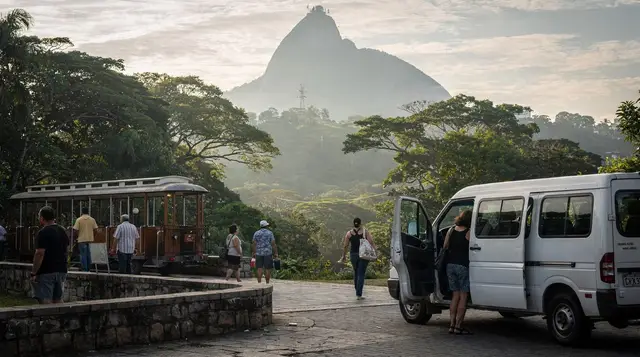
Rio de Janeiro: Christ the Redeemer Guided Hike

Best of Rio in One Day: Christ Redeemer, Sugarloaf & Local Lunch

Christ the Redeemer Entry Ticket by Corcovado Train
Photos show the destination, not the operator's own pictures.