Two different neighbourhoods, twelve hours apart
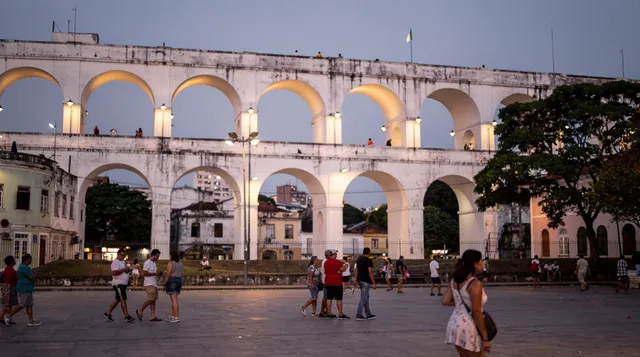
Nowhere in Rio changes character between day and night as completely as Lapa. At 2pm it’s a slightly scruffy stretch of Centro’s southern edge: the Arcos da Lapa — 42 white stone arches built in 1750 as an aqueduct, now carrying the Santa Teresa tram over the top — stand over an empty plaza, a few people cutting through on foot, most of the bars shuttered with their chairs stacked.
By 10pm on a Friday, the same plaza is standing-room-only: live samba drifting out of open-fronted bars, street vendors working coolers of beer and caipirinha, and a crowd that skews as much local as tourist, which is unusual for Rio nightlife and part of why it’s worth coming for. If you show up at 4pm expecting the nightlife version of Lapa, you’ll wonder what the fuss is about — the honest advice is to see the Arcos briefly by day if you’re passing through Centro, then come back after dark for the actual experience.
What the night actually looks like
The core of Lapa nightlife runs along Rua Joaquim Silva, Rua do Riachuelo and the streets directly under and around the Arcos. Rio Scenarium, a three-storey club packed with antique furniture and knick-knacks, is the most famous stop and the most touristy — good live samba, cover charge that runs R$60–100 (roughly US$12–20) depending on the night, worth it once.
Carioca da Gema is smaller, more local, and arguably better music for a lower cover. Democráticos, a traditional gafieira dance hall a short walk away on Rua do Riachuelo, is where you’ll see couples actually dancing forró and samba de gafieira rather than performing for a room of phones — go if you want the real social-dance version of the night rather than the concert version.
Outside the paid venues, the street itself is the draw: informal “pé-sujo” stalls sell chopp and caipirinha from coolers for R$8–15 (US$1.50–3), and by 11pm the block under the Arcos is a genuine street party with samba circles (rodas de samba) forming spontaneously. This part costs nothing beyond what you drink, and it’s where most of the actual atmosphere lives — the paid clubs are good, but the street is Lapa’s real signature.
a guided Lapa pub crawl with live samba takes the decision-making out of a first night here — useful if you don’t want to be standing on a corner working out which bar has the better band. For something calmer and more intimate, a private samba night with local hosts swaps the crowd-hopping for a curated evening with people who actually know the scene.
The Escadaria Selarón, at the edge
The Escadaria Selarón — the tiled staircase covered in mosaics from more than 60 countries, built obsessively over two decades by Chilean-born artist Jorge Selarón until his death in 2013 — sits right at the boundary between Lapa and Santa Teresa, connecting Rua Joaquim Silva to Ladeira de Santa Teresa. It’s one of the most photographed spots in Rio and, by mid-morning, one of the most crowded: expect a real queue for the classic shot on the yellow-green-blue central tiles. Go before 9am or after 5pm if you want it without fifty people in the frame. It works as a stop either from the Lapa side or the Santa Teresa side — see the Santa Teresa guide for the tram route that passes right by it.
Getting there, and — more importantly — getting home
By metro, Cinelândia is the closest station, about a 15-minute walk from the Arcos; a taxi or Uber from Copacabana or Ipanema runs 25–35 minutes depending on traffic and costs roughly R$35–55 (US$7–11). Arriving is the easy part.
Leaving late is where the real planning matters: don’t walk two or three blocks away from the crowd to “find a quieter spot” to hail a car — Uber pickup pins can sit right at the edge of the party, and that short walk into an empty side street is exactly the moment pickpockets and occasional muggings happen, not the crowded plaza itself. Set your pickup point somewhere with people around, keep your phone out only long enough to confirm the driver, and if a group of you is heading the same direction, share the ride rather than splitting off solo after 1am.
Within the crowd itself, the risk is pickpocketing rather than anything more serious — Lapa on a Saturday night is genuinely dense, and dense crowds anywhere in the world are where wallets and phones go missing. Carry a card and small cash rather than your whole wallet, keep your phone in a zipped or buttoned pocket rather than a back pocket, and skip the flashy jewellery.
None of this is Lapa-specific caution so much as generic big-city-crowd caution — it just matters more here because the crowds are bigger and later than almost anywhere else in the city. Travelling with at least one other person and agreeing on a rough plan for regrouping if you get separated in the crowd is a simple, low-effort habit that solves most of the small problems a big, loud crowd can create.
A short history of why Lapa sounds the way it does
Lapa’s reputation as Rio’s nightlife district isn’t a recent branding exercise — it dates back to the 1920s and 30s, when the neighbourhood was Rio’s bohemian centre, full of cabarets, cafés and the kind of louche reputation that made it both scandalous and magnetic to writers, musicians and the wealthy slumming it for a night. That golden age faded through the mid-20th century as Rio’s nightlife shifted south to Copacabana, and Lapa spent decades as a rundown, semi-abandoned district with a reputation for danger rather than samba.
Its revival started in the 1990s and accelerated through the 2000s, as musicians and bar owners began reoccupying the old buildings around the Arcos, deliberately reviving the samba-and-cabaret identity rather than inventing a new one — which is why so much of the architecture you’re drinking in front of tonight is the genuine 19th-century article, not a themed reconstruction.
The music, explained
What you’ll hear in Lapa isn’t a single genre. Samba de raiz (“roots samba”) — traditional, acoustic, built around cavaquinho, pandeiro and surdo drums — is what plays in venues like Carioca da Gema and in the street rodas (samba circles) that form spontaneously under the Arcos. Choro, an older, more instrumental style with roots in 19th-century Rio, turns up in smaller, quieter rooms and at Sunday afternoon sessions in some Centro-adjacent bars.
Gafieira refers less to a musical style than a social dance format — couples dancing samba and forró together in a ballroom setting, which is what you’ll find at Democráticos. If you only have one night, aim for a street roda under the Arcos for the purest version of the experience, and a paid club like Rio Scenarium if you want a guaranteed seat and a polished set from professional musicians.
What it costs, realistically
Beyond the cover charges and street drinks mentioned above, budget for the taxi or Uber both ways (R$35–55 each direction from the Zona Sul), and expect food to be an afterthought here rather than a highlight — Lapa is built around drinking and dancing, not dining, and the food on offer near the clubs is mostly quick, functional bar snacks (coxinha, pastel, torresmo) rather than a destination meal. A full night out — cover charge at one club, several rounds of street drinks, transport both ways — typically runs somewhere in the R$150–300 (US$30–60) range per person, considerably cheaper than an equivalent night out in most of Rio’s international peer cities.
Combining Lapa with a wider evening
A common and sensible way to structure a Lapa night is to start with dinner elsewhere — Centro empties out too early for a good dinner option, so most visitors eat in the Zona Sul or in Santa Teresa beforehand and arrive in Lapa around 9 or 10pm once the neighbourhood is already coming alive. Trying to eat a full meal in Lapa itself before the night gets going generally means settling for average bar food rather than a proper dinner, so treat Lapa as the after-dinner destination it’s built to be rather than a full evening in itself.
If you don’t drink
Lapa’s identity is bound up tightly with drinking, but the music itself doesn’t require a caipirinha in hand to enjoy — several venues, particularly the smaller listening-room-style spots away from the main strip under the Arcos, are perfectly comfortable for anyone happy to nurse a soda or a fresh juice while watching the band. Cover charges apply regardless of what you order, so budget for that rather than expecting a discount for skipping the bar tab. It’s a smaller slice of the Lapa experience than the drinking-and-dancing version most visitors come for, but the music itself is the actual draw for a lot of serious samba fans, and it holds up fine on its own.
Reservations, or the lack of them
Most of Lapa’s samba clubs don’t take reservations in any formal sense — Rio Scenarium is the exception, where booking a table ahead through the venue or a tour operator is genuinely worth doing on a Friday or Saturday, since walk-up seating fills fast and the standing-room alternative near the door has a worse view of the stage. Smaller venues like Carioca da Gema and Democráticos operate on a first-come basis; arriving by 9:30–10pm, before the night reaches its peak, is the practical way to guarantee a seat rather than standing through the whole set.
Lapa for LGBTQ+ visitors
Lapa’s street scene is broadly mixed and welcoming, and a handful of bars around the core nightlife streets have a specifically LGBTQ+-friendly reputation, though it isn’t organised around a single dedicated stretch the way Ipanema’s Farme de Amoedo is for the beach scene. In practice, the crowd’s focus on the music and dancing tends to make Lapa feel comfortable regardless of who you’re there with — the same general late-night caution about getting home safely applies to everyone equally, not specifically to LGBTQ+ visitors.
What to wear, and other small practicalities
Lapa’s dress code, such as it is, skews casual — shorts, t-shirts and sneakers or sandals are entirely normal even at the paid clubs, and there’s no need to dress up beyond what you’d wear to any warm-weather bar. Comfortable, closed shoes are worth prioritising over sandals if dancing is on the agenda, since the street surfaces under and around the Arcos aren’t always even, and a crowded dance floor is not the place to be nursing a stubbed toe.
Bring cash: while many bars and the paid clubs now take cards, the street vendors under the Arcos mostly still deal in cash only, and having small notes (R$5, R$10, R$20) speeds up every transaction and avoids drawing attention to a full wallet. A light jacket or wrap is worth having even in summer, since evenings can cool off more than the daytime heat suggests, and dancing works up a sweat that a breeze off the Arcos will find quickly.
Lapa and Carnival
Lapa sits close to several major Carnival street-party (bloco) routes, and while it isn’t the primary parade zone the way parts of Centro are, its bars and the Arcos themselves get folded into the broader Carnival atmosphere for the weeks around the main event — expect the area to be even busier and louder than a normal weekend if your trip overlaps with Carnival season. See the Carnival blocos guide for which specific street parties route through this part of the city, and the Rio Carnival guide for the wider event.
Solo visitors, and going with a group
Lapa works fine solo, particularly at one of the paid clubs where you’re seated among other patrons rather than standing alone in a crowd, but the street scene is more comfortable in company — not because it’s unsafe exactly, but because the dense, later-night crowds are simply more fun and easier to navigate with at least one other person watching your back and your drink. If you’re travelling alone and want the full night out without going it alone from start to finish, the guided pub crawl option effectively supplies the group, pairing you with other travellers and a local guide who knows which corner has the better band that particular night.
a cachaça-focused Lapa pub crawl with live samba stops
Comparing a paid club to the free street scene
For a first-timer deciding how to spend the night, it helps to see the trade-off directly:
| Street scene (free) | Paid club (Rio Scenarium, Carioca da Gema) | |
|---|---|---|
| Cost | Just what you drink | R$60-100+ cover charge |
| Music | Spontaneous rodas, unpredictable quality | Professional, reliably good |
| Seating | None — standing, moving around | Guaranteed if booked ahead |
| Atmosphere | Rawest, most local | Polished, more tourist-heavy at the famous spots |
Most good nights in Lapa mix both — a paid club early for a guaranteed good set, then the street for the later, looser hours once the crowds peak.
Day-time Lapa: what’s actually worth it
Beyond the Arcos themselves, Rua do Lavradio is Lapa’s antiques street, dead most of the week but worth timing around the Feira do Lavradio, a street market held on the first Saturday of the month with live music, food stalls and dozens of antique dealers spilling onto the pavement — genuinely one of the better Saturday-daytime activities in the whole city if the date lines up with your trip.
Fundição Progresso, a converted 19th-century foundry, hosts concerts and cultural events and is worth checking for a listing regardless of time of day. Outside of these, daytime Lapa is mostly a through-route between Centro and Santa Teresa rather than a destination in itself.
Where to read next
Lapa rarely works as a stand-alone plan, so it helps to see it alongside the rest of the city. The Lapa nightlife guide goes deeper on the bars and the rhythm of the evening, and the samba clubs guide compares the other rooms where you can hear live music. If the dance-hall side appeals, the gafieira guide explains what to expect from an evening of couples dancing.
For the practical side, the nightlife safety guide and the Uber and taxis guide cover the late-night habits that matter most here. If you’d rather take the day to explore, the Escadaria Selarón guide and the Centro walking guide fit naturally into the hours before dark, and the Pedra do Sal samba guide is a good alternative if you want a different kind of roda. Anyone building a full trip around a night out can start from the first-timer itinerary.
Frequently asked questions about Lapa
Is Lapa safe at night?
It’s crowded and lively rather than dangerous in the sense of violent crime, but pickpocketing is real in the dense areas. The specific risk moment is walking away from the crowd to find transport — arrange your Uber pickup somewhere with people still around, and don’t wander into quiet side streets alone after 1am.
What night should I go to Lapa?
Friday and Saturday are when the street scene and the clubs are both running at full strength. Sunday through Thursday nights are noticeably quieter, with some venues closed entirely.
Is Lapa worth visiting during the day?
Briefly — the Arcos da Lapa are worth seeing and photographing, and it’s a natural stop if you’re walking between Centro and Santa Teresa. Beyond that, most of what makes Lapa interesting only happens after dark.
How do I get from Lapa to Santa Teresa?
The Santa Teresa tram boards near Carioca station in Centro and crosses the Arcos into Santa Teresa; on foot, the Escadaria Selarón climbs directly from Lapa’s Rua Joaquim Silva up toward Santa Teresa’s Largo do Guimarães.
Do I need to book a table at the samba clubs?
For Rio Scenarium on a Friday or Saturday, arriving early or reserving ahead avoids a long line at the door. Smaller venues like Carioca da Gema are usually fine to walk into, though a queue can form later in the night.
Is Lapa expensive?
No — street drinks run a few reais, and even the paid clubs’ cover charges are modest by international standards. Budget more for transport (Uber both ways) than for the night itself.
Can I walk to Lapa from Copacabana or Ipanema?
Not realistically — it’s several kilometres through Centro-adjacent areas that aren’t a pleasant walk, especially at night. Metro to Cinelândia, or a direct Uber, are the sensible options.
What’s the difference between Lapa and Santa Teresa nightlife?
Lapa is street-level, loud, dense and largely public-space samba; Santa Teresa’s nightlife is smaller, more bar-and-restaurant based, and considerably quieter — see the Santa Teresa guide for that side of the hill.
Do I need cash in Lapa?
Yes, mostly. The paid clubs and some bars take cards, but the informal street vendors selling chopp and caipirinha under the Arcos are cash-only, and small notes make every transaction faster.
Is Lapa busier during Carnival?
Yes — while it isn’t the main parade route, Lapa’s bars and the area around the Arcos see a noticeable spike in crowds and noise during Carnival season, on top of an already busy weekend baseline.
Should I go to Lapa alone, or is it better with a group?
Solo works fine, especially at a paid club where you’re seated among other patrons, but the street scene is more fun and more comfortable with company. A guided pub crawl is a reasonable way to get the group experience if you’re travelling alone.
Is a paid club or the free street scene better for a first visit?
Both, ideally — a paid club early for a guaranteed good set, then the street later once the crowd peaks. If you can only pick one, the street under the Arcos is Lapa’s real signature and costs nothing beyond what you drink.