| Where | Hilltop above Lapa and Centro |
| Cost | Bonde tram ~R$20 round trip; sights mostly free/cheap |
| Time needed | Half a day |
| Getting there | Bonde from Carioca station, or Uber |
| Best time | Weekday afternoons, or Saturday for the market |
A hilltop village that happens to be inside Rio
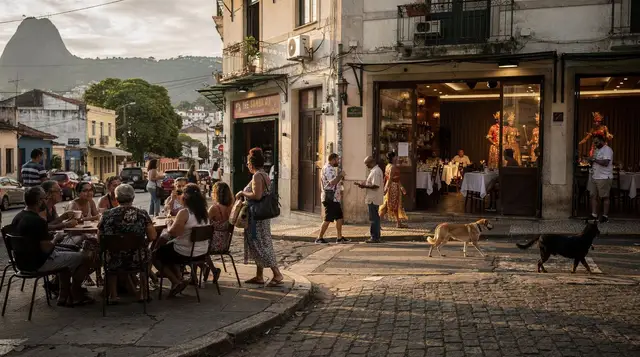
Santa Teresa doesn’t look or feel like the rest of Rio. Cobblestone streets switchback up a steep hill above Lapa and Centro, lined with colonial-era mansions in various states of restoration or decay, artists’ studios behind unmarked doors, and views that open up unexpectedly between buildings over Guanabara Bay.
It was Rio’s fashionable address in the 19th century, fell out of favour through the 20th, and has spent the last twenty years being rediscovered by artists, and more recently by restaurants and boutique guesthouses chasing the same view and the same faded-grandeur atmosphere. The result is a neighbourhood that rewards slow walking more than a checklist — the actual “sights” are modest, and the point is closer to Lisbon’s Alfama or Montmartre than a museum stop.
The bonde: still the best way up
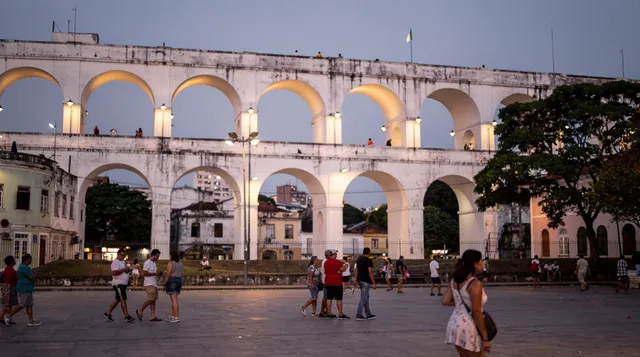
The Bondinho de Santa Teresa is a genuinely historic tram — narrow, open-sided, painted yellow, running on tracks laid in the 1890s — and it’s the reason most people organize their visit around a specific route rather than just wandering up. It departs from a small station beside Carioca metro station in Centro, crosses the top of the Arcos da Lapa (the same aqueduct arches you see from below in Lapa), and climbs into the neighbourhood along one of two lines: Paula Matos or Dois Irmãos.
Round-trip fare runs around R$20 (roughly US$4) — confirm at the boarding kiosk since fares are adjusted periodically — and the tram itself, standing-room and open-air, is as much the attraction as the destination. It gets crowded on weekends and around holidays; if you want photos without a packed carriage, ride mid-morning on a weekday.
Once up, most visitors get off around Largo do Guimarães, the neighbourhood’s main square, ringed with cafés and a good base for walking the rest of the hill on foot.
Parque das Ruínas and the Chácara do Céu
The single best reason to make the trip is Parque das Ruínas, the preserved shell of a mansion that once belonged to Laurinda Santos Lobo, a legendary early-20th-century Rio hostess. The building burned and was left as a ruin for decades before the city turned it into a free cultural space: walk up through the exposed brick and steel walkways to a rooftop terrace with one of the best panoramic views in Rio — Guanabara Bay, the bridge to Niterói, the port, all laid out below with none of the crowd you’d find at a paid viewpoint. It’s free, rarely busy, and open Tuesday to Sunday.
Next door, the Museu Chácara do Céu — a modernist mansion built by industrialist and art collector Raymundo Ottoni de Castro Maya — holds a small but genuinely good collection (Portinari, Picasso drawings, Matisse) for a modest entry fee, around R$8 (US$1.50), with free admission on Wednesdays.
Ateliers, lunch, and the streets in between
Santa Teresa’s other draw is quieter and less structured: dozens of artists keep working studios along Rua Almirante Alexandrino and the streets branching off it, many open to walk-in visitors in the afternoon, selling directly rather than through a gallery. There’s no single map for this — part of the neighbourhood’s appeal is that you find them by wandering, and a good number simply aren’t open on any given day.
For lunch, Bar do Mineiro near Largo do Guimarães does a reliably good feijoada any day of the week, not just the traditional Saturday, in a room that’s been serving the neighbourhood for decades. For something more polished with a view to match, Aprazível sits in a garden setting a short walk up the hill and is worth the higher price for a special occasion rather than a casual lunch.
a guided walking tour of Santa Teresa is a reasonable way to find the ateliers and backstreet detail you’d otherwise miss, and a combined tram, art and Selarón Steps tour packages the neighbourhood’s best-known stops — the bonde ride, the studios, and the mosaic staircase at the edge toward Lapa — into a single half-day.
A neighbourhood that fell, then was rediscovered
Santa Teresa’s mansions date largely from the coffee-boom decades of the mid-to-late 19th century, when wealthy families built summer residences on the hill to escape the heat and crowding of Centro below — cooler air, better views, and enough distance from the city to feel like an escape. That status held through the early 20th century, then eroded steadily as the aristocracy that sustained it declined and the neighbourhood grew increasingly isolated, undermaintained and, by the 1980s and 90s, associated with real crime problems tied to the favelas that grew up around its edges.
Its turnaround has been gradual rather than sudden: artists moved in for cheap rent and good light starting in the 1980s, a handful of well-regarded restaurants followed in the 2000s, and the tram’s 2011 accident — which killed several passengers and shut the line for six years of safety rebuilding — became, unexpectedly, a turning point, as the neighbourhood proved it could sustain itself on foot and by car during the closure, then thrived further once the modernised, safer tram reopened in 2015–2017. What you’re visiting now is a genuinely mixed neighbourhood: old money holdouts, working artists, gentrifying newcomers running guesthouses, and communities on the hill’s edges that the tourist route mostly doesn’t touch.
Carnival in Santa Teresa
If your visit lines up with Carnival, Santa Teresa runs its own bloco (street parade) scene distinct from the beach neighbourhoods’ — smaller, more neighbourhood-based, heavy on costume and irony rather than the sound-truck scale of the big Zona Sul blocos. Céu na Terra and Carmelitas are the best known, both starting from Largo das Neves and drawing crowds that spill through the same streets covered in this guide. It’s worth checking dates specifically if Carnival timing overlaps your trip — see the Carnival dates and planning guide for the annual calendar, since these blocos, like most, don’t run on a fixed date each year.
The Escadaria Selarón, from the top
The Escadaria Selarón mosaic staircase sits at Santa Teresa’s southern edge, dropping down toward Lapa’s Rua Joaquim Silva. Approaching from the Santa Teresa side rather than climbing up from Lapa means you’re walking downhill for the photo stop rather than up, and you can combine it naturally with a Santa Teresa afternoon before descending into Lapa for the evening. Go early or late in the day if you want the tiles without the crowd — mid-morning to mid-afternoon it’s genuinely busy.
Photography around the hill
Santa Teresa is one of the most photogenic neighbourhoods in Rio precisely because of what’s unglamorous about it elsewhere in the city — peeling paint on colonial façades, bougainvillea spilling over garden walls, narrow cobbled lanes with the bay appearing unexpectedly between buildings. The light is best in the late afternoon, when the hillside catches a warm angle that flattens out the midday harshness common everywhere else in Rio, and the practical upshot is that a Santa Teresa visit timed for 3–6pm serves double duty: better photos, and a natural segue into dinner before the after-dark transport advice below becomes relevant.
A neighbourhood best walked slowly
More than almost anywhere else in this guide, Santa Teresa rewards not having a fixed checklist. The genuine highlights — Parque das Ruínas, the Museu Chácara do Céu, Largo do Guimarães — are worth prioritising, but a meaningful share of what makes a visit memorable here is the unplanned wandering in between: a mural on an unremarkable garage door, a studio door propped open with music drifting out, a view over the bay appearing for ten seconds between two buildings before the street curves away from it again. Build in more unstructured time than you think you need, and resist the urge to move briskly between fixed stops the way you might in a more conventionally organised museum district.
When the tram isn’t running
The bonde periodically closes for scheduled maintenance or, occasionally, unplanned repairs, and there’s no substitute tram service during those windows — check current operating status before building a trip around it specifically, particularly if riding the tram itself is your main reason for the visit rather than a means to an end. When it’s closed, a taxi or Uber up to Largo do Guimarães takes roughly the same time as the ride and costs little more, so a closure needn’t derail the wider visit, just the specific experience of the historic tram itself.
Coffee, and staying overnight
Beyond Bar do Mineiro and Aprazível, Santa Teresa’s café scene has grown enough in the last decade to be a reason to visit on its own — small, independent spots scattered along Rua Almirante Alexandrino serve decent specialty coffee in settings that trade on the neighbourhood’s faded-grandeur atmosphere, mismatched furniture in converted colonial rooms rather than anything corporate.
It’s also become one of Rio’s more distinctive places to actually stay: a cluster of boutique guesthouses and small hotels, several occupying restored mansions, offer a genuinely different base than a Zona Sul high-rise — quieter at night, with views over the bay rather than a beach, at the cost of the walkability and easy late-night transport that Copacabana or Ipanema offer instead. It suits travellers prioritising atmosphere and are comfortable planning Uber trips for dinner and nightlife elsewhere, less so anyone wanting to walk straight from their room to the sand.
Getting up and down safely — the honest version
This is the question everyone actually has about Santa Teresa, so here’s the direct answer rather than a vague warning. By day, the neighbourhood’s main streets — Largo do Guimarães, Rua Almirante Alexandrino, the route to Parque das Ruínas — are safe to walk and well-trafficked with other visitors and residents. The bonde is the easiest and most enjoyable way up; a taxi or Uber works just as well if you’d rather skip the crowds or the tram isn’t running (it periodically closes for maintenance).
After dark, the calculus changes. Santa Teresa’s steep, poorly lit side streets border several favela communities, and while the neighbourhood itself isn’t especially dangerous, walking alone at night on unfamiliar switchback streets with limited lighting and few other people around is a genuinely bad idea regardless of city. The practical fix is simple: book dinner somewhere with a taxi or Uber pickup point, and take a car door-to-door rather than walking to or from the tram stop at night. Don’t wander off the main streets exploring “just a bit further” after dark, and don’t attempt the Selarón Steps between Santa Teresa and Lapa at night on foot — take a car around instead.
Getting there
From Centro, board the bonde at Carioca station (metro Linha 1 or 2). From Copacabana or Ipanema, an Uber runs 25–40 minutes depending on traffic and costs roughly R$40–60 (US$8–12) — cheaper and considerably less crowded than fighting for space on the tram during peak hours. There’s no metro station within Santa Teresa itself; the hill’s whole appeal is partly a function of that relative isolation.
Santa Teresa sits directly above Lapa and Centro Histórico, both connected by the tram route and, for the fitter, by the Selarón Steps on foot. For a longer walking day through this whole district, the Santa Teresa walking guide lays out a full route with timings, and nightlife safety in Rio covers the broader after-dark transport advice that applies here as much as in Lapa.
Where the views actually open up
Santa Teresa’s bay views don’t announce themselves the way a dedicated viewpoint does — they appear unpredictably between buildings and then disappear again as the street curves, which is part of the neighbourhood’s appeal but also means first-time visitors sometimes walk right past the best moments without realizing it.
Beyond Parque das Ruínas’ reliable panoramic terrace, keep an eye out along the upper stretches of Rua Almirante Alexandrino near its junctions with the smaller side lanes, where gaps between colonial-era houses frame Guanabara Bay and the port in a way no single named “viewpoint” captures — these are the moments locals mean when they describe Santa Teresa as a neighbourhood you experience by walking rather than by checking off a list of stops. Slowing down at these gaps, rather than treating them as incidental scenery between two planned destinations, is where a lot of the hill’s real character actually lives.
A tripod or even a steady phone grip helps more here than in most of Rio’s other photogenic spots, since the interesting shots tend to be narrow gaps between buildings rather than wide open vistas — a slightly longer exposure at dusk, when the light in these gaps softens considerably, tends to produce noticeably better results than a quick daytime snapshot taken in passing.
Santa Teresa vs Lapa: a natural pairing, not a rivalry
Santa Teresa and Lapa sit almost on top of each other geographically but offer genuinely different experiences at different times of day — Santa Teresa’s ateliers, cafés and Parque das Ruínas suit a daytime visit, while Lapa’s arches, samba clubs and street parties come alive after dark. Most travellers do both as a single loop: bonde up to Santa Teresa in the afternoon, wander the studios and Parque das Ruínas, then walk down the Escadaria Selarón as the light fades and continue into Lapa for dinner and nightlife. Trying to reverse this order — Lapa first, Santa Teresa after dark — works far less well, since the hill’s after-dark transport advice below applies in the other direction too.
Fitting Santa Teresa into a wider Rio plan
Because the hill works best as a relaxed half-day, it slots easily into a short stay rather than demanding a day of its own. The first-timer itinerary and the Rio in three days plan both show where a Santa Teresa afternoon fits alongside the big sights, and the Escadaria Selarón guide goes deeper on the staircase that marks the hill’s edge toward Lapa.
If the mosaics and murals are what draw you, the street art in Rio guide connects the neighbourhood’s painted walls to the wider city scene. And if you are still deciding where to sleep, where to stay in Rio compares the hill’s guesthouses with the beachfront alternatives, while the getting around Rio guide covers the Uber and metro logistics that make the hill easy to reach.
Money and practicalities
Card acceptance is reliable at Bar do Mineiro, Aprazível and most established cafés, but smaller ateliers selling directly often prefer cash, and street vendors around Largo do Guimarães on market Saturdays are cash-only. Bring small notes for the bonde kiosk as well — fares are collected in cash at the boarding point near Carioca station.
Frequently asked questions about Santa Teresa
How much does the Santa Teresa tram cost?
Round-trip fare is roughly R$20 (about US$4), payable at the boarding kiosk near Carioca station. Confirm the current price when you board, since fares are periodically adjusted.
Is Santa Teresa safe to visit?
During the day, yes — the main streets are well-used and safe for walking. After dark, take a taxi or Uber door-to-door rather than walking the steep, dimly lit side streets, since several favela communities border the neighbourhood.
How long does the bonde ride take?
The ride itself is about 20 minutes each way, though queues to board can add significant time on weekends and holidays. Weekday mid-morning is the quietest window.
Can I walk from Santa Teresa to Lapa?
Yes, via the Escadaria Selarón mosaic staircase, during daylight hours. At night, take a car instead of walking the steps or the connecting streets.
What’s the best day to visit Santa Teresa?
Any weekday works well and is quieter; Saturday brings a livelier atmosphere around Largo do Guimarães with more shops and studios open, at the cost of larger crowds on the tram and at the Escadaria Selarón.
Do I need to book the art studios in advance?
No — most operate as informal walk-in visits, though which ones are open varies day to day. There’s no comprehensive schedule; wandering Rua Almirante Alexandrino and its side streets in the afternoon is the standard approach.
Is Parque das Ruínas free?
Yes, and it’s arguably the single best viewpoint in Santa Teresa for the price. It’s open Tuesday to Sunday; check the current hours before making a special trip.
What should I eat in Santa Teresa?
Bar do Mineiro near Largo do Guimarães is the reliable, unpretentious choice for feijoada any day of the week. For a nicer sit-down meal with a view, Aprazível is the neighbourhood’s best-known upscale option.
Is Santa Teresa a good place to stay in Rio?
It suits travellers who value atmosphere and quiet over walkability — a cluster of boutique guesthouses in restored mansions offer a distinctive base, but you’ll rely on Uber for dinner and nightlife elsewhere rather than walking straight out to the beach.
Does Santa Teresa have its own Carnival celebrations?
Yes — neighbourhood blocos like Céu na Terra and Carmelitas start from Largo das Neves and draw large local crowds, distinct in character from the bigger Zona Sul street parties.