A business district first, a historic quarter second
Most of Rio’s “old city” advice gets written as though Centro were a static museum you can wander at any hour. It isn’t. Centro is where the banks, ministries, law firms and shipping offices of Rio actually operate, and its centuries-old streets — Rua do Ouvidor, Travessa do Comércio, the block around Praça XV — are wedged in between glass office towers whose staff are the reason the sandwich counters, juice bars and the Confeitaria Colombo stay in business.
| Where | Centro, near Uruguaiana/Carioca metro (Linha 1) |
| Cost | Free walking; Paço Imperial and museums modest fees |
| Time needed | Half a day, on foot |
| Getting there | Metro Linha 1, 20–30 min from Copacabana/Ipanema |
| Best time | Weekday, 10am–4pm — avoid Sunday |
On a Tuesday at noon this is one of the most alive parts of the city: suits and flip-flops crossing paths, church doors open, kiosks doing a brisk trade in pastel and guaraná. On a Sunday, the same streets are close to abandoned — grates down, churches locked outside Mass hours, not a queue anywhere. If you only have one day for Centro, make it a weekday, ideally not a Monday either, since some museums (including Museu do Amanhã) close then too.
Start at Praça XV de Novembro (Praça Quinze), the square where the Portuguese royal family landed in 1808 and where Brazil’s imperial family later lived. The Paço Imperial on the square’s north side was the seat of colonial and then imperial government; today it’s a free-to-modest-fee cultural center with rotating exhibitions and a courtyard café that’s a good place to sit before the walk gets hot.
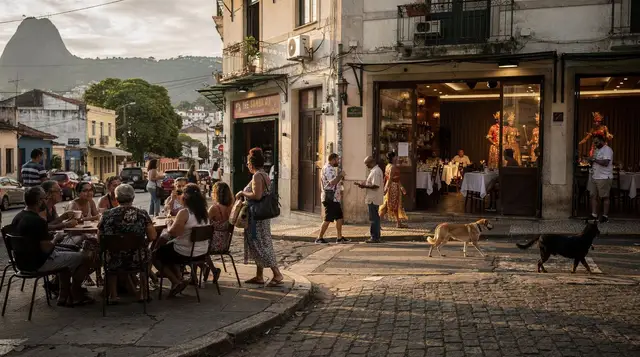
From here, duck through the Arco do Teles into Travessa do Comércio, a narrow colonial-era pedestrian lane of two-storey townhouses now lined with bars. On Friday from about 5pm this alley fills with office workers standing in the street with a chopp (draft beer) in hand — locally called “descer para o Rio” or just “beber na Trav” — genuinely one of the better free spectacles in the neighbourhood, and one that only exists because it’s a weekday.
Confeitaria Colombo and the Belle Époque core
A ten-minute walk from Praça XV, on Rua Gonçalves Dias, the Confeitaria Colombo has been serving coffee and pastries since 1894 in a room of jacaranda-wood mirrors and Belgian stained glass that makes the case for the visit on its own. It’s touristy, the coffee is unremarkable, and you’re paying for the room — that’s a fair trade for fifteen minutes here, less so for a full lunch, where the food is priced for the setting rather than the plate. A second, quieter branch operates inside the Forte de Copacabana, if you’d rather have the pastries with an ocean view.
Ten minutes further on foot is Cinelândia, the square built around the Theatro Municipal, Rio’s opera house, modelled loosely on the Paris Opéra. Guided tours run most weekdays (check the day you’re there — hours shift and the theatre closes for rehearsals without much notice); even from outside, the building and the square around it — flanked by the National Library and the National Museum of Fine Arts — are worth the detour. Cinelândia is also a metro stop, useful if your legs are done.
For something with no entry fee and no crowd management, the Real Gabinete Português de Leitura near Praça Tiradentes is a working library open to the public: a two-storey cast-iron reading room under a stained-glass skylight, one of the most photographed interiors in the city and one of the least visited, because almost nobody puts a library on a Rio itinerary. It’s a five-minute stop that rewards the two minutes it takes to walk in and look up.
a guided walking tour that ties Centro’s street art and colonial core together is a reasonable option if you’d rather have someone narrate the history than piece it together from plaques, most of which are in Portuguese only.
Churches, and the one reason Sunday can work
Centro has more baroque and colonial churches per block than anywhere else in Rio, and most keep business-hours-only access, locked outside services. The two worth prioritising: Mosteiro de São Bento, a working Benedictine monastery near Praça Mauá with an interior so gilded it’s startling against the plain façade — Sunday Mass at 10am includes Gregorian chant sung by the monks, and is genuinely one of the only good reasons to be in Centro on a weekend. The second is the Igreja de São Francisco da Penitência, whose gold-leaf woodwork rivals anything in Salvador or Ouro Preto, tucked beside the Convento de Santo Antônio near Largo da Carioca — open weekday mornings, closed for a long lunch, so go before 11am.
Getting there and getting around
Metro Linha 1 stops at Uruguaiana, Carioca and Cinelândia, all inside the historic core; Linha 2 trains run the same route through Centro on their way from the Zona Norte. From Copacabana or Ipanema it’s a straight Linha 1 ride, 20–30 minutes, and by far the easiest option — driving into Centro on a weekday means fighting commuter traffic and paying for scarce parking. The core sights sit within a 15-minute walk of each other, all flat, all cobblestone in places, so wear shoes you can walk in rather than sandals.
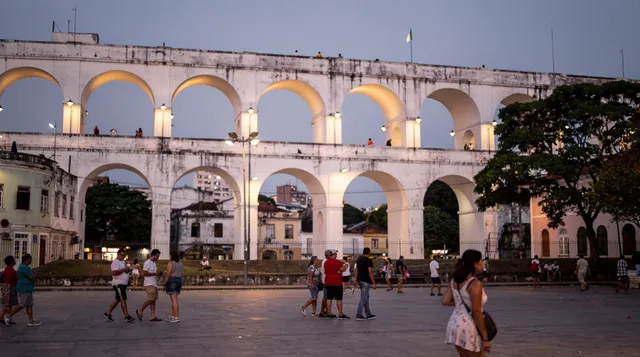
Centro connects directly to Porto Maravilha — the Museu do Amanhã and Praça Mauá waterfront redevelopment are a 15-minute walk or one VLT tram stop north — and to Lapa, whose Arcos are a 20-minute walk south along Avenida República do Chile. A reasonable day plan links all three: Centro in the morning while it’s cool and open, Porto Maravilha for the museums after lunch, Lapa for an early-evening look at the Arcos before heading elsewhere for dinner, since Lapa’s own restaurant scene is thin outside its nightlife hours.
Safety, in practical terms
Centro’s risk profile is different from the beach neighbourhoods: pickpocketing in dense pedestrian pockets (Uruguaiana market streets, the area right around Praça Tiradentes) rather than anything more serious, and it drops off sharply outside office hours simply because there’s nobody around to rob or be robbed — which is its own kind of problem after dark, when empty streets are a bad place to be lost looking at a phone.
Keep valuables in a front pocket or crossbody bag zipped shut, don’t wave a phone around for photos in the crowded market blocks, and plan to be out of Centro by early evening unless you have a specific reason (the São Bento Sunday Mass, an evening event at the Theatro Municipal) to be there later. This isn’t a “Rio is dangerous” warning — it’s the same advice you’d get for any big city’s financial district after the offices close.
Rainy-day Centro
Centro is one of the better wet-weather options in Rio precisely because so much of it is indoors — the Real Gabinete Português de Leitura, the Theatro Municipal’s guided tour, the Paço Imperial’s exhibition halls and the Museu Nacional de Belas Artes near Cinelândia all give you a full day of activity without depending on clear skies, unlike almost everything covered elsewhere in this guide.
If the forecast for your Rio trip includes a rainy day, moving your Centro visit to that day rather than a sunny one is a sensible piece of itinerary planning that a lot of first-time visitors don’t think to do until they’re already stuck. See what to do in Rio when it rains for the fuller list of indoor options across the city.
A brief history, because it explains the layout
Centro is Rio in its oldest form — the settlement founded in 1565 grew outward from roughly where Praça XV now stands, and for nearly 250 years this small grid of streets was essentially the whole city.
Everything changed twice, fast: first in 1808, when the Portuguese royal family fled Napoleon’s invasion of Portugal and relocated the entire court to Rio, instantly turning a colonial backwater into an imperial capital and triggering a wave of construction (the Paço Imperial, the churches, the first proper streets); then again after 1889, when the monarchy fell and Centro modernised into a Belle Époque business district, tearing down swaths of colonial building stock in the 1900s–1920s to build the wide Avenida Rio Branco and grand structures like the Theatro Municipal.
What you’re walking through today is mostly that second layer — Belle Époque civic architecture — with pockets of the older colonial city surviving in the Travessa do Comércio area specifically because it was narrow and marginal enough not to be worth demolishing. Rio stopped being the national capital in 1960, when Brasília took over, and Centro’s importance shrank from “seat of national government” to “Rio’s financial and legal district” — which is the version you’re visiting now.
Saara: the market district
West of Praça Tiradentes, the streets of Saara (Sociedade de Amigos das Adjacências da Rua da Alfândega, though nobody calls it that) form Rio’s dense, chaotic, largely working-class shopping district — fabric, costume jewellery, carnival supplies, imported goods, all sold from packed storefronts and street stalls at prices well below anything in the Zona Sul.
It’s not a tourist attraction in the conventional sense, but it’s a legitimate slice of how ordinary Rio shops, and it’s worth a walk-through if you’re curious what the city looks like away from anything designed for visitors. It gets extremely crowded on weekday lunch hours and Saturday mornings — hold your bag in front of you and keep phones pocketed, the same crowd-awareness that applies to any dense market anywhere.
Museums worth building extra time for
Beyond the walkable core, Centro has a genuine concentration of serious museums that most short-trip visitors skip entirely in favour of the beach neighbourhoods — worth knowing about if history and architecture are part of what you’re in Rio for. The Museu Nacional de Belas Artes, on Cinelândia’s edge, holds Brazil’s national fine arts collection in a Belle Époque building that’s worth a look even from the courtyard. The Museu Histórico Nacional, near Praça XV, covers Brazilian history from the colonial period through the republic in a converted 18th-century fort and arsenal complex, with a genuinely substantial collection for a museum most visitors have never heard of.
None of these are essential the way the Paço Imperial or Confeitaria Colombo are for a first, time-limited visit, but for travellers with a second day to give Centro, or a specific interest in Brazilian history and art, they round out the half-day walking route into a fuller day without duplicating anything already covered above.
A practical half-day route
If you’re building your own walk rather than joining a tour, a workable sequence starts at Praça XV around 9:30am, once the Paço Imperial has opened, then the Travessa do Comércio and Arco do Teles (better for photos before the lunch crowd arrives), north to the Mosteiro de São Bento for the interior before its midday closure, back down through Saara if you want the market detour, then to Cinelândia and the Theatro Municipal by early afternoon, finishing at the Real Gabinete Português de Leitura near Praça Tiradentes before it closes.
That’s roughly four hours of unhurried walking, all flat, all within Linha 1’s reach if your legs give out partway through. Add an hour if you’re doing the São Francisco da Penitência church as well, and go on a day when it isn’t raining — Centro’s narrow colonial streets flood at the curb faster than the wider Zona Sul avenues.
Where to eat beyond Confeitaria Colombo
Centro’s weekday lunch culture is one of its underrated strengths: Bar Luiz, open since 1887 on Rua da Carioca, serves German-Brazilian food and ice-cold chope in a wood-panelled room that’s changed little in decades — a good, unpretentious alternative to Confeitaria Colombo’s tourist-priced pastries. Cedro do Líbano, nearby, is a long-running Lebanese restaurant popular with the office lunch crowd.
Street-level kibe and coxinha stands cluster around Uruguaiana and Carioca metro exits and are as good a gauge of real Centro food culture as anywhere formally seated. None of these are destination restaurants worth a special trip on their own — they’re what make a walking morning through Centro pleasant rather than a checklist of monuments with nowhere good to sit down.
Where it sits, and what’s nearby
Centro Histórico borders Lapa to the south and Porto Maravilha to the north along the harbour, with Santa Teresa visible on the hill above — the historic tram up to Santa Teresa boards from Carioca station, right in the middle of this district.
If you’re building a longer walking day, the Centro Histórico walking guide lays out a fuller route with timings, and street art in Rio covers the murals scattered through the district’s back streets, including work by Eduardo Kobra. For context on why Centro behaves so differently from the rest of the city, what locals actually do on Sunday is worth a read before you plan a weekend visit here.
Weekday versus weekend, at a glance
| Weekday (Mon–Fri) | Weekend | |
|---|---|---|
| Paço Imperial and churches | Open | Mostly closed (São Bento’s 10am Mass is the exception) |
| Travessa do Comércio | Lively lunch crowd; Friday evening chopp scene | Quiet, few open bars |
| Streets generally | Busy, safe, well-populated | Near-empty, grates down |
| Recommended visit | Any weekday, ideally not Monday | Only for São Bento’s Sunday Mass |
This is the single most important planning fact about Centro — build your visit around this table before anything else on this page.
A guided alternative to piecing it together yourself
For visitors who’d rather not navigate Centro’s mostly-Portuguese-only plaques and figure out the Belle Époque-versus-colonial layering on their own, a guided walk covers the same ground with context built in — genuinely useful here specifically, since Centro’s history is denser and less self-explanatory than a beach neighbourhood’s. An e-bike option also exists for visitors wanting to cover more ground, including a link out to Ipanema, without the full walking commitment: an e-bike tour connecting the historic centre with Ipanema is a reasonable way to combine a Centro morning with a beach afternoon without arranging separate transport between the two.
Frequently asked questions about Centro Histórico
Is Centro Histórico safe to walk around?
During business hours on weekdays, yes, with the same pickpocket-awareness you’d use in any dense downtown crowd. It empties out fast after about 6pm and at weekends, and an empty commercial district after dark is not where you want to be wandering with a map open — plan to finish your visit by early evening.
Why is everything closed on Sunday?
Centro is a business district, not a residential or tourist neighbourhood — the churches, museums and lunch counters that make it interesting largely serve the office population that isn’t there on a weekend. The one reliable exception is the 10am Sunday Mass with Gregorian chant at Mosteiro de São Bento.
How long do I need for Centro Histórico?
A focused half-day covers Praça XV, Travessa do Comércio, Confeitaria Colombo, Theatro Municipal and the Real Gabinete Português de Leitura on foot. Add the Mosteiro de São Bento and you’re closer to a full morning-into-afternoon.
Can I walk from Centro to Lapa?
Yes — it’s a flat 20-minute walk down Avenida República do Chile to the Arcos da Lapa, or a couple of stops on the metro if you’d rather sit down.
Is the Theatro Municipal open to visit inside?
Guided tours run on most weekdays, but the schedule shifts around rehearsals and events, so check the day you’re planning to go rather than assuming a fixed timetable.
Do I need a guide for Centro Histórico?
Not strictly — the core sights are walkable and close together — but a guided walk adds context that the (largely Portuguese-only) plaques don’t give you, particularly on the colonial architecture and the street art layered on top of it.
Where’s the best lunch in Centro?
Travessa do Comércio and the streets around Praça XV have the highest concentration of decent, reasonably priced lunch counters aimed at office workers rather than tourists — a much better ratio of quality to price than anything near the Theatro Municipal.
What should I combine Centro Histórico with in one day?
Porto Maravilha (Museu do Amanhã, MAR, the Valongo Wharf) sits a 15-minute walk north and pairs naturally with a Centro morning — see the Porto Maravilha guide for how to sequence the two.