
Street art in Rio — Selarón's steps, the port murals, and the Lapa walls
What's the best street art to see in Rio, and is it free?
The Escadaria Selarón (mosaic steps between Lapa and Santa Teresa) and the Kobra "Etnias" mural on Boulevard Olímpico in the port zone are the two essential, free, always-accessible pieces. Both are outdoor public art, viewable any time, though early morning or midday gives better light and thinner crowds for photos than late afternoon.
Rio’s street art is concentrated, not scattered
Unlike cities where street art spreads thin across dozens of neighborhoods, Rio’s best-known public art sits in two tight clusters, both walkable, both free, and both reachable in a single half-day if you don’t linger too long at either. The first is the hill between Lapa and Santa Teresa, anchored by the Escadaria Selarón.
The second is the Porto Maravilha waterfront, anchored by Eduardo Kobra’s mural on Boulevard Olímpico. A smaller, less visited scene exists around Vila Mimosa, near Praça da Bandeira — worth a mention for completeness, though it’s off the standard tourist route and better suited to a local-led walk than a solo visit. This guide covers all of it honestly: what’s there, what it costs (nothing), and what to skip if you’re short on time.
| Where | Lapa/Santa Teresa hill (Selarón steps) + Porto Maravilha (Kobra mural) |
| Cost | Free — both headline sites are outdoor public art |
| Time needed | Half a day for both clusters, less for either alone |
| Best time | Morning for softer light and thinner crowds at Selarón |
| Getting between | Taxi/Uber or VLT tram (Porto Maravilha side) |
Grafite versus pichação — the distinction worth knowing
Brazil has two genuinely separate visual traditions on its walls, and understanding the difference sharpens what you’re looking at in Rio.
Grafite (graffiti, in the sense used internationally for figurative or muralist street art) is the colorful, deliberate, often commissioned or tolerated work — the Selarón steps, the Kobra mural, the murals covered on this page all fall under this category. Pichação is different: a distinctly Brazilian tagging style, tall angular lettering climbed and painted freehand, often at genuinely dangerous heights on unfinished high-rise buildings, historically associated more with São Paulo than Rio but visible across both cities as a form of illegal, anti-establishment mark-making rather than public art in the curated sense.
Visitors sometimes lump the two together as “graffiti,” but they come from different traditions, different legal standing, and different intent — the murals in this guide are the grafite side of that divide, made to be looked at and photographed, not the pichação tags you’ll also see layered across many Centro and Lapa walls.
Escadaria Selarón — the steps everyone photographs
The Escadaria Selarón climbs 215 steps between Rua Joaquim Silva in Lapa and Rua Pinto Martins in Santa Teresa, and every one of those steps is covered in ceramic tile — over 2,000 tiles by most counts, gathered from more than 60 countries. The project was the life’s work of Jorge Selarón, a Chilean-born artist who settled in Rio in 1983 and began tiling the derelict steps in front of his own house in 1990, initially using scavenged construction debris and broken tile before visitors from around the world started mailing or hand-delivering tiles from home.
He kept adding to it until his death in January 2013, found on the steps he’d spent over two decades building; the work is now maintained as a public monument, still technically unfinished by his own description of it as a lifelong project.
What to expect on the ground. The steps are steep, uneven in places, and genuinely climbable in ten minutes if you don’t stop, though almost nobody doesn’t stop — the tile work rewards slow looking, and most visitors spend 20-30 minutes photographing details and finding tiles from their own country. It’s free, open 24 hours, and busiest from mid-morning through early afternoon when tour groups and photographers overlap; go before 9am or after 4pm for a quieter visit and softer light.
Safety note: the steps sit at the edge of Lapa, a nightlife district covered in Lapa nightlife guide and Nightlife safety in Rio — daytime visits are routine and low-risk; treat it like any other reasonably busy tourist landmark after dark, meaning don’t linger alone late at night. Full logistics — best time, best photo angles, nearby food — are in Escadaria Selarón guide, the dedicated page for the steps alone.
A guided Santa Teresa tram and Selarón Steps tour pairs the steps with the historic tram ride and the ateliers further up the hill — a reasonable option if you’d rather have context on Selarón’s story and the neighborhood’s art scene from a guide than piece it together yourself.
Kobra’s Etnias — the largest mural most visitors have never heard of
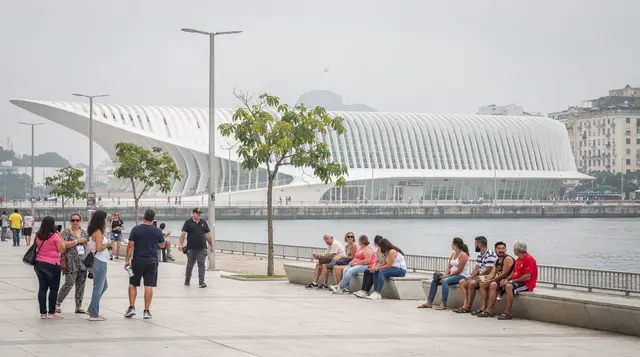
On Boulevard Olímpico in the port zone, a short walk from the Museu do Amanhã, Brazilian artist Eduardo Kobra painted “Etnias” (“Ethnicities”) ahead of the 2016 Olympics: five faces, one representing each Olympic ring’s color and continent — a Tapajó boy from Brazil, a Mursi woman from Ethiopia, a Karen woman from Thailand, a Supi man from Northern Europe, a Huli man from Papua New Guinea — spread across roughly 3,000 square meters of wall, 190 meters long and over 15 meters high.
Guinness recognized it as one of the largest spray-painted murals by a single artist in the world at the time it was completed; Kobra himself later painted a larger one in São Paulo, but Etnias remains the signature piece of Rio’s Olympic- era street art legacy and is significantly less visited than its scale deserves, mostly because it’s outside the usual Copacabana–Ipanema circuit.
It’s free, outdoors, and visible any time; the mural faces roughly east, so morning light tends to be more even across its full length than the afternoon glare it gets later in the day. Pair it with the Museu do Amanhã and Museu de Arte do Rio for a full Porto Maravilha art-and-architecture afternoon — all three sit within a 10-minute walk of each other. A three-hour urban arts walking tour covers the port zone murals plus additional smaller pieces scattered through Centro that are easy to walk past without a guide pointing them out.
Smaller pieces worth knowing about
Beyond the two headline clusters, Rio has a scattered handful of other notable murals worth mentioning for anyone spending real time exploring beyond the standard sights. Santa Teresa itself has murals and painted facades tucked into its steep side streets, distinct from the Selarón steps at its base — worth watching for while walking the neighbourhood covered in Santa Teresa walking guide rather than seeking out as standalone stops.
Botafogo and a few other Zona Sul neighbourhoods have smaller commissioned murals on building facades, generally the product of municipal beautification programs rather than a single artist’s body of work, and change more often than the two headline sites as buildings get repainted or renovated.
None of these carry enough individual weight to justify a special trip on their own, but they’re worth noticing as background if you’re already walking through the areas they sit in. Rio’s wider mural and graffiti scene keeps evolving beyond any fixed list — a return visit years after a first trip will likely turn up new work in Centro and the port zone alongside the two unchanged landmark pieces this guide treats as essential.
The Lapa walls
The area immediately around the Lapa Arches (Arcos da Lapa) — the 18th-century aqueduct the Santa Teresa tram crosses — functions as an informal, constantly changing outdoor gallery: murals, stencil work, and layered graffiti on the walls and underpasses near the arches themselves, updated often enough that no single piece is a fixed “must-see” the way the Selarón steps or the Kobra mural are.
Treat this as background texture for a Lapa evening rather than a destination in its own right — walk it on the way to or from the samba clubs and bars covered in Lapa nightlife guide and Live music in Rio, rather than making a special daytime trip purely to see wall art that will look different in six months anyway.
What a first-time visitor tends to get wrong
The most common planning mistake is treating the Selarón steps as a five-minute photo stop squeezed between other Lapa or Santa Teresa sights, rather than as a destination that rewards a proper look — the tile work genuinely repays slow attention, with individual tiles from dozens of countries worth hunting for rather than photographing the staircase as a single wide shot and moving on.
The second most common mistake is treating the Kobra mural as a minor detour rather than the genuinely major artwork it is; at 190 metres and among the largest single-artist spray murals in the world at the time it was made, it’s easy to underestimate from a small photo online and easy to be genuinely struck by in person, provided the visit isn’t rushed. Both mistakes come from the same root cause: underestimating scale and craft from a thumbnail, which is exactly what this page is meant to correct before you arrive.
Photographing street art respectfully
A short, practical note that applies across every site on this page. The Selarón steps and the Kobra mural are public art in the fullest sense — made to be photographed, no restrictions, no tension around it. That changes the moment street art shifts to murals painted on or near people’s actual homes, which happens inside several favela communities and, more informally, in neighbourhoods like Vila Mimosa below.
The same rule that applies to Favela tours done right applies here in miniature: a mural on a public wall in Porto Maravilha is fair game; a mural on the side of someone’s house is still, first, someone’s house, and the resident’s comfort with being photographed in front of it matters more than getting the shot.
Vila Mimosa — worth knowing about, not a priority stop
Vila Mimosa, near Praça da Bandeira, is Rio’s largest concentration of legal sex work and has, in recent years, become the site of small mural and urban-art projects as part of broader efforts to change how the area is seen and talked about. It’s a genuinely different kind of neighborhood from the tourist-facing clusters above, off any standard sightseeing route, and best approached — if at all — with a local guide or as part of an organized tour rather than as a solo detour; it isn’t set up for casual sightseeing and treating it as one misses the point. Most visitors to Rio will never have a reason to go, and that’s a reasonable choice; it’s included here for completeness, not as a recommendation to add it to a first-time itinerary.
What to bring, and what to skip carrying
Neither major site requires special equipment beyond a phone or camera and comfortable shoes — the Selarón steps genuinely are steps, uneven ones, and the Boulevard Olímpico walk is flat but long enough on a hot day to make water worth carrying. Leave valuables minimal at both sites, the same sensible practice as any busy outdoor tourist spot anywhere in the world rather than a Rio-specific warning; neither location has a materially different risk profile from a well-trafficked landmark in any major city.
A wide-angle lens or phone setting helps considerably at the Kobra mural given its scale — standard portrait-mode photos rarely capture more than a fraction of the full 190-metre length, which is worth knowing before you’re standing in front of it trying to fit it all in frame.
Planning a street art half-day
A sensible route: start at the Escadaria Selarón in the morning, walk up into Santa Teresa for the ateliers and Parque das Ruínas view (full route in Santa Teresa walking guide), then taxi or Uber down to Porto Maravilha for the Kobra mural and the two museums on Praça Mauá. That’s a full, satisfying day covering both clusters without backtracking.
If you only have time for one, the Selarón steps are the more central, more photographed, and easier to combine with a Lapa evening; the Kobra mural rewards visitors who are already planning a Porto Maravilha museum day and want to add fifteen minutes to it. See Rio de Janeiro in three days for where a street art morning fits into a short first trip, and Getting around Rio de Janeiro for moving between the two clusters.
A short history of Rio’s street art scene beyond the two landmarks
Rio’s public art wasn’t always this curated. Through the 1980s and 90s, the city’s walls carried mostly informal graffiti and pichação, tolerated rather than commissioned, with little municipal interest in murals as tourism infrastructure. That shifted meaningfully in the run-up to the 2014 World Cup and 2016 Olympics, when the city — alongside private developers redeveloping the long-neglected port zone — actively commissioned large-scale murals as part of a broader push to rebrand Centro and Porto Maravilha for an international audience.
Kobra’s Etnias is the clearest product of that era, but smaller commissioned pieces scattered through Centro and the port district date from roughly the same wave of investment. The Selarón steps predate all of this by decades and grew organically rather than as civic planning, which is part of why the two landmark sites feel so different in character up close — one a single artist’s decades-long personal project, the other a deliberate, funded piece of Olympic-era placemaking.
Comparing the two headline sites directly
| Escadaria Selarón | Kobra’s Etnias | |
|---|---|---|
| Location | Lapa/Santa Teresa border | Porto Maravilha, Boulevard Olímpico |
| Scale | 215 steps, 2,000+ tiles | ~3,000m², 190m long, 15m+ high |
| Origin | One artist’s personal project, 1990-2013 | Commissioned for the 2016 Olympics |
| Best light | Early morning | Morning (mural faces east) |
| Pairs well with | Santa Teresa ateliers, Lapa evening | Museu do Amanhã, Museu de Arte do Rio |
Frequently asked questions about street art in Rio
Is it free to see the Escadaria Selarón and the Kobra mural?
Yes, both are outdoor public art with no ticket or entry fee, viewable at any hour.
Can I add a tile to the Selarón steps myself?
The project is considered complete as a monument since Selarón’s death in 2013; unofficial additions do sometimes appear but adding your own tile isn’t an organized or endorsed activity — treat it as a finished work to look at, not a participatory one.
Is the area around the steps safe during the day?
Yes, routinely busy with tourists and photographers through the morning and early afternoon; normal city-center awareness applies, same as any well-trafficked landmark.
How do I get to Boulevard Olímpico and the Kobra mural?
The VLT light rail’s Praça Mauá stop puts you within a few minutes’ walk; see Getting around Rio de Janeiro for the wider system.
Are there other Kobra murals in Rio besides Etnias?
Yes, smaller pieces are scattered around Centro and elsewhere in the city, though Etnias on Boulevard Olímpico remains by far the largest and best-known.
Is street art connected to Rio’s favela communities?
Some of it, yes — murals inside several favelas are created by and with resident artists as part of community projects, distinct from the port zone and Lapa pieces covered here, which sit in public, non-favela areas. See Favela tours done right for how to see that work respectfully, through a community-based operator rather than as a drive-by.
What’s the best time of day for photos at the Selarón steps?
Early morning, before roughly 9am, for the thinnest crowds and the most even light on the tile work; late afternoon gets busy with tour groups and long shadows across the steps.
Is a guided street art tour worth it over doing it independently?
Independently is entirely workable for the two main sites, both well-signed and easy to find; a guide adds most value for the smaller, scattered Centro pieces and for context on the artists and neighborhoods that a self-guided walk won’t surface on its own.
What’s the difference between grafite and pichação?
Grafite refers to deliberate, often figurative or muralist street art like the pieces covered on this page; pichação is a distinct Brazilian freehand lettering tradition, more associated with São Paulo, generally illegal and made for a different purpose than public mural art. Both appear on Rio’s walls, but they’re not the same tradition and shouldn’t be conflated.
Is Eduardo Kobra Rio-based?
Kobra is Brazilian, born in São Paulo, and has painted murals across multiple countries; Etnias is his best-known Rio commission specifically, created for the 2016 Olympics, rather than a piece tied to him living or working in the city long-term.
Can I see street art from a boat trip on the bay?
The Kobra mural faces the waterfront and is visible from the water on some Guanabara Bay boat routes, though most such trips prioritize the wider skyline and Sugarloaf views over a close look at the mural itself; see Boat trips on Guanabara Bay for what those trips typically cover.
Is it worth visiting both clusters on the same trip if I only have a few days in Rio?
If street art specifically interests you, yes — they’re different enough in scale and setting (intimate mosaic steps versus a monumental waterfront mural) to both be worth the half-day combined effort. If it’s a minor interest among many others, the Selarón steps alone, easily combined with a Lapa evening, cover the essential experience.
When did Rio’s street art scene become this prominent?
Largely in the run-up to the 2014 World Cup and 2016 Olympics, when the city and private developers commissioned large-scale murals as part of redeveloping the port zone — Kobra’s Etnias is the clearest product of that wave, though the Selarón steps predate it by decades.
Does Rio have a dedicated street art museum or gallery?
Not a dedicated single-artist museum, but Museu de Arte do Rio covers urban and street-adjacent visual culture within its wider contemporary Brazilian art collection, and is worth combining with a Porto Maravilha street art stop for a fuller picture of how the two forms relate.
tours.culture-museums
Verified deep-linked GetYourGuide tours. Book through these links and we earn a small commission at no cost to you.
Rio: Boulevard Olímpico, Museu do Amanhã e Tour Histórico

Rio’s Best_Corcovado, Sugar Loaf, Selaron, Cathedral and more
Rio de Janeiro: Marine Aquarium Entry Tickets
Photos show the destination, not the operator's own pictures.