
Lapa nightlife guide — a Friday night, street by street
What is the best way to spend a Friday night in Lapa?
Arrive under the Arcos da Lapa around 10:30-11pm, buy a caipirinha from a street cart for R$10-15 (about $2-3), and drift between the samba houses on Rua do Lavradio and Rua Joaquim Silva before the crowd peaks around 1am. Book your ride home before you start drinking, not after.
| Where | Rua do Lavradio, Rua Joaquim Silva, Avenida Mem de Sá |
| Arrive | 10:30-11pm, before it’s too early, before it peaks |
| Peak crowd | Midnight to 1:30am |
| Cost, one night | Roughly R$150-250 (US$30-50) incl. one club cover |
| Getting home | Uber/99 to a main street — book before you start drinking |
Lapa is a street party first, a club district second
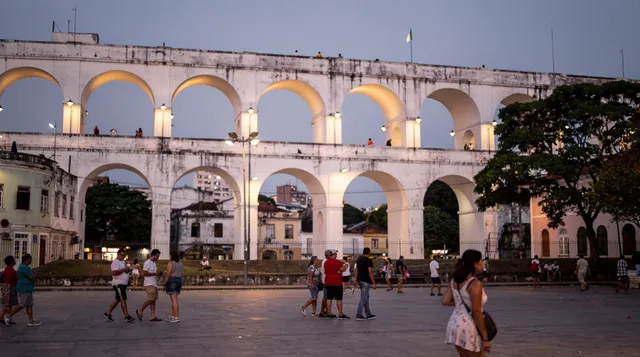
Most cities hide their nightlife behind doors. Lapa puts it in the road. On a Friday or Saturday night, the stretch of asphalt directly under the Arcos da Lapa — the old aqueduct that carries the Santa Teresa tram — fills with people standing around drinking, not going anywhere in particular, long before any club opens its doors. That street scene is free, it is the main event for a large share of the crowd, and it is the reason Lapa reads as chaotic to a first-time visitor who expected a district of venues rather than a district that has spilled entirely into its own streets. Understanding that distinction — street first, clubs second — changes how you plan the night.
The neighbourhood itself sits between Centro Histórico and Santa Teresa, at the base of the hill the old tram climbs, and its nightlife identity was built by samba houses that opened in the 1990s and 2000s in restored 19th-century townhouses along Rua do Lavradio and Rua Joaquim Silva. During the day those same blocks are quiet, a little run-down, dotted with antique shops. At night, from Thursday onward but properly from Friday, they become one of the densest concentrations of live music in South America.
The geography: three streets that matter
Rua do Lavradio is the anchor. Colonial-era buildings house the neighbourhood’s best-known samba clubs side by side, which means you can walk fifty metres and go from one roda de samba to a completely different band without crossing the street twice. This is the street to start on if you only have one night.
Rua Joaquim Silva runs up toward Santa Teresa and carries a rowdier, younger crowd — more street drinking, more bars with their fronts fully open to the pavement, less table service. It connects directly to the base of the Escadaria Selarón steps, which are worth a daytime visit but are not somewhere to linger after dark.
Avenida Mem de Sá, running under the Arcos themselves, is the widest and most crowded strip — street vendors, pop-up bars, and the loudest concentration of sound systems bleeding out of open club doors. It’s also where the Friday-night block party effectively happens, unplanned and unticketed, with thousands of people standing in the road by midnight.
The street drinking, honestly
Buying a caipirinha, a can of Antarctica or Brahma beer, or a shot of cachaça from a cooler on a folding table is completely normal in Lapa and not something to be nervous about. Vendors line Mem de Sá and the surrounding blocks from early evening, prices run R$10-15 (roughly $2-3) for a caipirinha and R$6-8 for a can of beer, and paying in cash is the norm — small notes, since a vendor at 1am rarely wants to make change for a R$100 bill. Bring more small notes than you think you need; running low forces a card transaction at whichever bar happens to have a machine working, at a worse price than the street.
The street drinking is also where most people’s Lapa night actually happens — standing in a loose group near the Arcos with a drink, moving on when the group thins out or a better sound catches your ear. It is not aggressive or unsafe in itself; the crowd at the Arcos on a normal Friday is dense, mixed-age, and self-policing in the sense that thousands of people milling around create their own kind of safety. The risk in Lapa is not the crowd — it’s the empty stretch you walk down to avoid it.
The clubs, and which is which
Samba clubs in Rio covers the full comparison in detail, but the short version for a Lapa Friday: Carioca da Gema and Rio Scenarium are the best-known rooms on Rua do Lavradio, both with a cover charge (R$40-80 depending on the night and whether there’s a table reservation fee on top) and both closer to a proper live-music venue with a stage than a bar with a band in the corner — good, but not the cheapest or the most local option on the street.
Trapiche Gamboa, a little further out in the Gamboa docks, leans more local and less polished, and is covered in the Pedra do Sal write-up since the two are often done as one night. For the bigger stages — Circo Voador and Fundição Progresso, both under or beside the Arcos — check what’s booked before you go, because they host everything from funk and rock to electronic acts, not exclusively samba, and the cover can run R$40-150 depending on who’s playing.
a guided Lapa pub crawl with live samba and shots removes the guesswork on a first visit — someone else picks the order, gets you past any line, and walks the group between venues, which matters more in Lapa than in most nightlife districts because the street layout is genuinely disorienting after a few drinks.
When to arrive, and why timing matters more here than elsewhere
10pm is too early — venues are half-empty, some samba houses haven’t started their live set, and the street crowd hasn’t built. 10:30-11pm is the honest start time for a first drink and a walk of the main streets while it’s still possible to see clearly and move freely. The street crowd peaks between midnight and 1:30am, when Mem de Sá is at its most crowded and most alive — this is also when cover charges at some smaller venues rise or a door starts turning people away past capacity.
By 2:30-3am the crowd thins unevenly: some blocks stay busy, others empty out fast, and this uneven thinning is exactly the condition that makes late-night Lapa riskier than early or peak-hour Lapa. The safest version of a Lapa night ends by calling a ride while the street is still busy, not after it has half-emptied.
a cachaça tasting and live samba crawl runs on the earlier side of the evening (starting around 7-8pm), which suits visitors who want the Lapa experience without pushing into the 2am-plus window.
Getting home — the part that actually matters
This is the real planning question for a Lapa night, more than which club to pick. Uber and 99 (the Brazilian ride app, often cheaper and with better late-night availability) both work reliably in Lapa, and the standard move is to walk toward Avenida Mem de Sá or one of the wider cross streets to get picked up rather than requesting a car to a side street the driver can’t find in the crowd. Set the pickup point before you start drinking, not as an improvised decision at 3am — full detail on which apps to use and how pickup points work at Uber and taxis in Rio.
The metro does not solve this. Lapa’s nearest useful station, Cinelândia, is a 10-15 minute walk from the Arcos through streets that are quiet and semi-deserted late at night — exactly the profile that’s genuinely riskier than the crowded blocks you just left. The Rio metro runs until roughly midnight on weeknights and pushes later, toward 1am, on Friday and Saturday, but even within that window, walking to Cinelândia alone at 1:30am defeats the purpose. If you’re taking the metro home, do it in a group and before the crowd thins, or skip it and take a car door-to-door.
What not to do: don’t walk the two or three blocks between Lapa and Centro Histórico late at night to “save money” on a short ride — those connecting streets are quiet, poorly lit, and carry real phone-snatching risk precisely because they’re empty compared with Lapa itself. Don’t flag a taxi off the street in Lapa at 3am; use the app. Don’t carry your passport or more cash than the night requires — a cheap phone case and R$100-150 in small notes covers a full night comfortably. Full behavioural detail on this, not just for Lapa, is in nightlife safety in Rio and the wider Rio safety guide.
a private samba night tour with locals in Lapa is worth the premium for a first visit or a solo traveller, since it includes transport logistics as part of the booking rather than leaving you to work them out at 2am.
What to bring, what to wear
Nobody dresses up for Lapa. Jeans, a t-shirt or light shirt, and shoes you can stand in for four hours on uneven cobblestone cover 90% of the crowd — the door policy at even the smart-looking samba houses is closer to “clean and casual” than anything resembling a dress code. Bring a light jacket if it’s winter (June-August evenings in Rio can dip to 15-18°C), since the Arcos create a wind tunnel. Cash in small notes matters more than a card, for the reasons above. A cheap phone or a phone in a zip pocket, not held out for photos at arm’s length near the crowd, is the single biggest theft-prevention habit that applies specifically to Lapa’s density.
Weeknight Lapa vs weekend Lapa
Lapa on a Wednesday or Thursday is a genuinely different, calmer proposition than Friday or Saturday — several samba houses run smaller, sometimes cheaper sets, the street crowd under the Arcos is thinner, and the whole neighbourhood is easier to navigate for a first visit. It’s a reasonable choice if the goal is to see live samba without the peak-night density, though it trades away the full street-party atmosphere that makes a Lapa Friday distinctive.
Sunday and Monday are the quietest nights by far — most of the samba houses either close or run a reduced schedule, and the neighbourhood itself feels closer to its daytime, semi-residential character. If a roda de samba specifically is the draw rather than the Lapa club scene, Pedra do Sal on Monday is the better use of that night.
What Carnival changes about this map
Lapa’s ordinary Friday-Saturday rhythm gets entirely overwritten during Carnival season, when the neighbourhood hosts some of the city’s best-known street blocos and the crowd multiplies several times over on nights that would otherwise be quiet. The venue-by-venue detail in this guide still broadly applies outside the Carnival weeks themselves, but during Carnival the street itself becomes the show, cover charges and drink prices climb, and the getting-home logistics get considerably harder simply from sheer crowd volume.
Full season-specific detail at Carnival blocos guide and carnival safety — treat this page as the year-round version and those as the overlay for the six or so weeks around Carnival itself.
A realistic cost breakdown for one night
Putting the numbers from this guide together: a street caipirinha or two (R$20-30), one club cover at a samba house (R$40-80), a couple of drinks once inside (R$30-50), and a rideshare each way (R$25-45 total depending on distance and surge pricing) comes to roughly R$150-250 per person (about $30-50) for a full night that includes both the free street scene and one paid venue.
Staying entirely on the street and skipping a club cover brings that down to R$60-100. Adding a second venue, or reserving a table at Rio Scenarium, pushes it toward R$300 or more — see Rio on a budget for how a Lapa night fits into a wider trip budget, and money and payments in Rio for the cash-vs-card question specific to street vendors.
Combining Lapa with the rest of the evening
Lapa works well as the back half of a night rather than the whole thing. A boteco dinner in Botafogo or Santa Teresa — see boteco culture in Rio — followed by a car to Lapa around 10:30-11pm, lands you in the neighbourhood right as it’s building toward its peak rather than sitting through its quieter early hours. A gafieira dance class beforehand, covered in gafieira dance halls, is another common pairing for visitors who want a fuller night of Brazilian music and dance rather than Lapa in isolation.
Lapa vs the rest of Rio’s nightlife map
Lapa is the loudest, most concentrated, most tourist-visible night out in Rio, and it is genuinely worth doing — but it is one stop on a wider map. Rio bar crawl guide lays out how Lapa compares with the rooftop and pub scene in Botafogo and the more upscale Baixo Leblon strip; boteco culture in Rio covers the quieter, cheaper, more everyday version of a night out that doesn’t require Lapa’s crowd or its 2am logistics at all.
If the roda de samba is what draws you rather than the club scene, the more local, less commercial version happens on Monday nights at Pedra do Sal — free, on the street, and a genuinely different crowd from Lapa’s Friday peak.
First-timer vs repeat-visit Lapa
A first Lapa night rewards sticking close to Rua do Lavradio and the immediate Arcos area — dense enough to feel the full energy of the neighbourhood without needing to navigate its quieter connecting streets to find it. A repeat visitor with a bit more familiarity can branch further: Trapiche Gamboa’s more local scene, a specific Circo Voador or Fundição Progresso booking checked in advance, or timing a weeknight visit deliberately for a calmer, more conversational version of the same neighbourhood. Either way, the core planning logic doesn’t change between visit one and visit five — arrive with a fixed idea of where you’ll get picked up, and treat that decision as settled before the first drink, not an improvised call at 3am.
Frequently asked questions about Lapa at night
What night is best for Lapa?
Friday and Saturday carry the fullest street crowd and the widest range of open venues. Some samba houses also run sets on Wednesday, which is quieter and easier if you want to see live samba without the peak-night density.
Is the street drinking in Lapa safe?
Buying and drinking on the street is normal and not itself risky — the dense, self-policing crowd around the Arcos is one of the lower-risk pockets of nightlife Rio has. The genuine risk sits in the quiet connecting streets, not the crowded ones; see nightlife safety in Rio for the specific behaviour that prevents most incidents.
Do I need to book ahead for Carioca da Gema or Rio Scenarium?
On a Friday or Saturday, yes — both fill up, and a reservation avoids a cover-charge-plus-wait at the door. A guided pub crawl or private tour bundles entry and removes this planning step entirely.
How much should I budget for a night in Lapa?
A realistic budget for one club cover, a few street drinks, and a ride home runs R$150-250 (roughly $30-50) per person — considerably less if you skip a paid venue and stay on the street, considerably more if you table-reserve at a samba house.
Is Lapa walkable from Copacabana or Ipanema?
No — it’s a 20-30 minute car ride depending on traffic, not a walking distance from the beach neighbourhoods. Most visitors base themselves in Copacabana or Ipanema and take a car to Lapa for the night specifically.
Can I do Lapa alone?
Plenty of solo travellers do, and the crowded main streets make it more comfortable than most nightlife districts for a solo visit — but the getting-home step matters even more alone, since there’s no group to flag a bad decision. See solo travel in Rio for the wider picture.
Is Lapa the same as a Carnival street party?
No — Lapa’s Friday and Saturday nights run year-round and are unrelated to Carnival’s scheduled blocos, though the neighbourhood does host some Carnival-season events. Full detail on the seasonal difference at Carnival blocos guide.
tours.samba-nightlife
Verified deep-linked GetYourGuide tours. Book through these links and we earn a small commission at no cost to you.
Rio Samba Bus: Hop-on Hop-off City Tour in Rio de Janeiro

samba class in Ipanema
Hop-ON Hop-OFF Sightseeing Bus in Rio de Janeiro – Rio Samba Bus
Photos show the destination, not the operator's own pictures.