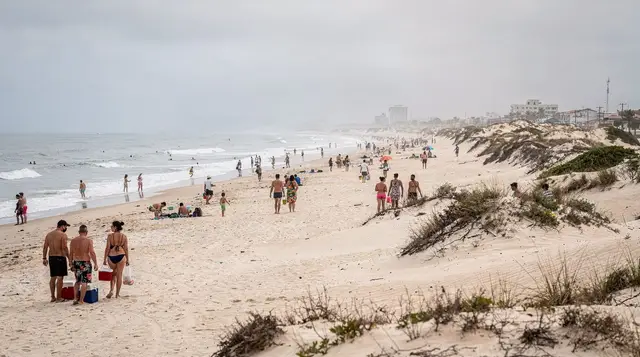
| Where | Zona Sul, between Arpoador and the Jardim de Alah canal |
| Cost | Beach is free; a chair and umbrella run around R$20–30/day |
| Time needed | Half a day for the beach; 1-2 days to see the neighbourhood properly |
| Getting there | Metro Line 1, General Osório or Nossa Senhora da Paz |
| Best time | April-June or September-November for smaller crowds; Sunday morning for the hippie fair |
Posto 9 is a scene, not just a lifeguard post
Ipanema uses the same posto numbering as Copacabana, but here the numbers carry a social weight Copacabana’s don’t have in quite the same way.
Posto 9, roughly in the middle of the beach, is the neighbourhood’s real centre of gravity — actors, musicians, and a younger, design-and-media crowd have gathered on this exact stretch of sand since the 1960s, when it was the epicentre of Rio’s bohemian scene and the literal setting that inspired “The Girl from Ipanema.” It’s still where you go to see and be seen, with informal sub-groups (surfers, volleyball players, a long-running gay and lesbian beach crowd nearer the rainbow flag) clustering in loosely understood zones that locals navigate without a second thought and newcomers pick up within a day.
Posto 8, just to the east toward Arpoador, is the more family-oriented stretch — calmer, less performative, popular with households from the surrounding streets. Further toward Leblon, past Posto 10, the beach gets progressively quieter and more residential. None of these distinctions are really about safety; Ipanema overall runs safer and calmer than Copacabana, with a lower density of hawkers and a noticeably wealthier residential backdrop. For the direct comparison most first-time visitors actually want, see Copacabana vs Ipanema.
Farme de Amoedo and Rio’s most visible LGBTQ+ beach stretch
Rua Farme de Amoedo runs perpendicular to the beach between Posto 8 and Posto 9, and the sand directly in front of it has been Rio’s principal LGBTQ+ beach gathering point since the 1990s — rainbow flags planted in the sand, a visibly mixed and welcoming crowd, and a run of bars and cafés along the street itself that stay comfortably queer-friendly after dark, not just during the day. It’s one of the more genuinely relaxed public LGBTQ+ spaces in South America, not a separate “scene” so much as an integrated part of how this stretch of beach already works — couples holding hands, mixed groups sharing the same patch of sand as everyone else, no separation of any kind.
That said, Rio is not universally as easygoing as Farme suggests, and open affection elsewhere in the city — particularly outside Zona Sul, or late at night in less busy areas — is worth reading the room on. For the fuller picture, see is Rio safe for tourists, which covers this alongside the more general safety questions.
The Sunday hippie fair at Praça General Osório
Every Sunday, the Feira Hippie de Ipanema fills Praça General Osório, a few blocks inland from the beach, with several hundred stalls — jewellery, leather sandals, wood carvings, art, and a fair amount of straightforward tourist tat mixed in with genuinely well-made craft pieces. It’s been running continuously since 1968 and is one of the few “market” experiences in Rio that isn’t purely a tourist construction; plenty of Cariocas shop here too, especially for gifts and home pieces. Go before 11am if you want to browse without shoulder-to-shoulder crowds, and expect to haggle — opening prices assume you will.
It runs rain or shine, roughly 9am to 6pm, and is an easy, low-stakes way to spend a Sunday morning before the beach crowds build. For what else a Carioca Sunday typically looks like beyond the fair, see what locals actually do on Sunday.
Sunset at the far end
Ipanema beach runs east–west, which means — unusually for Rio’s south-facing beaches — you get a genuine ocean sunset here, not just a sunset over the hills.
The far western end, toward the Jardim de Alah canal that separates Ipanema from Leblon, and especially the rocks near Posto 11, fill up in the last half hour before sunset with people who’ve come specifically for the view, sometimes with a round of applause when the sun actually drops below the horizon — a tradition more associated with Arpoador’s rock next door, but one that spills naturally onto this end of Ipanema too on clear evenings. Bring a canga (sarong) to sit on and a cold drink from a nearby kiosk; it’s one of the better free things to do in the entire city.
Farme, Nossa Senhora de Copacabana’s opposite number: Visconde de Pirajá
Ipanema’s main commercial street, Rua Visconde de Pirajá, running the length of the neighbourhood one block off the beach, is where the shopping and dining actually happen — boutiques, jewellers (H. Stern’s flagship is here), and a dense run of good-to-excellent restaurants. It’s noticeably more expensive than the equivalent strip in Copacabana; a main course at a mid-range restaurant here runs R$60–110 (roughly US$11–20), against R$40–70 in Copacabana for a broadly comparable meal. The trade-off is quality and setting — Ipanema’s kitchens are, on average, simply better, and the outdoor tables along the side streets feel less like a tourist thoroughfare.
For a wider view of eating well without overpaying anywhere in the city, see what to eat in Rio — the boteco bar-and-snack format covered there is cheaper and, in most locals’ opinion, more fun than a sit-down restaurant, and Ipanema has several good ones tucked on its quieter side streets. A handful of the boteco-style spots stay open well past midnight on weekends, filling the gap between dinner and the neighbourhood’s later, quieter bar scene without the cover charge or dress code some of the more polished restaurants expect.
Sport, samba, and getting on the water
Surfing works reasonably well at the eastern end of Ipanema toward Arpoador when the swell is right, though the more consistent, teaching-friendly breaks sit just around the rock at Arpoador itself:
surf lessons with local instructors in Copacabana or IpanemaSamba classes are widely available here too, often taught by professional dancers who perform at Rio’s samba schools during the rest of the year:
learn samba in Ipanema — steps, rhythm and Carnival energyFor a broader look at the neighbourhood on two wheels, an electric bike route runs from the historic centre out through Ipanema’s beachfront, a good way to cover distance most people wouldn’t otherwise walk:
historic Rio and beaches electric bike tourBeach volleyball and footvolley courts run along this stretch too, informally marked out with rope and posts each morning and taken down each evening — worth a look even if you’re not playing, since the standard among regulars is high. For a broader roundup of surf spots across the city, see surfing in Rio.
Getting there and around
Ipanema’s own metro stops — General Osório and Nossa Senhora da Paz — sit on Line 1, making it as easy to reach by public transport as Copacabana, if slightly further from the airport. From Galeão, the shared shuttle covering Copacabana, Ipanema, and downtown is the simplest fixed-price option for a first arrival:
Galeão airport transfer to Copacabana, Ipanema and downtownFor onward trips from Santos Dumont, the smaller domestic airport in the city centre, a comparable transfer covers the same three neighbourhoods. See getting around Rio for the full transport picture, including which of the two airports you’re more likely to be using and how the metro’s operating hours affect a late night out.
Driving and parking a car here is more trouble than it’s worth for most visitors. Street parking fills quickly and is worked by informal, unofficial “flanelinhas” (parking watchers) who expect a small tip, R$5–10, for keeping an eye on a car — a longstanding, broadly tolerated local practice rather than a scam, though it isn’t an official service either. Paid parking garages along Visconde de Pirajá and the cross streets are more reliable, running roughly R$15–25 an hour, but between the cost, the search time, and how well the metro and ride-hailing already cover this neighbourhood, a car adds friction without adding much.
Where Ipanema sits in a longer trip
Ipanema is a natural pairing with Arpoador to its east and Leblon to its west — all three are walkable from each other along the coast in well under an hour combined, and most short first-time itineraries put all three on the same day. For a structured version of that, see Rio in three days, which builds a Zona Sul beach day around this exact stretch.
The neighbourhood behind the beach
Ipanema’s residential streets, running inland from Visconde de Pirajá up toward the Lagoa, are worth a slower walk in their own right — leafy, low-rise by Rio standards (a 1970s height cap kept most buildings under twelve storeys, unlike Copacabana’s wall of towers), and dotted with small praças that function as neighbourhood living rooms, particularly in the early evening when families bring out folding chairs and kids play football in the street. Praça Nossa Senhora da Paz, at the Leblon-facing end, is the pick of them — a proper square with mature trees, a playground, and a run of good casual restaurants around its edges that skew local rather than tourist.
The Jardim de Alah canal, at Ipanema’s western edge, connects the Lagoa Rodrigo de Freitas to the ocean and marks the informal boundary with Leblon. It’s not much to look at — a straight concrete-edged channel — but the footbridge across it is a genuinely pleasant vantage point at sunset, with Ipanema’s curve of beach on one side and Leblon’s on the other.
Safety after dark, specifically
Ipanema’s beachfront promenade and the streets around Visconde de Pirajá stay busy and reasonably well-lit well into the evening, and the neighbourhood overall runs safer than Copacabana on most measures. That said, the beach itself empties out and is best avoided after dark — sitting on the sand at night, even for a view of the lights, is a habit locals don’t share and one worth skipping. Quieter residential side streets, particularly those running up toward the hills, warrant the same late-night caution as anywhere else in Zona Sul. See is Rio safe for tourists for the fuller, non-alarmist picture that applies here as much as anywhere in the city.
A day at Ipanema, realistically
The rhythm here mirrors Copacabana’s but runs slightly later and slightly calmer: joggers and swimmers from around 6:30am, a build-up through mid-morning, a genuine thinning-out at midday as the sun peaks, and the real social action from around 4pm onward as the after-work and after-beach crowds arrive together and stay through sunset. Weekday afternoons are noticeably quieter than weekends, when much of Zona Sul’s population — not just tourists — treats the beach as the default place to spend a Saturday or Sunday.
Chair and umbrella rental works exactly as it does in Copacabana: flag a vendor carrying a stack, expect to pay roughly R$20–30 (about US$4–5.50) for the day, no booking required. Ipanema’s vendors sell a slightly more upscale range of snacks alongside the standard grilled cheese and coconut water — açaí bowls in particular are ubiquitous here, sold straight off coolers on the sand, and worth trying from a beach vendor rather than a sit-down juice bar for a more honest sense of what a local actually eats. For more on that specific food category, see açaí and juice bars.
Swimming conditions are generally gentler than Copacabana’s more exposed stretch, though the same lifeguard flag system applies — green, yellow, red — and is worth reading before getting in past waist depth, particularly near the rockier sections toward Posto 11.
Shopping beyond the hippie fair
Rua Visconde de Pirajá and its side streets carry Rio’s highest concentration of independent Brazilian fashion labels, alongside the big names like H. Stern (jewellery) and Osklen (beachwear), and it’s a genuinely good place to buy things you’ll actually wear again, as opposed to the souvenir-shop version of Rio sold nearer the beachfront kiosks. Farm Rio, a Brazilian print-heavy fashion brand that’s since expanded internationally, has its flagship a few blocks off the sand.
For books, records, and a slower browse, Livraria da Travessa on Visconde de Pirajá is a genuinely good independent bookshop with an English-language section and a café — one of the few indoor, air-conditioned things to do on a rainy afternoon in the neighbourhood, alongside the option covered in what to do in Rio when it rains.
Ipanema vs Leblon vs Copacabana, briefly
For anyone deciding where to spend a beach day, or where to base a stay, the three main Zona Sul beaches split fairly cleanly by character:
| Copacabana | Ipanema | Leblon | |
|---|---|---|---|
| Crowd | Dense, mixed tourist/local | Design-conscious, social | Calmer, family-first |
| Price level | Mid-range | Higher | Highest |
| Nightlife | Beachfront bars, casual | Restaurant-driven | Baixo Leblon bar scene |
| Best for | First-time base, easy logistics | Sunset, LGBTQ+ scene, people-watching | Quiet, upscale dinners |
Ipanema sits in the middle on most measures — livelier and pricier than Leblon, calmer and more design-conscious than Copacabana. See Copacabana vs Ipanema for the fuller head-to-head if that’s the actual decision in front of you.
Rainy-day options nearby
Ipanema itself is an outdoor neighbourhood, so a wet day changes the plan. Livraria da Travessa’s café and English-language section make a genuinely pleasant hour, Shopping stops along Visconde de Pirajá cover the basics if you need anything, and the covered arcades along parts of the main commercial strip let you window-shop without getting soaked. For a bigger indoor plan, the what to do in Rio when it rains guide covers museums and other options a short ride away, including the Lagoa’s covered kiosks if the rain is light enough to still want to be near water.
Where to stay if you base yourself here
Ipanema costs more than Copacabana for a broadly comparable hotel room, but the trade-off — quieter streets, better restaurants, marginally lower crime, and arguably Rio’s best single stretch of sand — is one plenty of repeat visitors decide is worth it on a second or third trip, even if Copacabana made more sense as a first-timer’s base with its wider hotel range and easier logistics. The blocks immediately around Posto 9 and Rua Farme de Amoedo put you in the middle of everything; the quieter streets toward Leblon trade a few minutes of extra walking for noticeably less street noise at night. For the full citywide comparison, see where to stay in Rio.
Frequently asked questions about Ipanema
Is Ipanema safer than Copacabana?
Marginally, yes — Ipanema has a lower density of street hawkers and opportunistic theft than Copacabana, and the beach empties out in a similar, predictable way after dark. The same core rule applies in both: enjoy the sand by day, stick to the lit streets and the promenade after dark, and don’t leave bags or phones unattended.
What’s the best posto for a first visit?
Posto 9 for the classic Ipanema experience and people-watching, Posto 8 if you want a calmer, more family-feeling stretch. Both are within easy walking distance of each other, so there’s little cost to trying one and moving if it isn’t the vibe you wanted.
Is Farme de Amoedo only for LGBTQ+ visitors?
No — it’s a welcoming, mixed stretch of beach and street that anyone is comfortable on, but it is specifically known as Rio’s LGBTQ+ beach hub and is worth knowing about whether or not that’s the reason you’re visiting.
How do I get to the hippie fair?
Praça General Osório is a short walk inland from Posto 9, about five minutes, or a one-stop metro ride to the General Osório station, which sits right on the square. It runs every Sunday except during Carnival week.
Is Ipanema expensive?
Yes, relative to most of Rio — it’s the city’s most expensive residential real estate, and restaurant and boutique prices reflect that. Beach access itself is free, as everywhere in Rio, and a coconut water from a kiosk costs the same here as in Copacabana.
Can I walk from Ipanema to Christ the Redeemer or Sugarloaf?
No — both are several kilometres away and require transport. Sugarloaf is roughly a 20-minute drive via Urca, and Christ the Redeemer requires a train, van, or hike up from Cosme Velho, a separate trip most people plan for a different half-day entirely.
Why is Ipanema associated with a song?
“Garota de Ipanema” (“The Girl from Ipanema”), written by Antônio Carlos Jobim and Vinícius de Moraes in 1962, was inspired by a young woman who regularly walked past a bar near Posto 9 — Bar Veloso, since renamed Garota de Ipanema in the song’s honour and still open a block off the beach. The song remains one of the most recorded pieces of music in history, and the bossa nova genre it helped popularise is still played live in a handful of small venues around Visconde de Pirajá most nights of the week.
What’s the etiquette around beachwear off the sand?
Rio is relaxed about swimwear on the beach itself and in beachfront kiosks, but walking several blocks inland in just a bikini or swim trunks — into a restaurant on Visconde de Pirajá, for instance — reads as out of place to locals, who typically throw on a T-shirt, dress, or canga before leaving the sand. It’s a minor point of local etiquette rather than a hard rule, but noticing it marks the difference between blending in and standing out.
Is Ipanema or Leblon better for a quiet stay?
Leblon, slightly — it’s calmer, smaller, and has fewer hotels overall, which suits a second or third-time visitor more than a first-timer. Ipanema strikes a middle ground between Leblon’s quiet and Copacabana’s energy, which is why most repeat visitors gravitate here.
What should I do in Ipanema if it rains?
Livraria da Travessa’s café, the boutiques and covered arcades along Visconde de Pirajá, and a short ride to one of Rio’s indoor museums all work. See what to do in Rio when it rains for the fuller list.