
Museu de Arte do Rio (MAR) guide — the rooftop, the collection, the square
What is the Museu de Arte do Rio, and is the rooftop actually worth it?
MAR is Rio's museum of Brazilian visual art from the 16th century to now, housed in a colonial palace joined to a converted 1918 bus terminal by a swooping shared roof — and yes, the rooftop terrace, reachable on the same ticket, gives one of the better free-standing views of Praça Mauá and the bay. It's closed Monday, open Tuesday through Sunday, with free entry on Tuesdays.
MAR is Rio’s museum of Brazilian visual art from the 16th century to now, occupying two connected buildings on the edge of Porto Maravilha, directly across from the Museu do Amanhã. This guide covers how the two buildings and the collection fit together, the rooftop terrace most visitor lists skip, and the practical hours and prices for planning a Praça Mauá afternoon.
| Where | Praça Mauá 5, Centro Histórico |
| Hours | Tuesday-Sunday, 10am ticket office, 11am-6pm galleries; closed Monday |
| Cost | Around R$20 full price, R$10 half-price, free on Tuesdays |
| Time needed | 90 minutes to 2 hours, including the rooftop |
| Payment | Cards only at the ticket desk — MAR does not accept cash |
Two buildings, one roof, one square
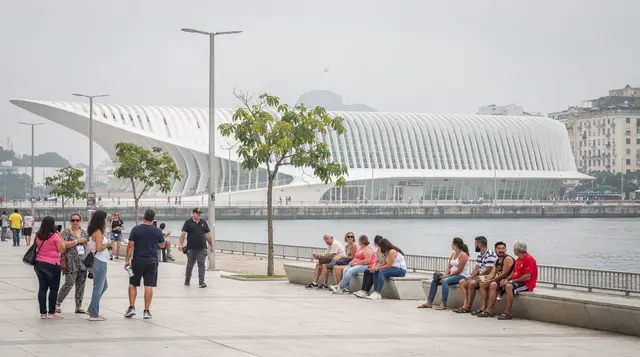
The Museu de Arte do Rio — everyone calls it MAR — occupies the northern edge of Praça Mauá directly across from the Museu do Amanhã, and the pairing of the two is the first thing to understand about visiting either. MAR opened in 2013, two years before its Calatrava-designed neighbor, and it solves a different problem: not a single dramatic new building, but two mismatched existing ones stitched together.
The first is the Palacete Dom João VI, a mid-19th-century eclectic-style palace that served various administrative functions before falling into disrepair; the second is the former Rodoviária do Rio bus terminal, built in 1918, solid and rectilinear where the palace is ornate. Architects Bernardes + Jacobsen connected the two with a single undulating white roof that reads from a distance as one continuous wave — the building’s signature image, and the reason MAR photographs as one striking object even though it’s really two renovated ones held together by a shared idea.
That idea, structurally, is worth knowing before you go in: the roof is walkable. A ramp winds up from the palace side to a rooftop terrace that runs the length of both buildings, and the terrace — not just the galleries below — is a real part of the visit, included on the standard ticket rather than sold separately.
How the galleries are organized
The palace side generally houses the more historic material — colonial and 19th-century painting, period furniture and objects reflecting the building’s own past as an administrative seat — while the former bus terminal’s larger, more industrial floors suit the bigger contemporary installations and photography shows that wouldn’t fit comfortably in the palace’s smaller rooms.
Moving between the two happens on several levels, not just at the ground floor, so it’s worth following the marked route rather than assuming you’ve seen everything after finishing one building — a genuinely easy mistake given how seamlessly the wave roof disguises the seam between old and new. Wall text runs bilingual Portuguese and English throughout, and gallery attendants are generally happy to point out which floor connects to which if the layout gets confusing partway through.
The rooftop
Budget fifteen to twenty minutes at the top even if art isn’t the draw. The terrace opens onto Praça Mauá, the VLT tracks curving below, the cruise terminal, and Guanabara Bay stretching toward Niterói — a genuinely good, unglamorous vantage point that most Rio viewpoint lists skip in favor of Sugarloaf or Christ the Redeemer.
It’s not a substitute for either of those — there’s no beach or forest in frame, and the elevation is a fraction of Corcovado’s — but as a free-with-admission, unhurried spot to sit with a coffee and look at the working port instead of a postcard version of Rio, it earns its place in Best viewpoints in Rio even if it’s the least famous entry on that list.
If the view from the terrace makes you want to get closer to the water, the bay looks quite different from the deck of a boat, and Boat trips on Guanabara Bay compares the options. Anyone who prefers to book ahead can look at a two-hour boat tour of Guanabara Bay, which turns the skyline you just saw from above into a view from below.
The collection
MAR’s holdings run roughly five centuries: colonial-era religious painting and Portuguese court portraiture through to contemporary Brazilian photography, video, and installation work, with a particular strength in work that engages Rio itself — favela life, the port zone’s own transformation, carnival visual culture, the beach as social space.
The permanent collection rotates through temporary thematic shows rather than a fixed hang, so what’s on display changes several times a year; check the current exhibition before a visit if a specific artist or period is the reason you’re going. The museum also runs an active public program — free workshops, talks, and a well-regarded outreach initiative connecting the museum to schools across greater Rio, which is part of why MAR reads less like a tourist stop and more like a working civic institution that happens to be excellent.
Compare this to the two other art-focused stops on this list: Niterói’s MAC is almost entirely about the Niemeyer building itself, with a modest permanent collection inside; MAR is closer to the reverse, a serious, changing collection housed in an architecturally interesting but secondary building.
If you only have time for one art museum in the city, MAR’s collection is the deeper reason to choose it; MAC’s building is the deeper reason to choose that one. Neither substitutes for the other, and a visitor with a genuine interest in Brazilian art and architecture should treat them as complementary rather than either-or — see Niterói Contemporary Art Museum guide for the full guide to making the trip across the bay.
Why MAR sits where it does
MAR’s location on Praça Mauá isn’t incidental — it was one of the first major cultural investments in the Porto Maravilha redevelopment, opening in 2013 specifically to signal that the port zone was becoming a cultural district rather than the mostly industrial, semi-derelict area it had been for decades before an elevated highway (the Perimetral) was demolished and the waterfront reopened to the city.
That history is worth knowing because it’s part of an honest, still-live conversation in Rio about who actually benefits from this kind of redevelopment — Porto Maravilha brought real public investment and new cultural infrastructure to a historically working-class, majority-Black part of the city, while also raising property values and, by some residents’ accounts, changing the character of neighbourhoods like Saúde and Gamboa in ways not everyone welcomes. MAR itself engages this directly through parts of its programming rather than ignoring it, which is one of the more honest things about the institution — worth keeping in mind alongside the more straightforward reasons to visit (the collection, the building, the view).
Hours, tickets, and the day everyone gets wrong
Opening hours. Tuesday through Sunday, galleries open 11am to 6pm (last entry 5pm); the ticket office opens earlier, from 10am. MAR is closed on Mondays, which — unlike the Museu do Amanhã across the square, closed Wednesdays — follows the standard Rio museum pattern. The two buildings on the same square keeping different closing days is exactly the kind of detail worth checking before you plan a single Praça Mauá day around both.
Ticket prices. Full admission is around R$20 (roughly US$4); half-price tickets, around R$10, apply to a standard list of categories — under-21s, 15-29 with a youth ID card, students, teachers, people with disabilities, and Rio residents with proof of address. Entry is free on Tuesdays. Cards only at the ticket desk; MAR does not accept cash.
Address and getting there. Praça Mauá 5, Centro, immediately beside the Museu do Amanhã. The VLT’s Praça Mauá stop is the easiest approach; on foot it’s 15-20 minutes from Centro Histórico or a short ride from Lapa. See Getting around Rio de Janeiro for the wider transport picture and Rio metro guide for the nearest stations, roughly 20 minutes on foot.
The education program, and why it matters to a visitor
MAR runs one of the more substantial museum education programs in Brazil, bringing school groups from across greater Rio — including from favelas and outlying neighbourhoods with little other access to art institutions — into the museum on a regular basis through the school year, alongside teacher training and community workshops that run independently of the exhibition calendar.
It’s mentioned here not as trivia but because it shapes what a visit actually feels like: MAR is frequently full of Brazilian schoolchildren on a weekday visit, engaged with the collection in a way that reads as substantive rather than a field-trip formality, and it’s a useful, grounding contrast to the more purely tourist-facing museums elsewhere in the city. If a quiet, empty-gallery experience is what you’re after, a weekday morning right at opening, before school groups typically arrive, is the better window.
The neighborhood MAR sits in
Praça Mauá anchors Porto Maravilha, the redeveloped port zone that replaced an elevated highway with the VLT line, new plazas, and a cluster of cultural buildings over the 2010s.
It’s worth understanding this isn’t a standalone “museum district” — walk two minutes further along the waterfront and you’re at the Kobra mural on Boulevard Olímpico (covered in Street art in Rio), and a few streets inland is the Valongo Wharf, the archaeological site at the center of Afro-Brazilian heritage in Rio — the same ground where, in the 19th century, hundreds of thousands of enslaved Africans were landed.
MAR itself addresses this history in parts of its collection and programming, but the wharf and the memorial sites nearby deserve their own unhurried visit rather than a rushed add-on to a museum afternoon; treat them as a separate stop, not a five-minute detour.
Visitors who would rather have the redevelopment story explained than piece it together alone can join a guided walk through the port zone that links the Olympic Boulevard, the Museu do Amanhã and the historic downtown, which fits neatly around a MAR visit and adds the context a museum label can’t.
For food after the museum, What to eat in Rio de Janeiro and The markets of Rio cover options in and around Centro; the port zone itself has a growing but still modest café and restaurant scene compared to Copacabana or Botafogo.
Beyond food, the wider Porto Maravilha area rewards a slower pace than most visitors give it. The VLT itself is worth riding a stop or two beyond the museum simply to see how the redevelopment reshaped what used to be an elevated highway corridor into an open, walkable waterfront — a genuinely unusual piece of urban planning to see in person for anyone interested in cities as much as museums. Combine that with the archaeological and memorial sites a short walk inland, and a single Praça Mauá afternoon can end up covering considerably more ground, historically and physically, than the museum ticket alone suggests.
Planning it into a day
MAR pairs most naturally with the Museu do Amanhã directly across the square — buy both tickets in one trip and expect a combined three to four hours between the two if you take both seriously, less if you’re moving quickly through one. It also works as the cultural half of a Centro Histórico walking guide day, bookending a morning of Paço Imperial, Travessa do Comércio, and Confeitaria Colombo with an afternoon on Praça Mauá.
Families deciding how to spend limited museum time with kids should see Rio de Janeiro with kids — MAR’s rotating contemporary shows are hit-or-miss for younger children compared to the more interactive Museu do Amanhã next door. For a longer stay, Rio de Janeiro in five days and Rio de Janeiro in seven days both have room for a full Porto Maravilha day without crowding out the beaches and viewpoints most visitors prioritize first.
Buying tickets and skipping the line
Tickets are sold at the on-site desk with cards only, and the ticket office opens an hour before the galleries at 10am, giving a genuine window to buy and be first through the doors at 11am on a day you want the quietest possible visit. There’s no advance online booking system for standard admission in the way some larger international museums use, so arriving slightly before opening on a Tuesday (free entry, the busiest day) is the closest thing to a queue-avoidance strategy MAR offers.
MAR versus a beach day — an honest trade-off
On a short Rio trip, an afternoon at MAR competes directly with time that could go toward Copacabana or Ipanema, and it’s worth being honest about that trade-off rather than treating every attraction as automatically worth the time. Visitors with a genuine interest in Brazilian art, architecture, or the Porto Maravilha redevelopment story get real value here that a beach afternoon doesn’t replace.
Visitors on a first, short trip whose main goal is the beaches, Christ the Redeemer, and Sugarloaf can reasonably treat MAR as a stop for a return visit or a longer stay rather than a must-do on day one or two — see How many days do you need in Rio de Janeiro? for how these trade-offs generally shake out.
What sets MAR apart from a typical city art museum
Two things make MAR worth the specific trip rather than a generic “there’s an art museum” checkbox: the free-with-admission rooftop terrace, genuinely one of the better unglamorous viewpoints in the city, and the active education program that makes the museum feel like a working civic institution rather than a static collection. Few museums anywhere combine a serious, changing exhibition program with this level of community engagement and a view over a working port — it’s part of why MAR earns its place on Best viewpoints in Rio despite being the least famous entry on that list, and why a repeat visitor often finds something different on a second trip even without a new temporary exhibition.
Frequently asked questions about the Museu de Arte do Rio
Is MAR the same as the Museu do Amanhã?
No — different buildings, different institutions, different subjects, sitting across the same square. MAR is an art museum in a converted colonial palace and bus terminal; the Museu do Amanhã is a science museum in a purpose-built structure. See Museu do Amanhã guide for the comparison.
Can I visit the rooftop without buying a full ticket?
No — the rooftop terrace is accessed via the museum’s internal ramp and is included with, not separate from, general admission.
How long should I budget for MAR?
Ninety minutes covers the galleries and rooftop at a reasonable pace; two hours if a temporary exhibition particularly interests you or you’re taking photos from the terrace at length.
Is MAR good for kids?
Reasonably, though the collection skews toward contemporary and conceptual work that’s less immediately engaging for younger children than the Museu do Amanhã’s interactive halls next door. Check the museum’s current program for family workshops, which run periodically.
Does MAR ever host free events?
Yes — free public programming (talks, workshops, occasional evening events) runs through the year alongside the ticketed exhibitions; check MAR’s own site for the current calendar rather than assuming a fixed schedule.
Is the area around MAR safe to walk after dark?
Porto Maravilha is well-lit and patrolled by day and early evening, with steady foot traffic near the VLT stops; like most of central Rio, it thins out later at night. See Rio de Janeiro safety guide for general guidance on timing evening walks in Centro.
What’s the best time of day to visit MAR?
Weekday mornings shortly after the ticket office opens at 10am tend to be quietest, before school groups arrive in larger numbers and before the museum’s own busier midday and afternoon hours; Tuesdays are the busiest day overall given free entry, so plan around that if a quiet visit matters more than a free one.
Is there parking near MAR?
Street parking in Porto Maravilha is limited and metered; a paid garage exists nearby, but arriving by VLT or rideshare is simpler than driving — see Uber and taxis in Rio for typical fares from Zona Sul.
Does MAR have a café or restaurant?
Yes, a café operates within the complex with seating that takes advantage of the same views as the rooftop terrace — a reasonable stop for a light lunch or coffee break partway through a Porto Maravilha day rather than needing to leave the site to eat.
Is photography allowed inside the galleries?
Generally yes for personal, non-flash photography, though specific temporary exhibitions occasionally restrict it depending on loan conditions from lending institutions or artists; signage at the entrance to each gallery will note any exhibition-specific rules.
Is MAR wheelchair accessible?
Yes — the ramp connecting the ground floor to the rooftop terrace also serves as the building’s main accessible route between levels, and both buildings have step-free access from the square; contact the museum ahead of a visit with specific mobility needs.
What language are the guided tours in, if any offered?
MAR occasionally runs docent-led tours in Portuguese, with English availability varying by day and season; check at the ticket desk on arrival, since self-guided visits with the bilingual wall text are the reliable default rather than assuming a guided option will be running.
How does MAR handle Rio’s Afro-Brazilian and favela history in its collection?
Directly, in parts of its permanent holdings and temporary programming — favela life and Black Brazilian visual culture are recurring subjects rather than a token inclusion, consistent with the museum’s broader civic, education-first approach. For the fuller historical picture beyond the museum’s collection, see Afro-Brazilian heritage in Rio.
Is MAR a good stop for someone with only a casual interest in art?
Yes — the building and rooftop alone justify the visit even for someone who doesn’t typically seek out art museums, and the collection’s strong focus on Rio itself as subject matter makes it more accessible than a purely academic survey of art history would be.
Is there a discount for buying tickets to MAR and Museu do Amanhã together?
Combined or bundled tickets have been offered periodically as promotions between the two Praça Mauá museums, but it isn’t a permanent, guaranteed feature — check at either ticket desk on the day rather than assuming a bundle exists, and budget for two separate admissions if none is currently running.
What’s the fastest way to reach MAR from Copacabana or Ipanema?
A taxi or rideshare from Zona Sul typically runs 25-40 minutes depending on traffic; the VLT and metro combination is cheaper but involves at least one transfer. See Getting around Rio de Janeiro for the comparative options and Uber and taxis in Rio for typical fares on this specific route.
How does MAR fit into a longer Rio itinerary beyond a single day?
On a week-long trip, MAR pairs naturally with a broader Centro and Porto Maravilha exploration spread across two half-days rather than one rushed afternoon — one day for the museums and rooftop, a separate day for the Valongo Wharf, Pedra do Sal, and the wider Little Africa district, each given the unhurried attention both deserve.
tours.culture-museums
Verified deep-linked GetYourGuide tours. Book through these links and we earn a small commission at no cost to you.
Rio: Boulevard Olímpico, Museu do Amanhã e Tour Histórico

Rio’s Best_Corcovado, Sugar Loaf, Selaron, Cathedral and more
Rio de Janeiro: Marine Aquarium Entry Tickets
Photos show the destination, not the operator's own pictures.