
Museu do Amanhã guide — what it actually is, and is it worth it
What is the Museu do Amanhã, and is it worth visiting?
It's a science museum about possible human futures — climate, biodiversity, technology, the cosmos — not a Rio history museum, despite the striking Calatrava building on Praça Mauá making it look like one from outside. It's worth two to three hours for anyone curious about science communication done well; skip it if you're purely after Rio's colonial or carnival history, which live elsewhere.
| Where | Praça Mauá 1, Centro Histórico |
| Hours | Thursday-Tuesday, 10am-6pm (last entry 5pm); closed Wednesday |
| Cost | Around R$30 full price, R$15 half-price, free on Tuesdays |
| Time needed | 90 minutes minimum, 2-3 hours reading and watching the films |
| Best for | Ages 8+; science communication, not Rio history |
Calatrava’s building gets photographed more than it gets understood
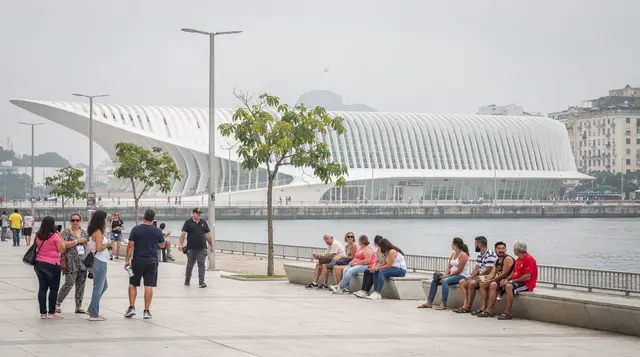
The Museu do Amanhã sits at the tip of Praça Mauá like something that landed there rather than something that was built — a long white skeleton of steel and concrete, ribbed like a whale or a turbine housing depending who you ask, with a set of moving solar-tracking wings (brises) along its spine and a reflecting pool wrapping the base that visibly changes with the tide of Guanabara Bay.
It was designed by the Spanish architect Santiago Calatrava and opened in December 2015, the anchor project of the Porto Maravilha redevelopment that also brought the VLT light rail, the Museu de Arte do Rio across the square, and the Boulevard Olímpico murals a short walk north.
Most visitors arrive having seen the building in a photo and assume it’s a maritime museum, a science-fiction pavilion, or some kind of Rio 2016 leftover. It’s none of those. It’s a museum about the futures the human species could plausibly build, structured as a walk through deep time, current planetary pressure, and the choices still open — genuinely a science museum, with an environmental and ethical spine rather than a nostalgic or triumphalist one.
That distinction matters for deciding whether to go. If you came to Rio for colonial architecture, carnival history, or Afro-Brazilian heritage, the Museu do Amanhã won’t scratch that itch — for that, Centro Histórico walking guide and Afro-Brazilian heritage in Rio, both a few minutes’ walk from here, are the better use of the same afternoon. If you’re curious how a science museum translates climate models and cosmology into something a twelve-year-old and a retired engineer can both follow, this is one of the better attempts anywhere, and it earns the two to three hours it asks for.
Why the building itself is part of the argument
It’s worth spending five minutes outside before going in, because Calatrava built the museum’s central idea into its engineering rather than leaving it to the exhibits alone. The structure cantilevers 75 metres out over the water on Praça Mauá’s pier, a genuine feat that required sinking new foundations into the bay bed rather than simply extending the existing waterfront. The mobile brises — the moving fin-like panels along the roofline that most photos catch mid-motion — aren’t purely decorative: they track the sun through the day, shading the glass beneath them and cutting the cooling load a building this size would otherwise need in Rio’s climate.
The reflecting pool at the base draws water directly from Guanabara Bay and is used, filtered, in the building’s cooling system rather than treated municipal water, and rainwater collection supplements it further. None of this is explained in detail inside the exhibition itself, so it’s worth knowing before you arrive: the building is functioning, in a small way, as a demonstration of the same sustainability questions the exhibits raise — proof-of-concept alongside argument, not just a striking shell around an unrelated set of galleries.
If the reflecting pool and the cantilever make you curious about the bay they sit on, seeing the building from the water gives a different sense of its scale than the plaza does. Guanabara Bay boat trips are covered in their own guide, and a shared catamaran sailing tour on the bay is one easy way to see the waterfront skyline from a distance, as a complement to the visit rather than a replacement for it.
What’s actually inside
The exhibition is organized as five connected halls, walked in sequence rather than browsed freely, which is unusual for a museum and worth knowing before you arrive so you don’t try to skip ahead.
Cosmos. The opening hall is dark, planetarium-adjacent, and covers 13.8 billion years of cosmic and biological history in about fifteen minutes — the Big Bang, the formation of Earth, the emergence of life — using projection rather than static panels. It’s the most cinematic room and the one most people photograph, though phones struggle in the low light.
Earth. The second hall gets specific: current data on biodiversity loss, resource consumption, and the Anthropocene, presented with large interactive globes and real-time data visualizations rather than text panels. This is the room that occasionally frustrates visitors expecting a gentler museum — the numbers on species loss and carbon are presented plainly, not softened.
Anthropocene. A hall built around the idea that humans are now a geological force, with displays on urbanization, technology, and the choices that got the planet here.
Tomorrows (Amanhãs). The exhibition’s actual argument, plural by design: four possible future scenarios — Excess, Rupture, Withdrawal, Transformation — mapped against different collective choices about resource use and cooperation, not a single predicted future. This is the hall the museum’s name actually refers to.
Us. The closing hall is quieter and more reflective, ending on questions rather than answers — what kind of future a visitor personally wants to help build, framed without a hard sell.
Budget 90 minutes minimum, two to three hours if you read exhibit text and watch the short films in each hall rather than skimming. Family groups with younger children often move faster through Cosmos and Earth and linger longer in the more hands-on Anthropocene displays.
Temporary exhibitions and events
Beyond the five permanent halls, the museum runs a rotating program of temporary exhibitions in a dedicated space near the entrance — past editions have covered subjects from artificial intelligence to the deep ocean to specific artists working at the intersection of science and design, and current temporary content is generally included in the standard admission price rather than ticketed separately, though this occasionally varies for major touring shows.
The museum also hosts evening events, talks, and screenings through the year, occasionally extending hours beyond the standard 6pm close; check the current calendar if you want more than the standard daytime visit, particularly around specific dates like World Environment Day or the museum’s own anniversary in December, when special programming is more likely.
Hours, tickets, and the one thing that trips people up
A guided Boulevard Olímpico and Museu do Amanhã walking tour bundles the museum with the Kobra mural and a downtown history overview if you’d rather have a guide narrate the port zone’s transformation than read wall text alone — worth it for a first visit if you’re short on time and want the Porto Maravilha context in one go, unnecessary if you’re happy reading at your own pace.
Opening hours. The museum runs Thursday through Tuesday, 10am to 6pm, with last entry at 5pm — the closing day is Wednesday, not Monday, which is the opposite of almost every other museum in Rio and the single detail visitors most often get wrong when planning a day around several museums. Double-check the current calendar before building a Wednesday itinerary around Praça Mauá.
Ticket prices. Full admission runs roughly R$30 (about US$5-6); half-price tickets (students, teachers, over-60s, and a few other categories with ID) run about R$15. Entry is free on Tuesdays, which makes Tuesday the single busiest day at the museum by a wide margin — go early if free entry is the plan, or accept the queue. Prices and the free-day policy do shift, so confirm current terms on the museum’s own site before you go rather than assuming a number from a year-old blog post.
Address and how to get there. Praça Mauá 1, Centro. The VLT light rail’s Praça Mauá stop drops you at the front door; it’s also a 15-20 minute walk from Centro Histórico or a short Uber from Lapa or Santa Teresa. There’s no dedicated metro stop at the museum itself — the nearest metro is Uruguaiana or Carioca, both roughly 20 minutes on foot or a five-minute ride away; see Rio metro guide for the full system map.
Practical details worth knowing before you queue
Timed-entry slots aren’t required, but arriving right at opening or in the hour before closing gives noticeably shorter lines than the midday peak, particularly on the free Tuesday and during Brazilian school holidays. Bags above a certain size go through a locker system near the entrance, similar to most major museums; there’s no need to arrive empty-handed, just budget an extra few minutes for the check-in.
A small gift shop near the exit sells science- and sustainability-themed items rather than generic Rio souvenirs, worth a look if that’s more your interest than another Christ the Redeemer keychain. Restrooms and water fountains are available throughout, useful given how much of the visit involves standing and reading rather than sitting.
Who should actually go, and who can skip it
The museum rewards visitors who like science communication and don’t need Rio-specific content to feel their time was well spent — it would work almost identically in any city, which is either a strength or a mild disappointment depending on what you came for. Families with kids roughly eight and up tend to do well here; younger children can find the Earth hall’s data-heavy screens dull.
Visitors on a tight one- or two-day Rio itinerary who have to choose between this and Christ the Redeemer or a first swim at Copacabana should probably choose the beach and the statue — see How many days do you need in Rio de Janeiro? and Rio de Janeiro in three days for how the trade-offs usually shake out on a short trip.
Pair it sensibly rather than as a standalone outing: Museu de Arte do Rio (MAR) guide sits directly across the square and can be added on the same ticket-buying trip without much extra walking, and the Kobra mural covered in Street art in Rio is five minutes north along the boulevard. Combine all three with lunch in the port zone and it’s a full, coherent afternoon rather than three separate trips into Centro.
If a striking piece of architecture is what draws you, the same appetite can be fed across the bay: the Niterói Contemporary Art Museum is the other building people photograph for its shape, and a Niterói outing combining the contemporary art museum with paragliding in the city park pairs well with a Porto Maravilha day on a longer trip. See also the Niterói day trip guide for planning.
What the museum is not
Worth stating plainly, since the building’s appearance sets expectations the content doesn’t match: it is not an aquarium (that’s AquaRio, a separate attraction nearby), not a Rio history museum, and not primarily about carnival, samba, or Afro-Brazilian heritage — the museum most directly answering that need is Afro-Brazilian heritage in Rio, covering the Valongo Wharf a few streets away. It’s also not a hands-on science center aimed at very young children in the way a dedicated kids’ science museum would be — see Rio de Janeiro with kids for age-appropriate alternatives if traveling with a family whose youngest is under seven.
It’s also worth being clear about what the museum is not trying to do: it doesn’t predict a single future, doesn’t advocate for one political or economic system over another, and doesn’t end on either blanket optimism or despair. Visitors expecting a straightforward “the future will be great” tech-showcase experience, or conversely a purely alarmist climate exhibit, will find the actual tone more measured than either — deliberately so, given the museum’s stated aim of laying out possibilities rather than a verdict.
Museu do Amanhã versus a headline sight, honestly
On a tight one- or two-day trip, the museum competes for time against Christ the Redeemer, Sugarloaf, and a first beach day — and for most first-time visitors, those three should win that competition. The museum earns its slot more clearly on trips of three days or longer, when there’s genuine room for a Porto Maravilha afternoon alongside the headline sights rather than instead of them. It’s worth being direct about this trade-off rather than treating every well-reviewed attraction as automatically worth a scarce half-day.
What a first-time visitor tends to underestimate
Two things surprise first-time visitors most: how much of the “future” content is actually about the Earth’s current state rather than speculative technology, and how long the sequential, single-path layout actually takes if you engage with each hall properly rather than skimming toward the exit. Budgeting the full two to three hours rather than the bare 90-minute minimum makes a real difference to how the museum’s cumulative argument lands — visitors who rush through report a noticeably shallower experience than those who give each hall its due time, particularly the Tomorrows hall where the museum’s actual thesis comes together.
Pairing it with a food stop in the port zone
The port zone’s café and restaurant scene has grown alongside the Porto Maravilha redevelopment but remains modest compared to Copacabana or Botafogo — reasonable for a coffee or a light lunch near the museum’s own café, but worth planning a proper meal for afterward in Centro Histórico or Lapa rather than expecting a wide choice immediately around Praça Mauá. See What to eat in Rio de Janeiro for the wider picture of where Rio’s food actually is.
Frequently asked questions about the Museu do Amanhã
Is the Museu do Amanhã worth visiting if I only have one day in Rio?
Probably not on a true one-day trip — Christ the Redeemer, Sugarloaf, and a beach block out most of a single day already. It earns a slot on trips of three days or longer, ideally paired with the rest of Porto Maravilha.
Is there an English audio guide or English exhibit text?
Exhibit panels are bilingual Portuguese/English throughout, and an audio guide is available at the entrance for an additional small fee; confirm current language options when buying tickets, as offerings occasionally change.
Does the museum get crowded?
Tuesdays (free entry) and school holiday periods are the busiest; a Thursday or Friday morning shortly after opening is typically the quietest window.
Is it wheelchair accessible?
Yes — the building was designed with step-free routes throughout the main exhibition halls, and accessible restrooms are available; contact the museum directly ahead of a visit with specific mobility needs.
Is there a café or restaurant inside?
Yes, a café near the entrance with light meals and drinks, plus outdoor seating along the reflecting pool that’s pleasant even for visitors who skip the exhibition.
Can I just photograph the building without paying for entry?
Yes — the exterior and the plaza around the reflecting pool are public space and free to walk, photograph, and sit in at any hour; only the exhibition halls require a ticket.
How does it compare to the Museu de Arte do Rio across the square?
Different subject entirely — MAR is an art museum covering centuries of Brazilian visual art in a converted colonial palace and 1918 bus terminal; Museu do Amanhã is a science museum about the future in a purpose-built Calatrava structure. See Museu de Arte do Rio (MAR) guide for the comparison in full.
Can I visit the museum’s temporary exhibition without seeing the permanent halls?
Standard admission covers both, and the exhibition is designed as a single sequential walk, so most visitors see the permanent halls and any current temporary show in one continuous visit rather than choosing between them.
Is the museum name a translation issue — “tomorrow” versus “tomorrows”?
Not a translation issue, a deliberate choice: the Portuguese name uses the plural amanhãs — “tomorrows” — reflecting the museum’s core argument that multiple futures remain genuinely open rather than one fixed outcome being predicted. The English name “Museum of Tomorrow” flattens that plural slightly, which is worth knowing if the distinction matters to how you read the exhibition.
Is it near the cruise terminal?
Yes — Praça Mauá sits directly beside Rio’s cruise ship terminal, which makes the museum one of the most convenient stops for anyone in port for a single day; combine it with the MAR and the Kobra mural for a full port-day itinerary without needing transport beyond the VLT.
What’s the museum’s own recommended visit order?
Follow the halls in sequence — Cosmos, Earth, Anthropocene, Tomorrows, Us — since the exhibition’s argument is built cumulatively and loses coherence if halls are skipped or taken out of order. If short on time, it’s better to walk faster through all five than to skip one entirely.
Why does the building move?
The fin-like brises along the roofline track the sun through the day as a passive cooling measure, shading the glass beneath rather than relying purely on air conditioning to manage heat gain in Rio’s climate — a functioning part of the building’s engineering, not a purely decorative gesture.
Is the museum’s content politically or scientifically controversial?
The exhibits present mainstream climate science and biodiversity data plainly, without the softened framing some general-audience science museums use — a handful of visitors expecting a purely celebratory or neutral experience have found the Earth and Anthropocene halls more direct than anticipated. It reflects scientific consensus rather than staking out an unusual position.
Does the museum offer any discount combining it with other Porto Maravilha attractions?
Combined tickets covering the museum alongside AquaRio or other nearby attractions have been offered periodically as promotions; check current options at the ticket desk or the museum’s own site, since bundled pricing isn’t a permanent, guaranteed feature.
Is there a good spot for photos of the building’s exterior?
The reflecting pool at the base gives the classic symmetrical shot, especially in the early morning or late afternoon when the light rakes across the ribbed structure and the moving brises; the Boulevard Olímpico side, walking toward the Kobra mural, gives a different angle showing the full 75-metre cantilever over the water. Both are public space and accessible without a ticket at any hour.
How does the museum handle groups and school visits — will it feel crowded with children?
Weekday mornings often include Brazilian school groups as part of the museum’s active education programming, similar in spirit to MAR’s own outreach work — it doesn’t typically overwhelm the space, but a visitor prioritising a quiet, adult-paced visit may prefer a weekday afternoon or the quieter hour just before the 6pm close instead.
Is the audio guide worth the extra fee?
For a first visit to a hall as visually dense as Cosmos or Earth, the audio guide adds useful context beyond the bilingual wall text, particularly for visitors who want more than the surface-level takeaway from each hall. It’s optional rather than essential — the exhibit text alone is thorough enough for most visitors to follow the argument without it.
Does the museum change its content over time, or is it fixed since 2015?
The five permanent halls have stayed largely consistent since opening, with data and specific displays periodically updated to reflect newer research, alongside the separately rotating temporary exhibition space near the entrance — so a repeat visitor years apart will recognize the core structure while still finding some content refreshed.
tours.culture-museums
Verified deep-linked GetYourGuide tours. Book through these links and we earn a small commission at no cost to you.
Rio: Boulevard Olímpico, Museu do Amanhã e Tour Histórico

Rio’s Best_Corcovado, Sugar Loaf, Selaron, Cathedral and more
Rio de Janeiro: Marine Aquarium Entry Tickets
Photos show the destination, not the operator's own pictures.