
Cycling in Rio — the beachfront ciclovia, the lagoon loop, and Sunday's closed roads
Is cycling a good way to get around Rio?
Yes, along the coast specifically — Rio has a well-built, mostly protected beachfront ciclovia running from Leblon through Copacabana and beyond, plus a flat, scenic loop around the Rodrigo de Freitas lagoon. A bike-share system (Bike Itaú) covers Zona Sul cheaply, and on Sunday mornings the Avenida Atlântica closes to cars entirely for pedestrians and cyclists.
A city built for a bike along the water
Visitors arriving expecting Rio’s famous hills to make cycling impractical are usually surprised by how much of the city that actually matters for a short visit is completely flat. The mountains ring the city and separate its neighbourhoods, but the beachfront strip itself — where most visitors spend the bulk of their time — sits at sea level for its entire length, and the ride from one end of Zona Sul to the other barely registers any elevation change at all.
Rio’s geography — a narrow strip of flat beachfront squeezed between ocean and mountain — happens to suit cycling extremely well, and the city has built a genuinely good protected path system along that strip. This isn’t a guide about mountain biking Rio’s hills (that exists too, and is covered below) but primarily about the flat, scenic, low-effort riding most visitors actually want: the beachfront ciclovia, the lagoon loop, and the once-a-week window when one of the city’s busiest roads shuts to cars entirely.
| Best for | Beachfront ciclovia, lagoon loop (both flat) |
| Bike share | Bike Itaú, around R$10-15/day pass |
| Kiosk rental | Around R$25-40 for a couple of hours |
| Sunday bonus | Avenida Atlântica closed to cars, free |
| Best time | Early morning, before roughly 9am |
The beachfront ciclovia
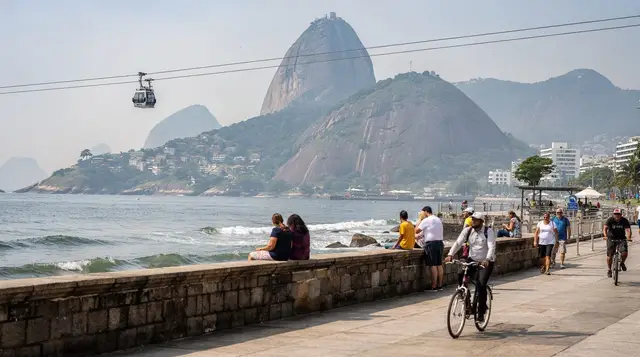
A protected, mostly separated bike path runs along the sand-side edge of Rio’s Zona Sul beaches, connecting Leblon, Ipanema, Arpoador, and Copacabana in a single continuous ride of roughly 8-10km one way, with further extensions reaching toward Botafogo and Flamengo on the bay side.
It’s flat, well-signed, and busy — shared with joggers, other cyclists, and skaters — so this is a cruising ride at a moderate pace rather than a training ride, but it delivers a genuinely excellent, uninterrupted view of the ocean and the neighbourhoods it runs beside for its entire length. Riding the full stretch end to end, with stops, is a comfortable half-day.
a guided bike tour covering Botafogo, Flamengo, and the lagoon is a good option for a first ride if you’d rather have route guidance and local context than navigate the full ciclovia network solo.
The lagoon loop
Lagoa Rodrigo de Freitas has its own paved perimeter path, roughly 7.5km around, entirely flat and largely separated from car traffic — arguably the single most pleasant short ride in the city, framed by Christ the Redeemer rising directly over the water and passing several kiosks and cafés worth a stop along the way. This loop connects directly to the beachfront ciclovia near Ipanema, so a rider based in Zona Sul can string the two together into one longer route without backtracking. See Kayaking and SUP in Rio for the same lagoon from the water rather than the path around it.
Bike Itaú — the bike-share system
Rio’s public bike-share system, Bike Itaú, has stations spread across Zona Sul and parts of Centro, with bikes unlocked through an app for a per-ride or day-pass fee — genuinely one of the cheapest ways to cover ground in the city, at roughly R$10-15 for a day pass covering rides up to a set duration each (commonly an hour) before a small extra charge kicks in.
It’s a solid option for a single ciclovia ride or the lagoon loop without committing to a rental for a full day, though station availability can be inconsistent at peak times — a station with no docked bikes, or no free dock to return one, isn’t unusual on a busy Sunday. A private rental from a beachfront kiosk, with no station-hunting required, is the more reliable option if your plans are time-sensitive.
Sunday morning — Avenida Atlântica closes to cars
Every Sunday, a significant stretch of Avenida Atlântica, Copacabana’s beachfront avenue, closes to car traffic for the morning, opening the full width of the road to cyclists, runners, and pedestrians alongside the existing ciclovia. This is one of Rio’s genuinely great free experiences — an entire major avenue, normally thick with traffic, turned over to people on foot and on bikes, with local families, joggers, and cyclists of every age filling the road end to end.
It’s worth timing a Zona Sul cycling day specifically around this closure if your visit includes a Sunday; see Sunday on the Avenida Atlântica for more on what the morning actually looks like beyond the cycling angle, and What cariocas actually do on Sunday for the wider Sunday routine Cariocas actually follow.
Guided bike tours beyond the beachfront
Not every good ride in Rio is flat and coastal. Tijuca National Park has forested trails suited to a guided mountain-bike-style ride through genuine rainforest, a completely different experience from the ciclovia’s ocean views.
a jungle bike tour through Tijuca forest covers this, riding shaded forest track rather than beachfront pavement, with waterfalls and dense canopy standing in for the ocean views of the coastal routes.
A different guided option climbs toward Christ the Redeemer itself by bike rather than cog train or van, a genuinely demanding but rewarding route for a fitter rider.
a guided Christ the Redeemer bike tour tackles this climb with a guide managing the route and traffic — significantly more physically demanding than the flat coastal rides above, and worth being honest with yourself about your fitness level before booking rather than assuming any bike tour in Rio is a leisurely cruise.
For visitors who want a broader introduction covering multiple neighbourhoods in one outing, guided small-group bike tours typically combine the beachfront, the lagoon, and a stretch of Centro or Flamengo Park into a single half-day ride with a local guide providing context along the way — worth comparing against the Botafogo-Flamengo-lagoon tour above if you want a wider loop than that route alone covers.
Bike types and what suits which ride
Beachfront kiosks generally stock simple city or cruiser bikes — upright position, single or a few gears, built for comfort rather than speed, which suits the flat ciclovia and lagoon loop perfectly well. If you’re planning the Tijuca forest ride or the Christ the Redeemer climb, confirm with the tour operator that a geared bike suited to the terrain is provided — a cruiser bike is the wrong tool for a sustained hill climb or an unpaved forest trail, and a good operator will already have matched equipment to route, but it’s worth a direct question if you have any doubt.
Electric-assist bikes have started appearing at some rental points and guided tours, worth asking about specifically if a hill climb or a longer combined route (beachfront plus lagoon plus a Centro detour) sounds appealing but you’d rather not arrive everywhere sweating.
an e-bike tour running from the historic center to Ipanema covers a genuinely different stretch of the city than the beachfront-only rides above — Centro’s colonial-era streets, the port district, and a long coastal run home, with the electric assist making the distance and any hills manageable regardless of fitness level.
Rental cost and where to rent
Independent bike rental at beachfront kiosks (common along Copacabana and Ipanema) runs roughly R$25-40 for a couple of hours, or a flat day rate around R$60-80, cash or card depending on the kiosk. No ID deposit is unusual to be asked for at the more casual sand-side stands; a credit-card hold is more typical at established rental shops. Bike Itaú, described above, is the cheaper option for shorter single rides if you’re comfortable with the app and station system.
Safety on the ciclovia
The path itself is protected from car traffic for most of its length, which removes the biggest risk factor found in most cities’ cycling — but it’s shared, busy infrastructure, and pedestrians, joggers, and slower cyclists cross or drift into the bike lane constantly, especially near beach access points and kiosks. Riding at a moderate, attentive pace rather than treating the ciclovia as a training route is both more pleasant and safer.
Standard city cycling caution applies at the road crossings where the ciclovia intersects side streets — Brazilian drivers don’t reliably yield to cyclists at these points, so treat every crossing as your responsibility to check rather than assuming right of way. See Rio de Janeiro safety guide for the wider safety picture, including keeping a phone secured rather than held while riding — a moving target is an easier grab than one on a stationary towel.
Best time to ride
Early morning, before roughly 9am, is meaningfully cooler and less crowded than the rest of the day, and is when most locals do their own cycling — worth matching that pattern rather than riding in the full heat of a Rio afternoon. See Best time to visit Rio de Janeiro and Rio in summer for the broader seasonal heat and rain pattern that affects when a longer ride is comfortable versus miserable.
What to bring on a ride
Sunscreen matters more on a bike than on foot — the moving air makes the sun feel less intense than it actually is, and a two-hour ride along the exposed beachfront delivers a lot more sun exposure than the breeze suggests. A refillable water bottle beats buying repeatedly from beach kiosks along the way, though those kiosks are frequent enough that running out isn’t a real risk on the coastal routes.
A phone mount isn’t standard on rental bikes, so plan to keep your phone in a secured pocket rather than trying to navigate while riding — the ciclovia’s signage is generally good enough that you shouldn’t need constant map-checking on the main coastal stretch. For the forest or Christ the Redeemer climbs specifically, closed-toe athletic shoes are worth wearing over sandals, given the terrain and effort involved.
What a bad day on the ciclovia actually looks like
Worth naming honestly rather than only describing the good version: a bad ride here is usually a crowding problem, not a danger problem. Weekend late-mornings see the path genuinely congested near beach access points, with joggers, skaters, dog-walkers, and slower riders all sharing the same narrow strip — patience matters more than speed on those stretches.
A punctured tyre far from a rental kiosk is the other common annoyance; sticking to the well-trafficked main ciclovia rather than side detours keeps you within easy reach of help or another rental point. Neither of these is a reason to skip cycling in Rio — they’re simply the realistic downside of riding one of the city’s most popular pieces of shared infrastructure, and both are easily avoided by riding earlier in the day, as recommended above.
Rio’s cycling culture beyond the tourist routes
Cycling is a genuine part of Carioca daily life, not just a tourist activity bolted onto the beach — locals commute, exercise, and socialize on these same paths every single day, particularly early morning and around sunset. Riding the ciclovia at a normal hour puts you among actual Rio residents doing their regular routine rather than in a tourist-only bubble, which is part of what makes it a worthwhile way to spend a morning even for visitors who wouldn’t otherwise think of themselves as cyclists.
Weekend mornings in particular see a noticeably wider mix of riders — families with kids on training wheels, serious road cyclists doing repeat lagoon laps before the heat builds, and casual riders out for exactly the kind of unhurried cruise this guide describes.
Combining cycling with the rest of Zona Sul
A ciclovia ride naturally breaks up into stops — a coconut water at a beach kiosk, a pause at Arpoador to watch the surf covered in Surfing in Rio, or a detour inland to one of the viewpoints in Best viewpoints in Rio if you’re willing to walk a bike up a short stretch. It’s a genuinely good half-day activity precisely because it isn’t a single destination but a way of moving through several of them at once.
Frequently asked questions about cycling in Rio
Do I need to book a guided tour, or can I just rent a bike and ride the ciclovia myself?
Independent riding on the ciclovia is straightforward — well-signed, flat, and hard to get lost on given it mostly hugs the coastline. A guided tour adds context and route planning but isn’t necessary for the basic beachfront or lagoon rides.
Is the Bike Itaú app in English?
The app generally supports English alongside Portuguese, though station-level information can be inconsistent. A private kiosk rental is the simpler option if app friction is a concern.
How fit do I need to be for the Christ the Redeemer bike tour?
Genuinely fit — this is a sustained climb, not a flat cruise, and is a different category of difficulty from the beachfront or lagoon rides. Confirm the route profile with the operator if you’re unsure of your own fitness for it.
Is cycling at night safe on the ciclovia?
The path is lit along most of its length, but as with most outdoor activity in Rio, it’s quieter and less supervised after dark — daytime riding is the more comfortable default, especially for a first visit.
What’s the best single ride for a first-time visitor with limited time?
The lagoon loop, for its combination of scenery, flat terrain, and manageable length — under an hour at a relaxed pace, with the option to extend onto the beachfront ciclovia if time allows.
Does the Sunday road closure affect the whole beachfront or just Copacabana?
Primarily the Avenida Atlântica stretch through Copacabana, though similar closures and heavy cycling and pedestrian use extend along other Zona Sul beachfront roads on Sunday mornings as well — check current signage on the day, since exact closure boundaries can shift.
Can I combine a bike ride with the lagoon’s kayak or SUP rentals?
Yes — the lagoon’s kiosks rent both bikes and paddling equipment in the same area, making it easy to do one after the other. See Kayaking and SUP in Rio for that half of the pairing.
Are e-bikes worth the extra cost over a standard rental?
For a longer combined route or the Christ the Redeemer climb, genuinely yes — the assist takes the edge off both distance and elevation without removing the experience of riding. For the flat beachfront or lagoon loop alone, a standard bike is entirely sufficient and cheaper.
Is it normal to see other tourists on the ciclovia, or is it mostly locals?
Both, in roughly equal measure along the busiest Zona Sul stretch — the path is popular enough with visitors that you won’t stand out, while still carrying enough daily local traffic to feel like a real part of the city rather than a tourist-only lane.
Does the ciclovia connect all the way to Centro or Santa Teresa?
The main protected path runs primarily along Zona Sul’s beachfront and around toward Flamengo and the start of Centro; reaching further into Centro or up toward Santa Teresa’s hills means leaving the dedicated path and riding on regular city streets, which is a different, less protected undertaking best done with a guide or an e-bike tour familiar with the route.
tours.outdoor-adventure
Verified deep-linked GetYourGuide tours. Book through these links and we earn a small commission at no cost to you.
Rio: Jeep Tour 4 Wonders with Lunch

Hang gliding Hang gliding Experience Rotorfly
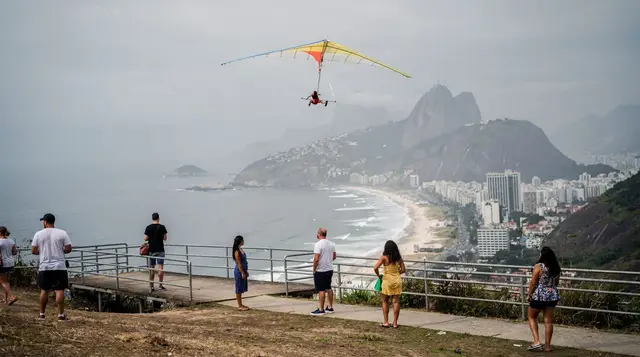
Rio de Janeiro: Pedra Bonita Hike and Hang Gliding Flight Watching
Photos show the destination, not the operator's own pictures.