| Where | Aterro do Flamengo park, plus the Flamengo and Catete neighbourhoods, Zona Sul |
| Cost | Free (park, church, gardens); Palácio do Catete entry is inexpensive |
| Time needed | Around half a day for a relaxed loop of the park and the palace |
| Getting there | Metro Line 1, Flamengo or Catete stations |
| Best time | Weekday mornings for quiet; Sunday when the road through the park closes to cars |
A park built on reclaimed land, and the neighbourhoods around it
Aterro do Flamengo — officially Parque Brigadeiro Eduardo Gomes, though almost nobody in Rio calls it that — sits on land reclaimed from Guanabara Bay in the 1960s, when the demolished remains of the Morro de Santo Antônio hill were used as landfill to create more than a million square metres of new park running along the waterfront between Glória and Botafogo.
It was designed by Roberto Burle Marx, the same landscape architect behind Copacabana’s Avenida Atlântica mosaic, and it remains one of the largest and best-used urban parks in Latin America — not a manicured tourist garden, but a genuinely functional piece of everyday city infrastructure that Cariocas run, cycle, play sport in, and picnic on every single day of the year, rain or shine.
Flamengo and Catete, the two neighbourhoods bordering the park’s inland edge, are residential and largely untouched by tourism relative to the beach neighbourhoods further south — older apartment buildings, a slower unhurried pace, and a demographic that skews toward long-time residents and young families rather than visitors passing through. It’s a useful corrective if a trip has otherwise been spent entirely in Copacabana or Ipanema: this is what a normal middle-class Zona Sul neighbourhood actually looks like day to day.
What the park is actually for
On weekdays, the park is used much as any large city park would be — joggers and cyclists on the dedicated paths from early morning, dog walkers, and office workers from the surrounding neighbourhoods eating lunch on the grass.
On Sundays and holidays, Avenida Infante Dom Henrique, the road running through the park, closes entirely to cars, and the whole space fills with families, cyclists, skaters, and informal football and volleyball games — one of the more genuinely pleasant free things to do in Rio on a weekend morning, and a useful counterpoint to the idea that Rio’s public life happens only on the beach. For a wider sense of how Cariocas actually spend a Sunday beyond this one park, see what locals actually do on Sunday.
A bike route runs the length of the park and connects onward toward Botafogo and the Lagoa, a reasonable way to cover the distance if you don’t want to walk the whole thing:
Rio bike tour — discover the beaches and lagoonBikes are also available to rent by the hour from stands along the park’s length if you’d rather go independently. Note that, as with Botafogo next door, the bay water here is not for swimming — the park’s beach-facing edge is for walking, sport, and the view, not the water itself.
Free outdoor gym equipment (academias ao ar livre) is dotted along the park at regular intervals, heavily used by locals of all ages at almost any hour — a small but telling detail about how thoroughly Cariocas treat the park as everyday infrastructure rather than a scenic backdrop. Marked football and volleyball courts run along several sections too, informally claimed by regular groups who show up at the same time most days; watching a serious late-afternoon match between longtime local players is free and often better entertainment than anything ticketed nearby.
At the park’s northern end, near where it meets Glória, the Museu de Arte Moderna do Rio de Janeiro (MAM) occupies a striking mid-century concrete building designed by Affonso Eduardo Reidy, one of Brazil’s most significant works of modernist architecture. Its permanent collection covers 20th-century Brazilian art, and the building itself, framed by a Burle Marx-designed garden, is worth seeing even for visitors who’d rather skip the galleries — a rare case of a museum’s exterior being as compelling as what’s inside.
Two small museums worth the detour
Set within the park itself, easy to miss if you don’t know to look, are two small, specific museums that reward the short detour. The Monumento aos Mortos da Segunda Guerra Mundial — Brazil’s national World War II memorial — commemorates the roughly 25,000 Brazilian soldiers of the Brazilian Expeditionary Force who fought alongside the Allies in Italy, with an eternal flame, two soaring concrete columns visible from across the park, and a small underground museum covering a chapter of Brazilian history that surprises many visitors who don’t associate Brazil with European WWII combat at all.
A short walk away, the Museu Carmen Miranda is a modest, purpose-built museum dedicated to the Portuguese-Brazilian singer and actress whose fruit-hat headdresses and Hollywood career made her one of the most recognisable Brazilian cultural exports of the 20th century — a small, slightly kitsch, genuinely fun collection of costumes and memorabilia that takes twenty minutes and costs very little.
Marina da Glória and getting onto the bay
At the park’s southern end, Marina da Glória is Rio’s main marina and the departure point for a range of Guanabara Bay boat trips — a straightforward way to see the bay, the bridge to Niterói, and the city skyline from the water rather than the shore:
boat tour of Guanabara BayThe marina also hosts occasional large concerts and events on its grounds, and functions as a genuine working marina for private boats alongside the tourist-facing trips — worth a wander even without booking anything, since the boats themselves and the view back toward Sugarloaf are worth the short detour.
Nossa Senhora da Glória do Outeiro
On a small hill overlooking the park’s southern end, the octagonal Igreja de Nossa Senhora da Glória do Outeiro is one of Rio’s finest surviving examples of colonial religious architecture, built in the 18th century and closely associated with the Brazilian imperial family, who worshipped here regularly. The climb up (or a short funicular, when running) rewards with both the church’s blue-and-white azulejo-tiled interior and a clear view back down over the Aterro and the bay — a quieter, more reflective stop than anything else in the immediate area, and one most visitors to the park below don’t realise is there.
Palácio do Catete
A short walk inland from the park, the Palácio do Catete is a 19th-century palace that served as the official residence of Brazil’s presidents from 1897 to 1960, before the capital moved to the newly built Brasília.
It’s now the Museu da República, covering the history of Brazil’s republican period from the fall of the monarchy in 1889 onward — including the dramatic 1954 suicide of President Getúlio Vargas, which took place inside the palace and remains one of the defining, still-debated events of 20th-century Brazilian political history. The building itself, with its formal gardens and preserved period interiors, is worth the visit independent of the history; the gardens are free to enter and a pleasant, shaded break from the park’s open sun.
It’s a genuinely substantive stop for anyone interested in Brazilian history beyond the postcard version most itineraries stick to, and it pairs naturally with a walk through the surrounding Catete neighbourhood’s older residential streets, which retain a noticeably more traditional, unrenovated character than the beach neighbourhoods further along the coast.
Vargas’s death here is still taught in Brazilian schools as one of the defining moments of the country’s 20th century — facing mounting political pressure and a looming military ultimatum to resign, he shot himself in his bedroom on the palace’s upper floor in August 1954, leaving behind a widely read suicide note that framed his death as a final political act rather than a personal collapse.
The room itself is preserved and can be visited as part of the museum, a genuinely sobering counterpoint to the palace’s otherwise formal, ceremonial interiors. The gardens surrounding the building, designed in a French formal style with mature trees and quiet fountains, are worth lingering in regardless of how much of the history interests you — one of the more peaceful green spaces in this part of the city, and free to enter even without paying for the museum itself.
Before Copacabana, this was the fashionable address
It’s easy to forget, standing in a quiet residential street in Catete today, that this neighbourhood — along with Flamengo and Glória — was Rio’s most fashionable residential district through the 19th century and into the early 20th, before Copacabana’s beachfront development drew the city’s wealth south in the 1920s and 1930s. The palace’s presence here as the seat of the presidency for over sixty years reflects that earlier status; the ornate, aging apartment buildings that line many of Flamengo and Catete’s streets today were, in their time, some of the most desirable addresses in Brazil.
That history left a physical legacy still visible today: a higher concentration of well-preserved early-20th-century architecture than almost anywhere else in Zona Sul, largely because the neighbourhood’s shift to a quieter, more middle-class identity after the wealth moved south meant less pressure to demolish and rebuild. Walking Rua Correia Dutra or Rua Buarque de Macedo, a few blocks off the park, gives a clearer sense of pre-Copacabana Rio than almost any other easily accessible part of the city.
Everyday Rio, at street level
Rua do Catete, the neighbourhood’s commercial spine, carries the kind of shops and businesses that exist for residents rather than visitors — pharmacies, bakeries (padarias), hardware stores, and a solid run of no-frills lunch spots serving comida a quilo (pay-by-weight buffet food) at prices noticeably below anything in Copacabana or Ipanema, since there’s no beachfront rent premium to pass on.
It’s one of the better places in Zona Sul to get an honestly priced, filling lunch, and a fair introduction to the difference between “tourist Rio” and the city most of its residents actually inhabit day to day. For a wider picture of eating well without the mark-up, see what to eat in Rio and rio on a budget.
A half-day, sequenced
A reasonable order for a first visit: start at the Palácio do Catete in the morning, when the museum is at its coolest and least crowded, then walk the short distance into the park itself, taking in the WWII memorial and Museu Carmen Miranda on the way toward Marina da Glória. From there, either continue on foot or by rented bike toward MAM and the Glória church at the park’s edges, or head the other direction toward Botafogo if the plan is to end the day there for dinner. The whole loop, done unhurried with stops at each point, runs three to four hours — comfortably a half-day, with room left over for lunch on Rua do Catete along the way.
Weather matters more here than in most of Zona Sul, since so much of the appeal is outdoor and shadeless — the park has relatively little tree cover along its central paths compared with, say, Tijuca National Park, so a hot, cloudless midday is genuinely uncomfortable for an extended walk. Aim for morning or late afternoon rather than the midday hours if visiting between December and March.
A rainy-day option in a mostly outdoor area
Because so much of the appeal here is the open park, a wet morning changes the plan more than it would in, say, Botafogo. The good news is that both of the neighbourhood’s headline stops are indoors: MAM’s galleries and the Museu Carmen Miranda are a reasonable rainy hour each, and the Palácio do Catete’s period rooms and the Museu da República’s exhibits easily fill a couple more, with the covered arcades of the palace’s ground floor offering a dry route between wings if a shower passes through while you’re inside.
If the rain looks likely to last the whole day, this is one of the better half-day plans in Zona Sul that barely touches the outdoors at all, and it pairs naturally with the wider list in what to do in Rio when it rains.
Free events, and when the park is busiest
Beyond the regular Sunday car-free morning, Marina da Glória and the open lawns along the Aterro periodically host free public events — outdoor concerts, fitness classes, and occasional civic gatherings tied to national holidays — that are worth checking for if a visit happens to line up with one.
These pull noticeably larger crowds than an ordinary weekend and are worth building extra time around if you’re also trying to see the museums calmly; conversely, if the goal is a quiet park walk, an evening with no listed event is the more reliable choice than gambling on an empty Sunday. New Year’s Eve and Carnival week both see a spike in activity along this stretch of waterfront as the city’s broader celebrations spill over from Copacabana and Centro, so expect a livelier, more crowded park than usual if visiting during either window.
Getting there
Both Flamengo and Catete have their own metro stations on Line 1, along with Largo do Machado just inland, making this one of the easiest half-day trips to reach from almost anywhere in central or southern Rio without needing a car or ride-hail. The park itself runs for several kilometres, so picking an entry point close to whichever end you want to visit — nearer Glória and Marina da Glória, or nearer Botafogo — saves unnecessary walking. See getting around Rio for the wider transport picture.
Photography and the view back toward Sugarloaf
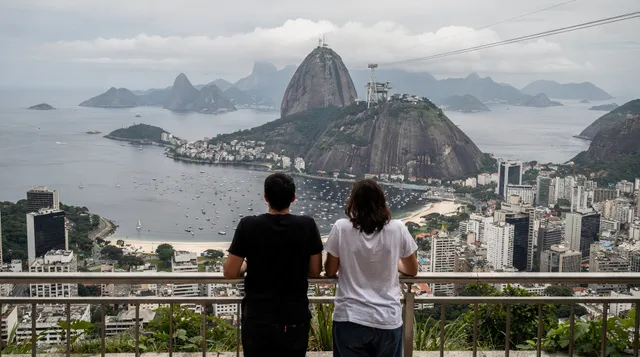
The Aterro’s waterfront edge, particularly near Marina da Glória and the stretch closest to Glória church, gives one of the more underrated photo angles on Sugarloaf and the bay — fewer people crowding the frame than the viewpoints at Urca itself, and a genuinely different composition with the park’s palm trees or the marina’s boats in the foreground. Early morning light, before the haze builds over the bay later in the day, tends to give the clearest results; late afternoon works too but puts the sun more directly in the frame from this angle. It’s a useful stop for anyone trying to get a Sugarloaf photo without fighting the crowds at the cable car itself.
Where it fits in a longer trip
Flamengo and Catete work well as a morning or early-afternoon stop before an evening in Botafogo’s restaurant scene, or as a quieter, cheaper alternative to a full beach day if the goal is simply to be outside without the beach crowd.
It’s also a natural stop on the way to or from Urca and Sugarloaf, sitting roughly on the route between the historic centre and the southern beach neighbourhoods, and a sensible place to base a morning around if the rest of the day is already spoken for elsewhere — including a walk on toward the Lagoa for anyone with enough energy left to keep going. See Rio in three days and Rio on a budget for how this fits into a longer, cost-conscious itinerary.
Frequently asked questions about Flamengo and Catete
Is Flamengo beach safe to swim at?
No — like Botafogo next door, the bay water along Flamengo’s shoreline is contaminated and has been for decades, and it is not used for swimming by locals under any circumstances. The beach and park are for walking, sport, and the view; go to Urca’s Praia Vermelha or the open-ocean beaches for actual swimming.
Is the Museu da República worth the entry fee?
Yes, for anyone with even a moderate interest in Brazilian history — it’s one of the more substantive, well-presented history museums in the city, and admission is inexpensive relative to what’s covered. The building and gardens alone are worth the visit even without going deep into the exhibits.
Is this area safe to walk around?
Yes, generally, particularly around the park itself and the main commercial streets during the day. As with most of Rio, quieter residential side streets are best avoided alone late at night; the park and Rua do Catete stay reasonably busy into the evening. See the Rio safety guide for the fuller, non-alarmist picture.
What’s the best day to visit the park?
Sunday, when Avenida Infante Dom Henrique closes to cars and the park fills with cyclists, joggers, and families — it’s a genuinely different, livelier atmosphere than a weekday visit. Weekday mornings are the better choice if you’d rather have the space to yourself.
Can I rent a bike in the park?
Yes — bike rental stands run along the park’s length, and Rio’s citywide bike-share system also has stations here, alongside the guided bike tour option that covers Flamengo, Botafogo, and the Lagoa in one route. A helmet isn’t strictly required by law on the dedicated park paths, but it’s sensible on any stretch shared with road traffic.
How does Flamengo compare to Botafogo for a place to stay?
Flamengo has fewer hotels and a quieter, more purely residential feel than Botafogo’s growing restaurant-driven energy — a reasonable choice for visitors who want a calm, well-connected, budget-friendly base with metro access and don’t need to be near a nightlife scene, but less compelling than Botafogo for anyone prioritising food and evening activity. See where to stay in Rio for the full citywide comparison.
Is there a market in the neighbourhood?
Rua do Catete and the streets around Largo do Machado, the neighbourhood’s main square, host small produce and general goods stalls on set weekdays, mostly serving residents rather than visitors, and the area around Largo do Machado’s metro station has a reliable cluster of casual lunch spots worth knowing about if you’re in the area around midday.
Is Palácio do Catete accessible for visitors with mobility needs?
The ground floor and gardens are reasonably accessible, though the historic building’s upper floors, including the preserved presidential quarters, involve stairs in places without a lift — worth checking current accessibility provisions directly before visiting if this is a concern, since a heritage building of this age has real physical constraints.
Is Flamengo and Catete a good rainy-day plan?
Yes, one of the better ones in Zona Sul — MAM, the Museu Carmen Miranda, and the Palácio do Catete’s period rooms are all indoors, and together they can fill most of a wet morning or afternoon without spending much time exposed to the weather.
How long should I spend at the WWII memorial?
Ten to fifteen minutes covers the underground museum and the memorial itself comfortably, though anyone with a specific interest in Brazil’s role in the conflict could easily spend longer with the exhibits.