
Maracanã stadium guide — the tour, the museum, and a real match
Should I do the Maracanã stadium tour, or try to see a real match?
They are two different experiences, not a hierarchy. The stadium tour is a fixed-price, any-day walk through the tunnels, dressing rooms, and pitch-side, done in under an hour with no ticket risk. A real match — covered in full at how-to-see-a-football-match-in-rio — only happens when a Rio club is playing at home, needs advance planning, and delivers something the tour cannot: 60,000 people singing at once. If your dates allow either, do both.
| Where | Maracanã neighbourhood, Zona Norte, Line 2 metro |
| Tour length | 45 min-1 hour, plus 20-30 min for the museum |
| Cost | Roughly R$70-120 (US$13-22) depending on route/guide |
| Runs | Daily, regardless of the football calendar |
| Match vs tour | Different experiences — do both if your dates allow |
An empty stadium still has a lot to say
The Maracanã — officially Estádio Jornalista Mário Filho, though nobody in Rio calls it that — opened in 1950 for a World Cup Brazil famously lost in the final, in front of a crowd historians still argue about the exact size of, somewhere north of 170,000. It has been rebuilt twice since, most recently for the 2014 World Cup and 2016 Olympics, and now holds a still-enormous but far more comfortable 78,000 seated.
Most visitors experience it one of two ways: a daytime stadium tour that runs every day regardless of the football calendar, or an actual match, which only happens when a Rio club has a home fixture. This page covers the tour, the small museum built into the stadium, and the logistics of getting out to Maracanã in Zona Norte. For the separate, higher-stakes question of buying a match ticket and surviving matchday itself, see how to see a football match in Rio and matchday safety.
The stadium tour: what you actually see
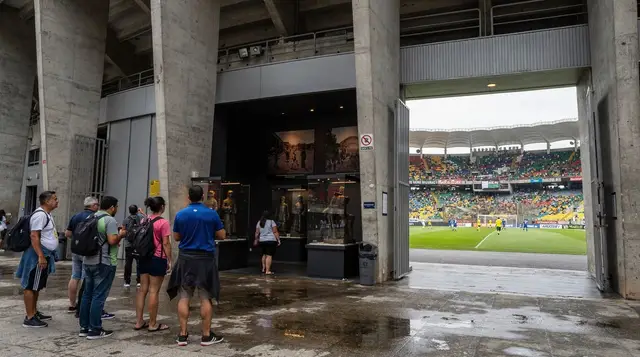
The self-guided or guided walk-through covers the players’ tunnel, at least one dressing room fitted out as if a Rio club is about to walk out, the pitch-side running track, and — on most tour routes — a seat in the stands looking down at the turf. It runs roughly 45 minutes to an hour at a relaxed pace, operates on a fixed daily schedule independent of any match, and is the only way to stand pitch-side at the Maracanã without a player’s pass or a ticket to the specific match being played that day.
a behind-the-scenes Maracanã stadium tour is the standard version — tunnel, dressing room, pitch-side, guided commentary on the stadium’s history including the 1950 final and the 2014 and 2016 renovations.
the official Maracanã entrance ticket is the leaner, self-paced option if you’d rather skip the guided narration and move at your own speed — useful if you’re combining the visit with something else the same day and don’t want to be tied to a group’s pace.
Price and timing. Tour tickets run roughly R$70-120 (about US$13-22) depending on route and whether a guide is included. Mornings are quieter than afternoons; avoid booking a tour for the day of or the day before a major match, since preparation work can close sections of the route without warning.
The small museum, and why it’s worth the extra twenty minutes
Built into the stadium’s structure is a compact museum covering Brazilian football history broadly, not just the stadium itself — shirts, trophies, and photographs spanning the national team’s World Cup wins and the club history of Flamengo, Fluminense, and Botafogo and Vasco, the four clubs that call greater Rio home. It’s not large — twenty to thirty minutes covers it properly — but for anyone who doesn’t already know why Brazilians take football this seriously, it fills in the context a stadium tour alone doesn’t.
a Maracanã tour that pairs the stadium walk-through with a local snack and drink stop extends the visit into a half-day and adds a guide who can put the memorabilia in context in a way a self-guided wander through glass cases can’t.
Tour vs match: the honest comparison
The tour guarantees you a result: you will see the tunnel, the pitch, and the dressing room, on whichever day suits your itinerary, rain or shine, football calendar or not. A match guarantees nothing in particular except unpredictability — which club, which opponent, which sector still has tickets — but delivers an atmosphere no empty stadium can fake: drums, flares outside the gates, songs that don’t stop for ninety minutes, and 60,000-plus people reacting to the same ball at the same instant.
If you only have one Rio visit and a flexible schedule, check the fixture list first — a home match from Flamengo, the derby especially, is worth reshuffling an itinerary around. If there’s no match during your dates, the tour is not a consolation prize; it’s a genuinely different, genuinely worthwhile hour that doesn’t depend on anyone’s schedule but yours.
Getting to the Maracanã
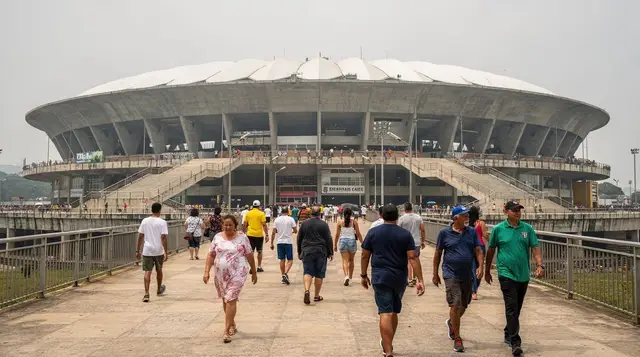
The stadium sits in the Maracanã neighbourhood of Zona Norte, and the single easiest way in is Line 2 of the metro to Maracanã station, which lets out within a short, well-signed walk of the main gates. Full line-by-line detail, hours, and why the metro is genuinely the right call here (not just the cheap one) is in the Rio metro guide; the wider transport picture, including when Uber makes more sense than the train, is in getting around Rio and Uber and taxis in Rio.
On a non-match day, a taxi or rideshare from Copacabana or Ipanema runs 30-45 minutes depending on traffic and costs roughly R$40-70 (about US$8-13) — reasonable for a tour visit where you’re not navigating a stadium crowd on the way out. On a match day, the calculus flips hard toward the metro, covered in detail in matchday safety: Line 2 runs extra frequency around kickoff and final whistle specifically because road access clogs completely.
What’s nearby, if you’re making a day of it
Quinta da Boa Vista, the former imperial park with Rio’s national museum grounds, sits a short ride from Maracanã and pairs naturally with a stadium visit if you want to turn a one-hour tour into a half-day in Zona Norte rather than a there-and-back trip. Neither location is a place to wander at length after dark — see Rio’s safety guide for the broader picture of which neighbourhoods reward daytime exploring versus a direct-there, direct-back approach.
The 1950 final and the stadium’s long rebuild
The Maracanã was built in a rush for the 1950 World Cup, poured in under two years on marshland that gave the stadium its name — a corruption of the Maracanã river that once ran through the site before the ground was drained and built over. On 16 July 1950, a crowd whose official FIFA figure sits around 173,850 paying spectators (unofficial estimates from the day run closer to 200,000, since standing terraces made exact counts impossible) watched Brazil, needing only a draw against Uruguay to win the tournament on home soil, lose 2-1.
Rio still calls it the Maracanaço, and it remains one of the few sporting defeats a country discusses in the present tense at bars seven decades later; a discreet plaque and small memorial garden near the stadium acknowledge the loss without dramatizing it. The physical stadium bears almost no resemblance to the 1950 bowl that hosted that match.
A first major overhaul before the 2007 Pan American Games removed the standing terraces — the geral — that once packed in the biggest crowds, converting the whole bowl to individual seating and cutting nominal capacity by more than half, from a peak that some counts put above 200,000 down to roughly 90,000. The 2013-2014 renovation ahead of that year’s World Cup went further still: a new roof covering every seat, the athletics running track pulled back to bring the stands closer to the pitch, and a full structural rebuild of the lower tier, landing on today’s seated capacity of 78,000.
The 2016 Olympic opening and closing ceremonies used that same rebuilt shell without further structural change. What visitors see today, in other words, is a 2014-era stadium wearing a 1950 name and a 1950 legend — tour guides are generally upfront that almost nothing you physically touch on the walk-through existed when the Maracanaço happened, which is exactly what makes the museum worth the extra time: it’s the one part of the visit that actually bridges the two stadiums.
Inside the tour: timing, entrances, and what people get wrong
The tour and the museum use a different entrance from the ones used on match day, and mixing them up is the single most common visitor mistake — match-day gates are numbered and spread around the stadium’s full circumference, while the tour and museum both funnel through one designated visitor entrance on the side facing the metro station. Turning up at a match-day gate on a non-match day usually just means an unnecessary walk around the perimeter with no signage pointing you the right way.
Tour groups depart continuously through the day rather than at fixed advertised times, so arriving mid-morning rarely means a long wait, but the last tour of the day is genuinely the last — arrive after it and the ticket desk will not sell you one regardless of the official closing time posted online, since guides need the full walk-through window to finish before the stadium locks up for the night.
Bag rules are lighter than on match day but not absent: large backpacks and any glass containers get held at a bag check near the entrance rather than carried through, which costs a few minutes queuing that first-time visitors rarely budget for. The pitch-side section is the one part of the route that occasionally closes without notice, not for weather but because ground staff are working on the grass ahead of a match later that week, and tour operators don’t always know in advance which days that will happen — treat “guaranteed pitch access” as likely rather than certain.
Photography is unrestricted throughout except inside the home dressing room, where flash is asked to stay off out of respect for a space still used by professional players; nobody enforces this strictly but guides do ask. Wheelchair access covers the museum and most of the tour route, though the players’ tunnel has a short stepped section requiring a staff-assisted alternate path — worth flagging at the ticket desk rather than discovering it partway through the walk.
| Stop | What you see | Typical time |
|---|---|---|
| Entrance and bag check | Ticket collection, security screening | 5-10 min |
| Players’ tunnel | The route teams walk out through on matchday | 5 min |
| Dressing room | Home dressing room, set up matchday-style | 10 min |
| Pitch-side | Running track and seats at pitch level | 15 min |
| Museum | Brazilian football history and club memorabilia | 20-30 min |
Mangueira, the neighbourhood, and what’s actually around the stadium
Zona Norte around the Maracanã is not a district built for tourists, and it shows the moment you step outside the tour entrance: street vendors sell grilled cheese and sugarcane juice from handcarts rather than kiosks, the traffic is real commuter traffic rather than tour buses, and almost nobody around you is there for the stadium visit specifically.
The Morro da Mangueira favela rises directly behind one side of the stadium, home to Estação Primeira de Mangueira, one of Rio’s oldest and most decorated samba schools, whose green-and-pink colours and rehearsal hall are visible from parts of the stadium approach — the neighbourhood’s samba tradition predates the stadium itself by decades. None of this is set up as a visitor attraction and it isn’t one; admiring the view from the public street is normal, walking up into the favela itself has no connection to the stadium tour and isn’t advisable without a dedicated, locally-guided visit arranged separately through a proper operator.
On an ordinary non-match afternoon the immediate stadium surroundings feel more like a transit hub than a destination — people heading to the metro, to Quinta da Boa Vista, to the university buildings nearby — which is part of why the “go, tour, head back” approach mentioned earlier in this guide holds up: there’s little reason to linger once the tour and museum are done, not because it’s unsafe in daylight but because there’s genuinely little else designed for a visitor’s afternoon in the immediate blocks around the gates.
Food near the stadium is functional rather than notable — simple lanchonetes and juice stands aimed at stadium staff and commuters rather than at visitors — so most people planning a proper meal save it for Zona Sul or a stop at Quinta da Boa Vista rather than expecting a destination-worthy lunch at the stadium gates. On match days this same stretch transforms completely, filling hours before kickoff with flag sellers, drum circles forming outside specific gates by tradition, and a density of foot traffic that makes the neutral, half-empty daytime version of the neighbourhood hard to picture.
Pairing the tour with a match on a different day
Visitors with more than a couple of days in Rio and any interest in football get the most out of the Maracanã by splitting the tour and a match across two separate visits rather than trying to combine them in one trip. The tour, being available daily, is the easier one to fix first — book it for whichever slot fits the wider itinerary, then check the fixture list for a Flamengo, Fluminense, Botafogo, or Vasco home game and build a second Zona Norte trip around it if the dates line up. Doing both on the same day is possible in principle but rarely sensible: match-day crowds and gate logistics are different from the tour’s quieter daytime flow, and cramming both into one afternoon leaves little room for either to be enjoyed properly.
Frequently asked questions about the Maracanã stadium
Do I need to book the tour in advance?
Not strictly, but booking ahead guarantees your preferred time slot and skips the walk-up ticket queue, which can run 20-30 minutes on a weekend. Same-day tickets are usually available except on days with preparation for an evening match.
Is the tour worth it if I’m also seeing a match?
Genuinely yes if your schedule allows both — the tour is the only way to stand where the players stand and see the dressing rooms, none of which is accessible on a normal match ticket. Many visitors do the tour on one day and a match on another.
How long should I budget for the visit?
45 minutes to an hour for the tour alone; add 20-30 minutes if you’re doing the museum properly, and more if you’ve added a guided snack stop. Half a day covers tour, museum, and a walk around Quinta da Boa Vista comfortably.
Which clubs actually play at the Maracanã?
Flamengo and Fluminense use it as their primary home ground for most fixtures; Botafogo and Vasco mostly play smaller stadiums (their own grounds, covered in Botafogo and Vasco) but move certain high-demand fixtures to the Maracanã when their own capacity can’t meet ticket demand.
Is the area around the stadium safe to walk around on a non-match day?
During daylight hours on an ordinary day, yes — it’s a normal, if unremarkable, Zona Norte neighbourhood with tour groups and stadium staff around. It’s not a place to linger after dark or wander far from the main stadium approach; go, tour, and head back the way you came.
Can I combine the Maracanã with Christ the Redeemer or Sugarloaf in one day?
Logistically yes, but it makes for a long day — the three sites sit in different zones of the city with real transfer time between them. Most visitors who want to do all three spread them across two days rather than rushing a single marathon itinerary.
What should I wear or bring?
Comfortable shoes — the tour includes stairs and a fair amount of walking on hard surfaces — and a hat or sunscreen if you’re doing the outdoor pitch-side sections at midday, since the stands offer little shade.
Is there a gift shop or merchandise stand?
Yes, at the tour exit, with official stadium and national team merchandise; club-specific gear for Flamengo, Fluminense, Botafogo, or Vasco is more reliably found at each club’s own store or a general sports retailer in Zona Sul, not at the stadium itself.
tours.football-culture
Verified deep-linked GetYourGuide tours. Book through these links and we earn a small commission at no cost to you.
Maracana Stadium - Behind the Scenes Tour

Private tour: Christ the Redeemer, Maracanã,Sugarloaf, Old Downtown and Selaron
Rio de Janeiro: Maracanã Stadium Tour and Beach Soccer
Photos show the destination, not the operator's own pictures.