| Where | Zona Sul, past Leblon and Vidigal |
| Cost | Watching free; tandem hang-gliding paid, price varies |
| Time needed | Half a day |
| Getting there | Taxi/Uber from Leblon or Ipanema, ~15–20 min |
| Best time | Clear, low-wind mornings for flying |
A beach best known for what lands on it
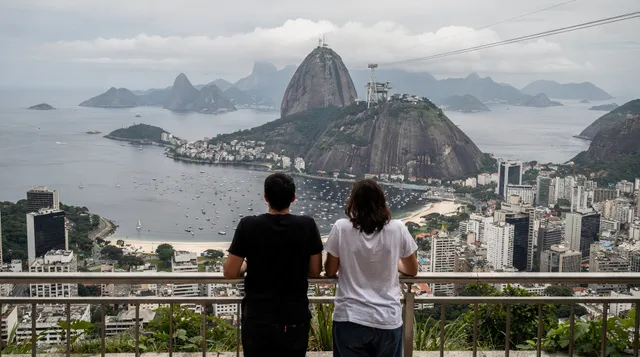
São Conrado sits in a wide, sheltered bay past Leblon and the Dois Irmãos hillside, physically separated from the rest of Zona Sul’s beach strip by the Vidigal headland — a genuinely different pocket of the city, calmer and less built-up along its immediate beachfront than Copacabana or Ipanema, despite being only a short drive from either.
The coastal road connecting them, cut into the base of the headland, is itself a scenic stretch worth noticing rather than simply passing through — Vidigal’s houses climbing the slope on one side, the open Atlantic on the other, for the few minutes it takes to cover the distance by car. Its beach, Pepino, is wide and pleasant for swimming and walking, but its real claim to attention is what regularly descends onto it from the sky: hang-gliders launched from a ramp on Pedra Bonita, a granite outcrop roughly 500 metres above the neighbourhood, glide down over the forest and the coastline and land directly on the sand here, most days the wind cooperates.
Watching a session — a steady rotation of tandem flights coming in to land, often to a small crowd of onlookers gathered near the designated landing strip — is free, genuinely dramatic, and one of the more unusual, memorable free spectacles anywhere in the city. Doing it yourself, strapped in tandem with a certified pilot, is one of the more memorable single activities available anywhere in Rio:
tandem hang gliding flightFlights depend entirely on wind conditions and are usually flown in the morning, when thermals and wind patterns are most favourable and most consistent; afternoon flights happen too but are more weather-dependent. For the flight from the launch side, including watching from Pedra Bonita itself, see hang gliding in Rio and Pedra da Gávea hike, the more strenuous hiking trail that shares the same trailhead area.
How hang gliding here actually works
Flights launch from a purpose-built ramp on Pedra Bonita, reached by a short drive up a winding road through the Tijuca forest from São Conrado itself, and a tandem flight typically covers a route of a few kilometres over the forest canopy and out over the coastline before descending to the landing strip on Pepino.
Pilots are certified and the activity is well established — it’s been a fixture of São Conrado since the 1970s — but it remains genuinely weather-dependent: operators cancel or postpone on days with unfavourable wind, and a flight booked for a specific morning can be pushed to the afternoon or the following day if conditions don’t cooperate. There’s typically a minimum and maximum weight requirement for tandem passengers, and most operators set a minimum age; check specifics with the operator when booking rather than assuming.
For those who’d rather hike than fly, the trail up to Pedra Bonita and on to the more strenuous Pedra da Gávea peak beside it shares the same access road as the hang-gliding ramp, and hikers doing the trail by morning will likely cross paths with pilots setting up for the day’s first flights — a good vantage point to watch a launch up close before the glider disappears over the treeline toward the beach below. Both trails sit within the wider Tijuca forest system, and the launch ramp itself offers one of the best free viewpoints in the city even without flying, looking directly out over São Conrado, the ocean, and Rocinha’s hillside all at once.
What sits directly above the beach
São Conrado’s other defining feature is its geography relative to Rocinha, Rio’s largest favela, home to somewhere between 100,000 and 200,000 people depending on the estimate used, which climbs the steep hillside immediately behind and above the neighbourhood’s beachfront towers and shopping mall. It is not a backdrop, a viewpoint, or a photo opportunity — it’s a dense, functioning neighbourhood with its own commercial streets, schools, churches, health clinics, and generations of families who have lived there since the mid-20th century, when rural migrants from Brazil’s northeast began settling the hillside in search of work.
The contrast is genuinely stark and worth naming plainly rather than glossing over: some of Rio’s wealthiest addresses — private condominiums, a five-star hotel, the exclusive Gávea Golf Club — sit within a few hundred metres of one of Latin America’s largest informal settlements, separated by nothing more than the hillside’s slope and the accident of which side of a property line a family happened to build on. This isn’t unique to São Conrado — Leblon sits below Vidigal in a comparable arrangement — but it’s more visually total here, since Rocinha is larger and the two zones are more directly stacked on top of each other.
A brief, honest history
Rocinha’s settlement dates back to the early-to-mid 20th century, growing substantially from the 1940s through the 1970s as migrants, many from Brazil’s poorer northeastern states, arrived in Rio seeking work in the growing city and settled the hillside where formal housing was unavailable or unaffordable.
Over decades, informal construction became permanent brick-and-mortar housing, infrastructure like water and electricity arrived unevenly and often through resident-led organising as much as government provision, and the community grew into what it is today: dense, vertical, multi-generational, with its own commercial economy centred on Estrada da Gávea, the main road climbing through the neighbourhood, lined with banks, pharmacies, shops, and restaurants serving residents rather than visitors.
Rio’s public security approach to Rocinha and similar communities has shifted repeatedly over the decades, including a period of Pacifying Police Unit (UPP) presence installed in 2012 as part of a citywide programme ahead of the 2014 World Cup and 2016 Olympics, which was later scaled back. None of this history is a reason to avoid the neighbourhood entirely, but it’s part of why a casual, uninformed visit is a bad idea — conditions and dynamics shift, and a guide with current, genuine local knowledge is the only reliable way to visit responsibly and safely.
If you’re interested in visiting Rocinha
The right way to approach this, if the intention is genuine interest rather than spectacle, is a guided visit with an operator that’s community-based or has deep, transparent ties to residents — someone who can speak honestly to the neighbourhood’s real history, economy, and daily life, and whose visit puts money into businesses Rocinha residents actually own, rather than a drive-by photo stop:
a 3-hour tour of the Rocinha favela with a local guideIf that kind of guided, respectful visit isn’t available or doesn’t fit the trip, the honest alternative is not to go at all — wandering in independently to look around is not appropriate, and treating a residential neighbourhood as a sightseeing stop without that context does real harm, both to how residents are treated and to the broader, tired narrative that reduces Rio’s favelas to a curiosity. See the truth about favela tours and favela tours done right before deciding whether and how to go, since the difference between a good and a bad operator is significant and not always obvious from a listing alone.
One specific point worth carrying into any visit: don’t photograph residents, their homes, or their daily activities without clear consent, and follow whatever guidance a guide gives about where cameras are and aren’t appropriate. A good operator will brief this explicitly at the start of a tour; if one doesn’t, that’s itself a signal worth noting about how seriously they take the community they’re bringing visitors into.
The beach itself
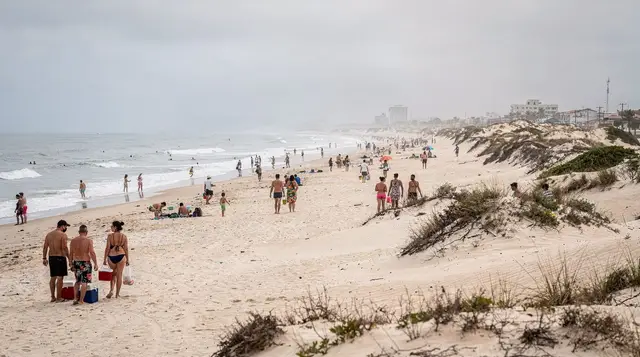
Pepino beach is wide, less crowded than the main Zona Sul strip, and pleasant for swimming, with calmer water than the more exposed stretches further along the coast. It draws a genuinely local crowd — São Conrado’s own residents, along with visitors specifically there for the hang-gliding — rather than the dense tourist traffic of Copacabana or Ipanema, which makes it a reasonable choice for anyone who wants beach time without the crowd, provided the relative lack of amenities (fewer kiosks, less infrastructure) and the longer trip from the main hotel neighbourhoods don’t outweigh that trade-off.
The beachfront itself is lined with a run of high-rise residential towers and, at one end, a large luxury hotel — a physical reminder, standing on the sand, of the wealth concentrated at sea level directly beneath a hillside home to some of the city’s least wealthy residents. It’s not a subtle contrast, and it’s worth taking in deliberately rather than simply as scenery on the way to a hang-gliding landing; few places in Rio make the city’s economic geography as immediately, physically legible as a single glance up from this particular beach towel.
São Conrado Fashion Mall and the golf club
The neighbourhood’s other landmarks are a study in contrast with everything above: São Conrado Fashion Mall is a genuinely upscale shopping centre, and the Gávea Golf Club, one of Brazil’s oldest golf courses, occupies a large stretch of flat land between the beach and the hillside. Neither is a must-see in the way the beach or the hang-gliding is, but they’re worth knowing about as part of the neighbourhood’s full picture — a small, wealthy enclave and Rio’s largest favela, sharing the same square kilometre of the city, with a shopping mall and a golf course sitting in the middle of that contrast.
The golf club, founded in the early 20th century, has hosted international tournaments and remains a private, members-and-guests facility rather than a casual walk-in attraction; most visitors will only see its manicured fairways from the road rather than step onto the course itself. The mall, by contrast, is open to anyone and functions as a genuinely useful practical stop — air conditioning, restrooms, a food court, and a pharmacy, all of which are in shorter supply directly on São Conrado’s beachfront than they are in Copacabana or Ipanema.
Getting there
São Conrado doesn’t have its own metro station; the most common approach is by taxi or ride-hail from Leblon or Ipanema, roughly 15–20 minutes depending on traffic, along the coastal road that runs beneath Dois Irmãos and Vidigal. Buses also connect it to central Zona Sul, though less frequently than the routes serving the main beach neighbourhoods. Most hang-gliding operators include transport from central Zona Sul hotels as part of the package, which removes the need to arrange this leg independently. See getting around Rio for the fuller transport picture.
Traffic along the coastal road can back up significantly at peak times, particularly where it narrows beneath the Vidigal headland, so building in extra time for a booked flight or tour departure is worth doing rather than cutting the journey close.
Where it fits in a longer trip
São Conrado is rarely a full-day destination on its own — most visitors combine it with a hang-gliding flight or with the drive out toward Barra da Tijuca and Rio’s western beaches, since São Conrado sits on the route between Zona Sul and Zona Oeste. For anyone building a Rocinha visit into the trip, pairing it with a morning of hang-gliding — landing on the same beach the tour eventually returns to — makes for a full, well-sequenced half-day that touches two very different sides of the same hillside. See day trips from Rio for how this fits alongside the city’s other half-day options.
A reasonable sequence for visitors doing both: book the hang-gliding flight for the morning, when wind conditions are most reliable, then use the afternoon for a guided Rocinha visit once the day has settled and the initial adrenaline of the flight has worn off. Trying to compress both into a rushed few hours does a disservice to the second half of the day in particular, which benefits from a guide who isn’t watching the clock.
Why the launch site sits where it does
Pedra Bonita’s ramp wasn’t chosen arbitrarily — the granite outcrop’s height (roughly 500 metres), its orientation toward the coast, and the reliable thermal and onshore wind patterns generated by the combination of forest below and open ocean ahead make it one of the more consistently flyable launch sites in Brazil, which is part of why hang gliding took root here specifically in the 1970s rather than at other elevated points around the city.
The same geography that makes for good flying conditions also makes for a dramatic hike if you’d rather approach the ramp on foot than fly from it — see hang gliding in Rio for how the launch-side visit works if watching pilots prepare and launch appeals more than the beach-side landing spectacle covered above.
Weather windows for flying can be narrow enough that a booked morning slot occasionally shifts within the same day rather than being cancelled outright — operators generally message clients with updates rather than leaving them guessing, but building a little slack into whatever comes immediately after a booked flight (rather than a tightly timed onward plan) avoids frustration if the schedule needs to move.
Money and practicalities
Card acceptance is reliable at São Conrado Fashion Mall and most hang-gliding operators, who typically take payment online or by card at booking. Cash is worth carrying for the food court and any small purchases near the beach, since the immediate beachfront has far fewer card-friendly kiosks than Copacabana or Ipanema. If you’re booking a Rocinha tour separately from hang-gliding, confirm the pickup point in advance — most operators collect from central Zona Sul hotels rather than from São Conrado itself.
What to bring for a hang-gliding morning
Wear closed shoes rather than sandals — the launch ramp and landing strip both involve a short run on uneven ground, and flip-flops are a genuine tripping hazard at exactly the wrong moment. A GoPro or action camera mount is worth bringing or renting if photos matter to you, since most tandem pilots can’t manage a handheld phone mid-flight; several operators offer a camera add-on for an extra fee if you’d rather not bring your own. Light, comfortable clothing works better than anything bulky, since you’ll be strapped into a harness for the flight itself, and sunglasses with a secure strap are worth the small extra step given the windspeed at altitude.
Weighing the two very different halves of a São Conrado day
It’s worth being honest about what a full São Conrado day actually asks of you: a genuinely thrilling, adrenaline-driven activity in the morning, followed by a guided visit to one of Latin America’s largest informal settlements in the afternoon — two experiences that sit at opposite emotional registers and shouldn’t be rushed together. Travellers who try to compress both into a tight half-day tend to shortchange the Rocinha portion in particular, arriving still keyed up from the flight rather than present for a neighbourhood visit that deserves attention and respect. If your schedule only allows one, choose based on genuine interest rather than trying to fit both in for the sake of it.
Frequently asked questions about São Conrado
Is São Conrado safe to visit?
The beach and the immediate tourist-facing areas — the mall, the hang-gliding landing strip — are generally fine to visit as a day-tripper. Rocinha itself is a real, functioning neighbourhood, not inherently dangerous to residents going about daily life, but it is not somewhere to wander into independently as a visitor without a guide who has genuine ties there; go with a reputable, community-connected operator or not at all.
How much does hang-gliding cost and how long does it take?
A tandem flight typically runs a couple of hours door to door once transport to the Pedra Bonita launch site, the flight itself (10–15 minutes in the air), and the return are all included. Exact pricing varies by operator and season; booking ahead is recommended since flights depend on weather and slots can fill on good-wind days.
Can I just watch the hang-gliders without flying myself?
Yes — watching from Pepino beach as gliders come in to land is free and doesn’t require booking anything. It’s one of the better free spectacles in the city and a reasonable way to experience the activity if flying yourself isn’t of interest or within budget.
Is Rocinha the same as a slum in the way outsiders sometimes picture?
No — it’s a large, dense, established neighbourhood with its own economy, infrastructure, and multi-generational communities, not a temporary or lawless settlement. Conditions and challenges vary within it as they would in any large urban area, and reducing it to a single stereotype misses a genuinely complex, functioning part of the city.
Is it worth staying in São Conrado rather than the main Zona Sul beaches?
For most first-time visitors, no — it’s further from the main sights, has fewer hotels and restaurants, and lacks the metro access that makes Copacabana or Ipanema easier bases. It’s a reasonable choice only for a specific reason, such as the golf club, a particular hotel, or a strong preference for a quieter beach, rather than as a default first-time base.
Why do the hang-gliders land on this specific beach?
Pepino’s width, its position directly below the Pedra Bonita launch ramp, and its relatively open approach without tall buildings in the flight path make it the natural, established landing zone for the route — the geography lines up in a way that few other Rio beaches offer for this specific activity.
Do I need to book hang gliding in advance?
Booking a day or more ahead is sensible, particularly in high season, since good-weather days fill quickly and a same-day walk-up isn’t guaranteed to find an available slot. It also gives more flexibility to shift the booking if the forecast changes closer to the date.
Is there anywhere to eat lunch in São Conrado?
Options are limited compared with the main beach neighbourhoods — a few restaurants near the beachfront and a food court inside São Conrado Fashion Mall are the main choices. Most visitors either eat before arriving or plan to have a fuller meal back in Leblon or Ipanema afterward.