
Futevôlei and beach sports — the game cariocas actually play on the sand
What is futevôlei, and can a visitor try it?
Futevôlei (footvolley) is a sport invented on Copacabana beach in the 1960s that combines volleyball's net and court with football's no-hands rule — players use feet, chest, and head only. It is played daily on marked courts along Copacabana and Ipanema, and several operators run beginner lessons for visitors on the same sand where the sport was created.
| Where | Copacabana (Posto 4–6) and Ipanema courts |
| Cost to watch | Free, any time |
| Lesson length | Around 1–1.5 hours, beginners welcome |
| Best time | Late afternoon into evening for top-level play; before 10am for a quiet lesson |
| What to bring | Sunscreen, water, bare feet — no shoes on court |
The sand has its own version of the sport
Walk the promenade at Copacabana or Ipanema on any dry afternoon and the game you’ll see far more often than eleven-a-side football is something smaller, faster, and specific to Rio’s beaches: futevôlei, a two-a-side (occasionally more) sport played across a volleyball-height net, using every part of the body except the hands and arms.
It isn’t a beach variant invented for tourists — it was created on Copacabana in the mid-1960s by local players looking for a way to keep football sharp on sand too soft for a full pitch, and it has since spread across Brazil and internationally while staying, at its competitive core, a distinctly carioca game. This page covers futevôlei and its cousins — beach soccer and altinha — where to watch a serious match, and where a visitor can actually get on the sand and try.
Futevôlei, beach soccer, and altinha — the difference
Futevôlei uses a volleyball-style net and court, with the ball kept alive using feet, chest, thighs, and head — no hands, no arms, three touches per side, same basic scoring logic as volleyball. It rewards touch and control over pure athleticism, and top players — many of whom train daily on Copacabana — show a level of first-touch skill that rivals professional football.
Beach soccer (futebol de areia) is closer to conventional football scaled down: goals, a smaller pitch marked on the sand, five-a-side, hands allowed only for the goalkeeper. It’s the sport behind Brazil’s multiple beach soccer world titles, and casual matches happen on wider stretches of sand, particularly around Recreio and Barra beaches where there’s more open sand to mark out a pitch.
Altinha is the loosest and most spontaneous of the three — a keepie-uppie circle game with no fixed teams or scoring, just a group keeping a ball off the sand using any part of the body except hands, often with genuinely startling skill on display from complete strangers who happened to form a circle. You’ll see it anywhere there’s flat sand and a free half hour, no organisation required.
Where to watch — Copacabana’s dedicated courts
A long run of marked futevôlei and beach volleyball courts lines the sand at Copacabana, particularly in the stretch near Posto 4 through Posto 6, and serious, fast, high-skill matches run there most days from late afternoon into evening once the worst of the midday heat has passed — see rio in summer and rio in winter for how the crowd and the light change by season. Watching is free, entirely normal, and requires no more than finding an open patch of sand near the courts; regulars and semi-professional players train there year-round, and weekend afternoons draw the biggest crowds of both players and spectators.
Ipanema has its own smaller but equally active stretch of courts, generally with a slightly younger, more social crowd than Copacabana’s more competition-focused regulars.
Where to try it yourself
a footvolley lesson on Copacabana beach, taught in the exact spot the sport was invented is the most direct way for a visitor to actually play rather than just watch — a genuine beginner’s session covering the basic touches and rules, run by instructors who play competitively themselves. No prior skill or experience is expected; the sessions are built for complete beginners and typically run an hour to ninety minutes.
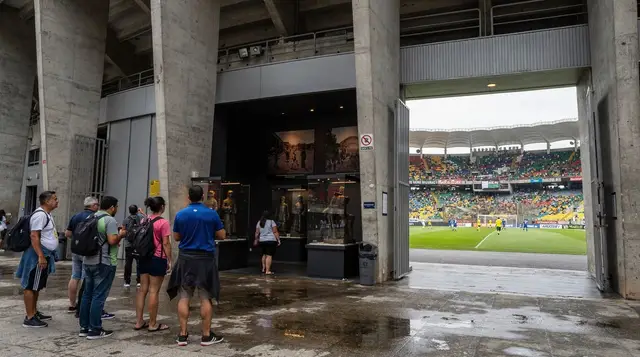
If your interest runs more toward the stadium side of Rio’s football culture than the beach, a combined Maracanã stadium tour and beach soccer session pairs the two, useful if you want both sides of Rio’s football identity — the stadium history and the sand — covered in a single organised day rather than arranging them separately.
The gear, and what to expect
Bare feet is standard on the sand — nobody wears shoes on a futevôlei court, and the sand itself, packed hard near the water’s edge where most courts sit, is kinder on ankles than it looks. Bring sunscreen and water; sessions run in full sun with limited shade nearby, and the sand reflects heat back up in a way that catches first-timers off guard. See beach safety in Rio for the broader picture on sun, currents, and what to leave at the hotel before a beach afternoon.
The wider beach sports culture
Futevôlei is the most visible sand sport, but it sits inside a much broader carioca beach culture of casual, informal games — frescobol (a paddle-ball game with no net, played purely to keep a rally going), volleyball proper, and simple keepie-uppie circles, all of which fill Copacabana, Ipanema, and Leblon on any warm afternoon.
None require an invitation to watch, and several — frescobol especially — are easy for a visitor to join informally if a local pair waves you in, which happens more often than guidebooks tend to mention. The wider context of what cariocas actually do at the beach, as opposed to what visitors assume they do, is covered in rio beach etiquette and best beaches in Rio.
Renting a court, joining a pickup game, and keeping your things safe
Most of the marked courts along Copacabana are run by small operators who rent them by the hour — look for a wooden hut or a folding table near the court with a handwritten price list, usually staffed from mid-morning until dark. Rates shift informally with demand, so expect a little negotiation if you’re not a regular; cash is standard, and courts are typically booked in one-hour blocks that can run long if nobody’s waiting behind you.
If you show up without your own group, the fastest way onto a court is to ask an operator whether there’s a mixed or open game running — many courts host a rotating system where players who don’t know each other split a booking and rotate out as new arrivals looking for a hit turn up. Altinha circles work on the opposite principle: there’s no booking or rental, just informal circles that form and dissolve on open sand, and joining one is usually as simple as standing at the edge and waiting for someone to kick the ball your way — a genuine invitation to step in, not an accident.
One practical wrinkle worth planning for: futevôlei and beach soccer are two-handed-free sports, so you can’t watch a bag while playing a fast rally, and informal court operators don’t offer formal storage, though many will keep half an eye on a bag left near their hut as a courtesy to paying customers. The safer habit locals follow is bringing as little as possible to a session — leave passports, extra cash, and valuables at the hotel, and treat anything left on the sand during a match as visible but not secure.
Lessons booked through a formal tour operator are more used to visitors carrying phones and bags and will often point out a spot near the lesson area to leave things, but it’s worth asking directly before a session starts rather than assuming. Beach soccer works differently again: because it needs open, unmarked sand rather than a fixed rented court, casual games organise far more informally, coordinated beach-side or through word of mouth among regular groups rather than through any operator — a visitor without local contacts is more likely to find an organised game through a booked session than by wandering up to a pickup match and asking to join, since a team of five is harder to break into casually than a two-person futevôlei pairing.
The rules and etiquette you’ll see used on the sand
Matches on the informal courts are self-officiated, with no referee — players call their own touches, and a contested call is far more often waved through with a shrug than argued over, since locals treat continuing to play as the higher priority. Games are typically played to 12 or 15 points rather than volleyball’s usual 21 or 25, which keeps a casual pickup match moving briskly enough that four or five games can rotate through a single hour of court rental.
The serve alternates strictly between sides after each point regardless of who won it, with none of volleyball’s side-out complexity, and a serve that clips the net and drops in is generally played as a live point rather than replayed. Two-touch and three-touch variants both appear depending on the pair: more competitive players stick to the standard three touches maximum per side, while casual pairs sometimes play looser, more forgiving rules purely to keep a rally going longer. None of this needs memorizing before a beginner lesson — instructors explain the specific version they’re using at the start — but recognizing it makes a match you’re only watching easier to read.
Common mistakes first-timers make on the sand
The single biggest technical mistake newcomers make in a futevôlei lesson is trying to control the ball the way they would in football, with a firm strike off the top of the foot — the sand game rewards a flatter, more deliberate contact with the instep and a much softer first touch, since the ball has to stay playable for a teammate rather than simply get cleared. Instructors spend most of a beginner session correcting this instinct before moving on to anything resembling a rally.
The second common error is underestimating the sand itself: soft, dry sand well back from the waterline saps far more energy per movement than the packed sand right at the courts, so a first session that feels manageable for twenty minutes can leave legs genuinely exhausted by the end of an hour — pace yourself rather than trying to match instructors who’ve played on this sand for years.
Positioning is a third, subtler mistake: newcomers used to indoor volleyball tend to hang back near the baseline the way a six-player rotation would, but two-a-side futevôlei has no baseline positioning to speak of — most of the court is covered by constant lateral movement close to the net, and standing deep leaves far too much sand for a partner to cover alone. Socially, the most common misstep is treating a pickup game or an altinha circle as a spectator sport to film up close; a phone held a few feet from a fast-moving game is a mild annoyance to the players and is usually met with a polite request to step back, not hostility, but it’s easy to avoid simply by watching from the same distance regulars do.
Watching like a local — rankings, tournaments, and timing your visit
The players running serious points on Copacabana’s central courts in late afternoon are often not casual regulars but ranked competitive players — futevôlei has an organised competitive circuit in Brazil with its own rankings, and Copacabana’s courts function as an informal training ground for players who compete in it, which is part of why the skill level on display there routinely surprises visitors who expect a beach hobby rather than something closer to a professional sport.
Tournaments and exhibition matches are scheduled on these courts through the year, but typically announced only locally — a banner strung between posts, or a crowd gathering earlier than usual in the afternoon, is often the only advance notice a visitor gets, so stumbling into one is a genuine highlight when the timing works out. A practical way to tell a serious match from a casual hit at a distance: watch the serve — competitive players drive it low, clearing the net by inches, while recreational games tend toward a higher, safer arc.
Timing matters beyond that too: weekday mornings before around 10am are the quietest window on Copacabana’s courts, favoured by regulars fitting in a session before work, and a good time for a beginner lesson if you’d rather learn without an audience of accomplished players nearby. The courts fill through the afternoon and peak on weekends, when both the number of active courts and the crowd watching them roughly double, making a Saturday or Sunday from mid-afternoon into evening the single most reliable window to see high-level competitive play.
Rio’s cooler, occasionally rainy stretches, concentrated in the southern hemisphere winter months of June through August, thin the crowds on the sand noticeably but never close the courts entirely — futevôlei is played essentially year-round, and a quieter winter afternoon can mean shorter waits for court time and a more relaxed lesson, trading away some of the buzz of a packed summer weekend for more room on the sand.
Frequently asked questions about futevôlei and beach sports
Do I need any prior skill to try futevôlei?
No — beginner lessons are built from the ground up, covering the basic touches before any real play. Reasonable fitness helps, but no football or volleyball background is assumed.
What should I wear?
Swimwear or athletic clothes you don’t mind getting sandy, bare feet, and sunscreen. Nobody plays in shoes on these courts.
Is watching free?
Yes, entirely — the courts are public beach space, and watching a match in progress requires nothing more than finding a spot on the sand nearby.
What time of day has the best matches to watch?
Late afternoon into early evening, once the midday heat eases, draws the strongest and most competitive play, particularly on weekends.
Is futevôlei only played in Rio?
It originated on Copacabana and remains most strongly associated with Rio, but it has spread across Brazil and internationally since the 1960s — Rio is where to see it played at its highest concentration and skill level, not the only place it exists.
Can children try a lesson?
Most beginner sessions can accommodate school-age children with reasonable coordination, though confirm the minimum age directly with your operator, since policies vary.
How is beach soccer different from the beach soccer played at professional level internationally?
Rio’s casual beach soccer follows largely the same rules as the competitive international game — five a side, sand pitch, goalkeeper allowed hands — the difference on Rio’s beaches is simply that most matches you’ll see are informal pickup games rather than organised competition, though Brazil’s national beach soccer team does train and compete at a professional level.
Where’s the best spot to watch if I only have one afternoon?
Copacabana between Posto 4 and Posto 6 offers the highest concentration of active courts and the strongest regular play, making it the most reliable single spot for a first visit.
tours.football-culture
Verified deep-linked GetYourGuide tours. Book through these links and we earn a small commission at no cost to you.
Maracana Stadium - Behind the Scenes Tour

Private tour: Christ the Redeemer, Maracanã,Sugarloaf, Old Downtown and Selaron

Rio de Janeiro: Maracanã Stadium Tour and Beach Soccer
Photos show the destination, not the operator's own pictures.