| Where | Zona Oeste, west of Barra da Tijuca |
| Cost | Free beach; surf lessons/rental modest local rates |
| Time needed | Half a day |
| Getting there | Car, Uber, or BRT TransOeste from Barra |
| Best time | Weekday mornings; check surf forecast |
Rio’s beach belt, quieter by the kilometre
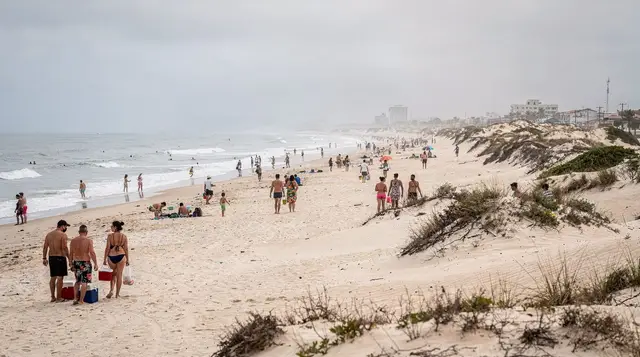
Recreio dos Bandeirantes is the natural continuation of Barra da Tijuca’s beach further west, and the difference between the two is immediately obvious even though they’re geographically almost seamless: Recreio has fewer malls, fewer high-rise towers crowding the beachfront, and a noticeably more local, residential feel. It’s the kind of neighbourhood that doesn’t really register on a first-timer’s Rio itinerary and is exactly the sort of place regular visitors and locals go when they want a beach day without the crowd management that comes with Copacabana, Ipanema, or even Barra on a hot weekend.
The beach and the surf scene
Recreio’s beach has a solid, consistent surf break that draws a steady community of local surfers, and the atmosphere along the sand reflects that — more surfboards racked against kiosk walls, more of a sport-and-fitness crowd than a see-and-be-seen one. It’s a reasonable spot to watch surfing even if you’re not doing it yourself, and conditions are generally considered good for intermediate surfers, though as with any ocean break, conditions shift with swell and season, so ask at a local surf shop rather than assuming a given day will be calm. Facilities are more modest than the Zona Sul’s kiosk culture — pack more of what you need rather than relying on finding everything beachside.
Pedra do Pontal
The most distinctive feature of Recreio is Pedra do Pontal, a large granite rock outcrop marking the boundary between Recreio and Barra da Tijuca’s beach. A trail climbs the rock to a series of viewpoints over the coastline in both directions — Barra’s long straight beach to the east, Recreio and the wilder coast toward Grumari to the west.
It’s a moderate hike rather than a technical one, doable in trainers rather than requiring hiking boots, and takes most visitors somewhere between 45 minutes and an hour and a half round trip depending on how far up you go and how many stops you make for the view. It’s considerably less crowded and less logistically complicated than the better-known hikes closer to the Zona Sul, like Pedra da Gávea or Dois Irmãos, and makes a good half-day activity paired with time on Recreio’s beach.
Macumba and the smaller coves
Just west of Recreio’s main beach, Praia da Macumba is a smaller, separately named cove with its own dedicated surf crowd, popular enough with local surfers that a cluster of casual, good-value seafood and grilled-fish restaurants has grown up along the road above it — a genuinely good, unfussy lunch stop if you’re spending the day on this stretch of coast, and considerably cheaper than equivalent beachfront dining in Ipanema or Leblon.
Macumba’s name has nothing to do with the Afro-Brazilian religious practice of the same name that non-Brazilians sometimes assume; it’s simply the historical name of this stretch of coastline, and locals use it without a second thought. The beach itself works well as a quieter overflow if Recreio’s main strip feels busy.
A neighbourhood built later than most
Unlike the Zona Sul or even Barra, Recreio dos Bandeirantes developed relatively recently and relatively slowly — much of its residential growth dates from the 1990s and 2000s, following the road improvements that connected it more reliably to the rest of the city. That later, more gradual development is part of why it feels less planned and more organically local than Barra’s master-planned grid: smaller apartment buildings, more small businesses run by longtime residents, fewer big-box retail chains. It’s not a neighbourhood with much in the way of formal sightseeing beyond the beach and Pedra do Pontal, but it rewards a slower pace and a willingness to just sit at a beachfront kiosk rather than working through a list.
The gateway to the wild west
Recreio’s real practical value for most visitors is as the last “normal” neighbourhood before the coast turns properly wild. Continuing west from here brings you to Grumari and Prainha, protected beaches with essentially no development, and further still to Pedra do Telégrafo, the famous optical-illusion cliff photo spot. If you’re planning a day that includes any of these, Recreio is a sensible lunch or coffee stop on the way out or back, since facilities thin out fast once you’re past it. The wild beaches of west Rio guide lays out what to expect beyond Recreio, and it is worth reading before you commit to a full day out west.
The view from Pedra do Pontal in context
The climb up Pedra do Pontal rewards you with a rare vantage point: looking east, the full sweep of Barra’s beach and its wall of high-rises stretches into the haze; looking west, Recreio’s own beach curves toward the greener, undeveloped hills that lead to Grumari and Prainha.
Standing at that midpoint makes the contrast between Rio’s developed and protected coastlines unusually legible in a single view — arguably a better single vantage point for understanding how the city’s western edge actually works than anything you’d get from a guidebook description. Photographers favour late afternoon here for the same reason as most west-facing viewpoints in Rio: the light softens and the haze over the water tends to glow rather than wash out the shot.
Learning to surf here
Recreio’s consistent break has supported a genuine cluster of surf schools and independent instructors, generally offering better value and shorter waitlists than the more established, tourist-oriented schools closer to Ipanema and Arpoador, simply because Recreio sees far fewer visiting beginners competing for lesson slots. Board and wetsuit rental is straightforward at any of the small shops clustered near the main beach access points; expect to pay somewhat less than Zona Sul equivalents for both lessons and rentals, another benefit of being slightly off the main tourist circuit.
If you would rather have a lesson arranged in advance and stay in the Zona Sul, you can book surf lessons with local instructors in Copacabana and Ipanema instead, then come out to Recreio later once you are comfortable standing up on a board. For a wider look at the sport across the city, see our guide to surfing in Rio, and for how the two western beaches compare, the Barra and Recreio beaches guide covers the stretch in more detail.
A calmer counterpoint to Rio’s headline beaches
If your trip has already covered Copacabana, Ipanema and Leblon and you’re wondering whether another beach day adds anything new, Recreio is a reasonable answer specifically because it doesn’t try to be those beaches — no vendors working every few metres of sand, no beach-volleyball-and-people-watching scene, no crowd to navigate for a spot to lay a towel. It’s a good half-day for travellers who’ve done the postcard beaches and want to see what an ordinary, unglamorous Rio beach day actually looks like for the people who live here rather than visit.
A neighbourhood in transition
Recreio has been steadily gentrifying over the past decade, as more of Rio’s middle class priced out of Barra or drawn by the quieter pace moves in, bringing a slow but noticeable uptick in newer restaurants, small boutique gyms and co-working-style cafés alongside the older, more established local businesses. It hasn’t tipped into anything resembling a tourist destination in the process, and that balance — improving amenities without losing the local, unpolished character — is arguably the most distinctive thing about visiting Recreio right now, a version of Rio that isn’t yet fully aimed at outside visitors but is comfortable enough to welcome them anyway.
Timing your visit around the tide and swell
Surf conditions and the general character of the beach shift noticeably with the tide and the size of the incoming swell — a small, gentle swell day suits beginners and families wanting calm water, while a bigger swell brings out the more serious local surf crowd and correspondingly rougher conditions for casual swimming. There’s no fixed rule for which days bring which conditions, so checking a local surf forecast or simply asking at one of the surf shops near the main beach access point before committing to a full beach day is worth the two minutes it takes.
Where to stay and eat
Recreio has a modest but growing supply of apartment rentals and small hotels, generally cheaper than equivalent options in Barra or the Zona Sul, and it suits travellers who’ve already decided they want a quieter, more local base and don’t mind relying on a car for restaurants and nightlife beyond the immediate neighbourhood.
Along the beachfront and the roads just behind it, simple kiosks and casual restaurants serve grilled fish, moqueca (Brazilian seafood stew) and the standard Brazilian beach-food staples — pastel, açaí bowls, coconut water — at prices noticeably lower than the Zona Sul’s tourist-facing kiosks. It’s not a neighbourhood built around fine dining, and that’s broadly the point: this is where people come to eat simply and well without paying for atmosphere.
Safety notes
Recreio is a generally calm, residential, low-crime neighbourhood by Rio standards, and the beach and Pedra do Pontal trail see steady foot traffic that makes both reasonably safe for solo visitors during daylight hours. As with the rest of the Zona Oeste, it thins out noticeably after dark away from the immediate beachfront strip, and taxis or Uber are the sensible way to move around at night rather than walking unfamiliar residential streets. Ocean conditions can be stronger here than the calmer Zona Sul beaches, given the surf break — swim within your ability and heed any flags or lifeguard guidance, particularly if you’re not an experienced ocean swimmer. Our beach safety guide goes through currents and flags in more depth, and the Uber and taxis guide explains how to get a car back at the end of the day.
Getting there
By car or Uber from Barra da Tijuca, Recreio is a straightforward 10–15 minute continuation along the coast road. The BRT TransOeste bus rapid transit line also connects Recreio to Barra and further west toward Santa Cruz, a workable option if you’re not driving and want a cheaper alternative to Uber, though it’s a bus system best used with a translated map or transit app rather than assumed familiarity. From the Zona Sul (Copacabana or Ipanema), budget 45–60 minutes by car depending on traffic, making Recreio more of a planned outing than a casual half-day unless you’re already staying in Barra or further west. For the wider picture of buses and the metro, see getting around Rio.
If you head back to the Zona Sul in the evening, a night of live music in the old centre makes a good contrast to the quiet of Recreio, such as an evening of live samba at Pedra do Sal with a local guide, and the Pedra do Sal samba guide explains what the night is like.
The wider Zona Oeste boom, and what it means for visitors
Recreio’s gradual gentrification sits inside a much larger transformation of Rio’s western edge over the past two decades — the BRT TransOeste line, the road improvements that connect Barra, Recreio and the beaches further west more reliably to the rest of the city, and a wave of new residential and commercial development that’s followed.
For visitors, the practical upshot is that infrastructure here keeps improving year over year: more restaurants, more organized surf schools, and better transport links than existed even five years ago, though it’s still meaningfully behind the Zona Sul in density of services. Anyone who visited this stretch of coast a decade ago and is returning now will likely notice the difference; anyone visiting for the first time should still expect a noticeably lower-key experience than Copacabana or Ipanema, just less rough-around-the-edges than older guidebook descriptions might suggest.
That gap is narrowing each year rather than staying fixed, so descriptions of Recreio as sparse or underdeveloped are becoming somewhat dated even over a two- or three-year span — worth keeping in mind if you’re reading older trip reports or guidebooks alongside this one, since the neighbourhood’s amenities today are noticeably ahead of what they were even recently.
Recreio vs Barra vs the Zona Sul beaches
Deciding where to spend a beach day in western and southern Rio comes down to what you’re prioritising — crowd, infrastructure, or authenticity.
| Recreio | Barra da Tijuca | Zona Sul (Copacabana/Ipanema) | |
|---|---|---|---|
| Crowd | Local, low-key | Busy, local families | Dense, tourist-heavy |
| Infrastructure | Modest kiosks | Malls, high-rises | Full kiosk culture, easy transport |
| Best for | Surfing, quiet | A middle-ground beach day | First-time sightseeing |
| Metro access | None; BRT or car | Limited | Good |
Money and practicalities
Surf lesson deposits and equipment rental at Recreio’s smaller independent operators are frequently cash-preferred rather than card-only, so ask before assuming a card will be accepted at the point of booking. Card acceptance at Recreio’s beachfront kiosks and simple restaurants is patchier than in the Zona Sul — carry some cash, particularly for surf lesson deposits or board rental at smaller independent operators. There’s no metro station anywhere near Recreio, so factor real transport time into any plan rather than assuming a quick hop the way you might between Copacabana and Ipanema.
Frequently asked questions about Recreio dos Bandeirantes
Is Recreio dos Bandeirantes good for surfing?
Yes — it has a consistent, well-regarded break and a genuine local surf community. Conditions vary with swell, so check locally rather than assuming a given day will suit your level.
How long is the Pedra do Pontal hike?
Roughly 45 minutes to an hour and a half round trip, depending on how far up the trail you go. It’s a moderate hike doable in normal trainers rather than technical hiking gear.
What’s the difference between Recreio and Barra da Tijuca?
Recreio is quieter, more residential and more surf-focused, with far less mall and high-rise development than Barra. The two are geographically continuous but feel distinct once you’re there.
Do I need a car to visit Recreio?
Not strictly — Uber or the BRT TransOeste bus both work — but Recreio and the beaches further west are not well served by the metro, so budget more transport time and planning than a Zona Sul day would need.
Is Recreio dos Bandeirantes worth visiting on its own?
It works best paired with the Pedra do Pontal hike and either a Barra day or a longer trip further west toward Grumari and Prainha, rather than as a sole standalone destination.
How far is Recreio from the wilder beaches further west?
Grumari and Prainha are roughly 15–20 minutes further west by car; Pedra do Telégrafo is closer to 30–40 minutes beyond that.
Is Recreio dos Bandeirantes safe?
Yes, generally — it’s a calm, residential, low-crime neighbourhood by Rio standards. Standard precautions apply after dark, when it’s better to take a car than walk unfamiliar residential streets away from the beachfront.
What is Praia da Macumba?
A smaller cove just west of Recreio’s main beach, popular with local surfers and home to a cluster of good, casual seafood restaurants. The name refers to the location, not the Afro-Brazilian religious practice of the same name.
Where should I eat in Recreio?
Simple beachfront kiosks and casual restaurants along the coast road serve grilled fish, moqueca and standard Brazilian beach food at prices well below the Zona Sul’s tourist-facing kiosks — this isn’t a fine-dining neighbourhood, and that’s part of its appeal.
Is it cheaper to learn to surf in Recreio than in the Zona Sul?
Generally yes — Recreio’s surf schools see fewer visiting beginners than the schools closer to Ipanema and Arpoador, and both lessons and equipment rental tend to cost somewhat less as a result.
Is Recreio worth visiting if I’ve already seen Copacabana and Ipanema?
Yes, if you want a sense of an ordinary, less touristy Rio beach day — Recreio has none of the vendor density or people-watching scene of the headline beaches, and that quieter, more local pace is exactly its appeal for a return visitor.
What’s the view like from Pedra do Pontal?
It’s one of the clearer single viewpoints for understanding Rio’s western coastline — Barra’s dense high-rise beachfront to the east, and Recreio’s own beach curving toward the protected, undeveloped hills of Grumari and Prainha to the west, all visible from the same spot.
Is Recreio close to public transport?
Not by metro, but the BRT TransOeste bus rapid transit line connects Recreio to Barra and further points west, offering a cheaper alternative to Uber if you’re not driving.