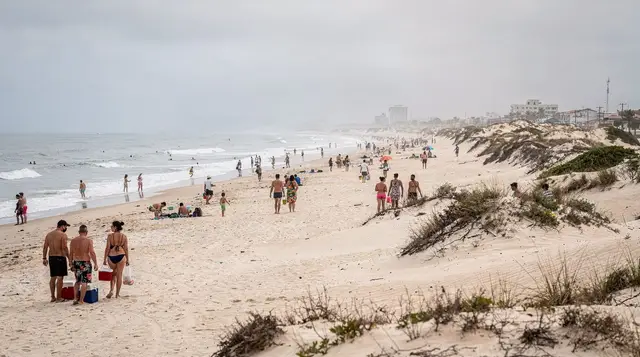
The beaches development skipped, on purpose
Grumari and Prainha sit inside a protected environmental area (Área de Proteção Ambiental) established specifically to stop the kind of high-rise development that swallowed Barra da Tijuca and pushed steadily west along the coast. The result is two of the closest genuinely wild beaches to central Rio: no hotel towers, no chain restaurants, no boardwalk — just sand, scrubby dune vegetation, and a coastal road that climbs over a scenic hill between them and the more developed neighbourhoods to the east. If your image of a “wild beach” got worn down by how developed most of Rio’s coastline has become, this is the corrective.
Prainha: the surf beach
Prainha is the more accessible and more visited of the two, a compact, horseshoe-shaped cove with one of the best and most consistent surf breaks in the greater Rio area — locals and surf schools travel from across the city specifically for it. It has a small amount of infrastructure (a few simple kiosks selling drinks and snacks, some limited parking) but nothing resembling the kiosk culture of Copacabana or Ipanema, so bring water, sunscreen, and cash rather than assuming you’ll find everything on-site. There is some limited bus service to Prainha, though it’s infrequent enough that you should treat it as a bonus rather than a plan, especially for the return trip.
Grumari: the quieter, more remote one
Continue further along the coastal road and you reach Grumari, a longer, calmer beach backed by low green hills and largely used by locals rather than tourists — families on weekends, a scattering of sunbathers on weekdays, and noticeably less noise and vendor traffic than anywhere in the Zona Sul.
There’s essentially no public transport to Grumari at all; getting there means a car, taxi, or Uber, and getting back means the same — this is the single most important practical fact about the beach, because more than a few visitors have found themselves stuck without an easy way home after arriving without a return plan. Book a round-trip taxi, arrange a pickup time with your driver, or use an app that reliably finds cars in the area before you commit to staying past a certain hour.
Sand dunes back parts of the beach, and on a clear day you can see the Restinga de Marambaia, a long sandy barrier peninsula, further along the coast to the west. Facilities are minimal — a couple of simple kiosks, no real shade beyond what you bring — which is precisely the trade-off for the quiet.
Sunset, and why Grumari specifically
Rio’s western-facing beaches have an advantage the Zona Sul’s south- and east-facing coastline doesn’t: a clear view of the sun setting directly over the ocean rather than behind the hills. Grumari, with its open bay and minimal development blocking the horizon, is one of the best sunset spots in the greater Rio area for exactly this reason, and it draws a small but dedicated crowd of photographers and couples specifically for the last hour of daylight.
If you’re timing a visit around sunset, arrive with enough daylight left to find your footing on the sand and settle in before the light show actually starts, and confirm your return transport is arranged before dark falls — this is the one time of day at Grumari where “figure it out when I get there” genuinely doesn’t work, given the total absence of public transport discussed above.
Wildlife along the coast road
The hills between Recreio and Grumari support a surprising amount of wildlife for how close they sit to a major city — capybaras are regularly spotted grazing near the lagoons and marshy patches along the drive, and the restinga scrub vegetation supports a range of coastal bird species, including occasional sightings of birds of prey riding the thermals along the ridge. None of this requires a special detour to see; it’s simply part of what makes the drive itself worth doing slowly rather than treating it as dead time between the two beaches.
Praia do Abricó, Rio’s nudist beach
Tucked into a small cove just past Grumari, Praia do Abricó is Rio’s only officially recognised nudist beach, designated as such by municipal decree in 2002. It’s a small, quiet stretch, reached by a short additional walk or drive beyond the main Grumari access point, and it operates on the same informal, low-key basis as the rest of this coastline: no facilities to speak of, a mixed but generally low-key and respectful crowd, and no expectation that visitors to the wider Grumari area need to know it’s there unless they’re specifically looking for it.
It’s mentioned here mainly because it’s a genuine, distinctive feature of this stretch of protected coast that most conventional guides skip over entirely, and because confusing it with the main Grumari beach (clothing optional only at Abricó specifically, not at Grumari itself) is an easy and avoidable mistake.
The protected area, and why it stays this way
The APA de Grumari (Área de Proteção Ambiental de Grumari) was formally established in 1988, one of the earliest environmental protection designations in the Rio metropolitan area, specifically to stop westward high-rise development from reaching this stretch of coast the way it had already reached Barra da Tijuca.
The designation restricts construction, protects the restinga (sandy coastal scrub) vegetation and the dune systems, and has, by most measures, worked: this remains one of the only stretches of Rio’s coastline that looks broadly similar to how it would have appeared before the city’s 20th-century expansion. Local advocacy groups continue to push back periodically against proposed developments at the area’s edges, and the protection’s durability is part of what long-time Rio residents point to as evidence the city can, when it chooses to, actually preserve a landscape rather than build over it.
The road itself
The drive or ride between Recreio and Grumari, over Estrada de Grumari, is worth mentioning on its own: a winding two-lane road climbing through the protected hillside with genuine ocean views opening up at several points, easily one of the more scenic short drives in the Rio area. If you’re driving yourself, take it slowly — it’s narrow, curvy, and shared with cyclists and the occasional pedestrian, not a road to rush.
Practical logistics: parking, cost, and timing
Parking at both beaches is informal — a flat area near the access point at each, with no barrier or ticket system, though it can fill on a busy weekend, particularly at Prainha where the surf crowd arrives early. Expect to pay a small informal fee to a parking attendant, similar to the flanelinha system found elsewhere in Rio. A taxi or Uber from the Zona Sul runs close to an hour each way depending on traffic, so budget realistically: a half-day trip to Grumari and Prainha from Copacabana or Ipanema is really closer to a full day once transport is factored in both ways, especially if you’re timing the visit around sunset and don’t want to be navigating an unfamiliar coastal road after dark.
No camping, and other things not to assume
Despite the undeveloped, wild feel of both beaches, camping is not permitted, and there are no official overnight facilities of any kind — this is a protected day-use area, not a backcountry destination, and treating it as one (setting up tents, lighting fires on the sand) risks a fine and, more importantly, damages the dune and restinga vegetation the protection exists to preserve. Similarly, don’t assume you’ll find an ATM, a pharmacy, or reliable phone signal at either beach — Grumari in particular has notably patchy coverage. Plan cash, sun protection and any medication needs before you leave Recreio or Barra.
A reasonable half-day plan
A workable sequence for a single visit: leave the Zona Sul or Barra in the late morning, stop at Prainha for an hour or two to watch the surf and have a simple lunch at one of the kiosks, continue over the hill road to Grumari for the afternoon into sunset, then head back before it gets fully dark. That pacing gives you both beaches without rushing either, and times your Grumari visit to catch the light discussed above rather than arriving and leaving in the flat midday sun.
Why this stretch of coast still feels like a secret
Even among Cariocas, Grumari and Prainha have a reputation as places you have to already know about to visit properly — there’s no obvious tourist infrastructure pointing you here, no prominent signage from the main roads, and a fair number of long-time Rio residents have never made the trip themselves despite living an hour away their whole lives. That obscurity is exactly what the protected-area designation was built to preserve, and visiting with the right expectations — minimal facilities, real planning required, a payoff that’s about quiet and landscape rather than amenities — is the difference between a trip that feels like a genuine discovery and one that feels like an inconvenience.
Swimming conditions and safety
Ocean conditions at both beaches are more variable than the calmer, more sheltered stretches of the Zona Sul — Prainha’s surf-friendly waves mean real currents and shore break that aren’t ideal for inexperienced swimmers or small children, while Grumari’s more open bay is generally gentler but still an open ocean beach rather than a protected cove. Neither beach has the dense lifeguard coverage of Copacabana or Ipanema, so exercise more caution and judgement than you would on a heavily patrolled Zona Sul beach, particularly with kids or weaker swimmers. Sun exposure is also a real factor: with minimal shade at either beach, sunscreen, a hat, and a reapplication plan matter more here than almost anywhere else covered in this guide.
What to eat, and where
Neither beach has anything resembling a restaurant — the handful of kiosks at Prainha and Grumari sell drinks, coconut water, and simple snacks like grilled cheese and pastel, priced a little above what you’d pay in Zona Sul given the remote location. Cash is genuinely necessary here; card machines are unreliable at best, and some kiosks don’t have one at all. For a proper meal, the practical move is to eat before you leave Recreio or Barra da Tijuca, or plan to stop at Barra da Tijuca’s wider restaurant scene on the way back rather than counting on finding much at either beach.
Where this fits in a wider Rio trip
Grumari and Prainha work best as the wild counterweight to a trip spent mostly in the Zona Sul. If you are still deciding how to spread your time, how many days in Rio and the beach and outdoors itinerary show where a half-day out west can sit between the city sights and the more famous sands of Ipanema and Copacabana. For a broader look at the options, best beaches in Rio and beaches near Rio put this protected coast in context.
Travellers who like the idea of seeing the coast from the water rather than the sand can look at a boat tour along the Barra coast and its islands and beaches, which gives a different angle on the same western shoreline without any of the return-transport planning that Grumari demands. Those with a free extra day and an appetite for more undeveloped coast can also consider Búzios, where a day trip from Rio with a boat ride and lunch covers several beaches in one outing.
Before heading out, it is worth reading beach safety in Rio and Rio beach etiquette, since the lighter lifeguard coverage out here makes good habits matter more. The Uber and taxis guide is also useful for planning the round trip that this beach day depends on.
Comparing Grumari and Prainha to Rio’s other beaches
For a visitor deciding whether the drive out here is worth it, it helps to see the trade-off plainly:
| Copacabana/Ipanema | Grumari/Prainha | |
|---|---|---|
| Development | Dense — hotels, kiosks, promenade | None — protected area, minimal facilities |
| Crowds | Heavy, especially weekends | Light to moderate, quieter on weekdays |
| Getting there | Metro, easy | Car, taxi or Uber only |
| Lifeguards | Dense coverage | Lighter, more variable |
| Best for | Convenience, people-watching | Quiet, surf (Prainha), sunset (Grumari) |
If the goal is a genuinely undeveloped beach experience within reach of the city, this stretch of coast is close to unmatched in Rio; if convenience and amenities matter more, the Zona Sul beaches remain the easier choice.
Getting there
From Recreio dos Bandeirantes, Prainha is roughly a 10–15 minute drive; Grumari, continuing over the hill road, adds another 10–15 minutes. From the Zona Sul (Copacabana or Ipanema), budget close to an hour by car depending on traffic — this is a planned half-day excursion rather than a spontaneous afternoon unless you’re already staying in Barra or Recreio. As above, there is no meaningful public bus option to Grumari and only limited service to Prainha — arrange a car both ways, and confirm your return plan before you settle in on the sand.
For the broader context on Rio’s less-developed western beaches, wild beaches of west Rio covers Grumari, Prainha and the surrounding coast together, and barra and Recreio beaches fills in the stretch between the city and this protected area.
Frequently asked questions about Grumari and Prainha
Is there public transport to Grumari?
No, effectively — there’s no reliable bus service to Grumari. A car, taxi, or Uber is the only practical way to get there and back, and you should plan your return before you arrive.
Is there a bus to Prainha?
Limited service exists but is infrequent enough that it shouldn’t be your primary plan, particularly for getting back. Most visitors arrive by car, taxi, or Uber.
Which is better for surfing, Grumari or Prainha?
Prainha — it has one of the more consistent and well-regarded surf breaks in the greater Rio area. Grumari is calmer and better suited to swimming and sunbathing.
Are there facilities at Grumari and Prainha?
Minimal — a handful of simple beach kiosks selling drinks and snacks, and not much else. Bring sunscreen, water and cash rather than expecting Zona Sul-level infrastructure.
Why is there no development at Grumari and Prainha?
Both sit within a protected environmental area established to prevent the kind of high-rise development seen further east in Barra da Tijuca, preserving the coastline in something closer to its natural state.
What’s the best time of day to visit Grumari?
Late afternoon into sunset is considered the signature time at Grumari, with the hills and dunes catching the light well and the day-trip crowds thinning out.
How do I get from Recreio to Grumari?
By car or taxi along Estrada de Grumari, a scenic but narrow winding coastal road, roughly 20–30 minutes total including the drive over the hill between Prainha and Grumari.
Is there a nudist beach near Grumari?
Yes — Praia do Abricó, a short walk or drive past the main Grumari beach, is Rio’s only officially designated nudist beach. It’s a separate, smaller cove; Grumari’s main beach itself is a normal clothed beach.
Why is Grumari protected from development?
The area has been a formally designated environmental protection zone (APA de Grumari) since 1988, specifically to stop the kind of high-rise development that transformed Barra da Tijuca further east. It remains one of the few stretches of Rio’s coastline still close to its pre-development state.
Is it safe to swim at Grumari and Prainha?
Use more caution than you would at a heavily patrolled Zona Sul beach — lifeguard coverage is lighter, Prainha’s surf conditions bring real currents, and neither beach is a sheltered cove. Exercise judgement, especially with children or weaker swimmers.
Are there restaurants at Grumari or Prainha?
Only a handful of simple beach kiosks selling drinks and light snacks — there’s no real restaurant scene at either beach, so plan a meal before or after in Recreio or Barra de Guaratiba instead.
Is Grumari a good sunset spot?
Yes, one of the best in the greater Rio area — its open, west-facing bay gives an unobstructed view of the sun setting directly over the ocean, unlike the Zona Sul’s south- and east-facing beaches. Arrange your return transport before you settle in, since there’s no way to summon a car easily after dark.
Can I camp overnight at Grumari or Prainha?
No — camping isn’t permitted at either beach, and there are no official overnight facilities. Both are protected day-use areas rather than backcountry camping destinations.
Can I combine Grumari and Prainha with Barra da Tijuca in one day?
Yes, comfortably — Barra da Tijuca sits closer to the city and makes a natural stop either before heading out to the wilder beaches or on the way back, particularly for lunch given how limited food options are at Grumari and Prainha themselves.
Is there cash access near Grumari or Prainha?
No — there’s no ATM at either beach, and card acceptance at the kiosks is unreliable. Bring enough cash for parking, snacks, and a taxi both ways before you leave Recreio or Barra.