
Buses in Rio — the honest version
Should I use the bus system in Rio as a visitor?
Only selectively. Rio's bus network is extensive and cheap, and reaches places the metro doesn't — but route numbers and destinations aren't intuitive for a first-time visitor, real-time information is inconsistent, and buses run hot and crowded at peak hours. For a short visit, the metro and Uber combination covers nearly everything more simply; buses are worth learning only for a specific route you'll use repeatedly, or if you're staying long enough for the learning curve to pay off.
| Cost | Around R$4-5 per ride (Bilhete Único card) |
| Best for | Routes the metro skips, long stays, tight budgets |
| Skip for | Short visits, night travel, first attempts at a new route |
| Board | Front door only; tap card or pay driver |
| Get off | Press the red/yellow button before your stop |
The honest pitch: cheap, everywhere, and not built for a first-timer
Rio’s bus network genuinely goes everywhere — far beyond the metro’s three lines, reaching neighbourhood streets, beach stretches, and Zona Norte and Zona Oeste corners that transit maps elsewhere leave blank.
A single ride costs roughly R$4-5 (under US$1), a fraction of an Uber fare for the same distance. That’s the real case for using them. The honest counterpoint, which most Rio guides underplay, is that the system wasn’t designed with a first-time foreign visitor in mind: route numbers correspond to specific, sometimes convoluted paths that aren’t obvious from a stop sign, digital real-time arrival information is patchy compared with what many visitors are used to at home, and the exact stop you need isn’t always clearly distinguishable from ten others clustered nearby. None of this makes buses unsafe — it makes them inconvenient for someone without local knowledge, which is a different and more practical problem.
What locals actually say
Ask a carioca for bus advice and the answer is rarely “here’s the full system” — it’s usually a specific route they use themselves, learned through repetition, plus a general shrug about the rest. That’s the honest local relationship with the bus network: deeply useful once you know your own handful of routes, opaque otherwise. The practical version of this advice for a visitor: if you’re staying somewhere long enough to learn one or two specific, repeatedly useful routes — say, a fixed commute between your accommodation and a beach you visit daily — ask your host or hotel for the exact number and where to board, rather than trying to learn the system generally.
Paying: the Bilhete Único
Buses use the same integrated Bilhete Único (RioCard) fare card as the metro, with a transfer discount if you connect to or from the metro within a set window — full detail on getting and topping up the card is in the Rio metro guide. Cash fare boxes exist on some routes but a pre-loaded card is faster and avoids fumbling with small change while the bus is moving, which is more disruptive on a crowded Rio bus than it sounds.
Comfort and crowding
Rush hour buses (roughly 7-9am and 5-7pm on weekdays) run genuinely crowded, standing-room-only, and without the metro’s air conditioning on many older vehicles — hot, tightly packed, and not the comfortable introduction to Rio transit a jet-lagged first day calls for. Midday and off-peak rides are noticeably calmer and a reasonable way to see street-level Rio that the metro’s underground tunnels don’t offer.
When buses are actually the right call
Reaching a specific beach or neighbourhood the metro skips — much of Barra da Tijuca and Recreio sit well beyond metro reach, and a direct bus route, once identified, beats a longer, pricier Uber ride for a repeat trip. Genuinely tight budgets where the fare difference across many rides adds up meaningfully — see Rio on a budget for the wider cost-saving picture. Longer stays where the up-front learning curve pays off over weeks rather than days.
When to skip them
For a short visit, for any route the metro already covers, for night travel, or for a first attempt at reaching somewhere you’ve never been — in all of these, Uber or the metro is simply the lower-friction choice, and the modest fare savings of a bus rarely justify the added complexity and time uncertainty. If what you want is simply to see the main sights without working out routes, a hop-on hop-off Rio Samba Bus links the main areas on one ticket. See getting around Rio for how buses fit into the wider transport mix.
Safety on buses
Ordinary bag-and-phone awareness applies exactly as it does on the metro or in any crowded space — keep bags in front of you, phones in a secured pocket rather than held out, particularly during the crush of boarding and alighting at a busy stop. Buses are not a higher-risk mode than the metro; they’re simply a more crowded, less air-conditioned one at peak hours. Full city-wide safety context in Rio’s safety guide.
Flagging a bus down — it’s not automatic
A Rio bus does not stop by default at every marked stop the way a train does at every station. If nobody at the stop signals, and nobody on board has pressed the request button, a driver running late or facing a green light will often just keep moving. Visitors used to transit systems where the vehicle always stops get caught out by this more than almost anything else on this list — standing at the right stop, in the right spot, watching the right number sail past without slowing.
Step slightly toward the curb as the bus approaches and extend an arm out, a clear, deliberate wave rather than a passive glance, especially at stops shared by several overlapping route numbers where the driver may reasonably assume you’re waiting for a different one. This applies doubly at quieter stops outside the historic centre and Zona Sul’s busiest corridors, where a driver has less reason to assume anyone is boarding.
How boarding and paying actually works
Board through the front door only, next to the driver — this isn’t optional, and using a rear door to enter (rather than exit) usually gets a shout or a hand wave from other passengers, since that door is for getting off. Tap the Bilhete Único card on the small validator mounted right at the driver’s shoulder, or feed cash into the fare box beside it; either action unlocks a chest-high turnstile that you push through to reach the seats. On a handful of longer-distance or “frescão” (air-conditioned executive) lines, a second staff member collects fares from a seat near the back instead, which changes the boarding sequence slightly but not the general logic.
Once through the turnstile, keep any backpack or bag held in front of your body rather than on your back, particularly during the rush-hour crush, both as ordinary crowd-awareness and simple courtesy in a packed aisle. To get off, press one of the small red or yellow buttons fixed to the poles along the aisle before your stop arrives — this rings a bell and lights a “parada solicitada” sign up front, which is the only reliable signal telling the driver to actually stop. Drivers do not reliably call out stop names, and if nobody presses the button and nobody is visibly waiting at the next stop, the bus can sail straight through it. Exit via the middle or rear door, which sometimes needs a firm push on the horizontal bar to release.
Reading the number and the destination board
Route numbers look arbitrary from outside but they’re not random — each one is tied to a fixed pair of endpoints, and the painted board or LED strip above the windscreen spells out both the origin and destination neighbourhoods, not just the digits. The number alone isn’t enough to confirm you have the right bus: several numerically similar routes serve overlapping streets but end in different places, and the same base number sometimes has lettered variants (a “213” and a “213A”) that diverge partway through. Read the destination text, not just the number, before boarding.
A route marked “circular” loops back to its starting point rather than running point to point, which matters if you’re trying to catch it for a return trip — you may need the same number going the opposite direction from a stop on the other side of the street, not across the road from where you got off. Physical stops themselves are often unmarked beyond a bare pole or a small shelter with no posted route list, so the destination board on the bus itself, read as it approaches, tends to be more reliable in the moment than anything printed at the stop — plan on confirming the route from the vehicle, not the signage around you.
BRT: a different system wearing a bus-shaped body
Rio’s BRT corridors — TransOeste, TransCarioca, and TransOlímpico — look like buses on the outside but function closer to a train line: dedicated lanes separated from regular traffic, enclosed stations with turnstiles you pay at before boarding, and level entry rather than curbside steps. They’re genuinely fast for long hauls across Zona Oeste, cutting journey times that a street-level bus stuck in ordinary traffic can’t match, and TransCarioca in particular is the practical way to cover ground between Barra da Tijuca and the airport area without a car.
The trade-off is station spacing: BRT stops are set further apart than regular bus stops, so unless your origin and destination both happen to sit near a station, you’ll still need a short walk, taxi, or a connecting street bus to close the gap at either end. Treat BRT as a separate mental category from “the bus” — the fare card works on both, but the boarding mechanics, the vehicles, and the routes don’t overlap with the ordinary city bus network described above.
Weekday, weekend, and late-night service gaps
Frequency isn’t constant across the week the way it can feel like in cities with dense, round-the-clock networks. Weekday peak-hour routes that run every five to ten minutes can drop to every twenty or thirty on a Saturday, and Sunday schedules are thinner still on many lines, with some routes running half as often as their weekday equivalent. Late at night the gap widens further: a meaningful share of routes stop running altogether somewhere between 11pm and midnight, well before Rio’s dinners, live music, and bar nights typically wind down.
Don’t plan a return trip home by bus after a late evening out — default to Uber for anything after roughly 11pm, both for the wait time a thinned-out schedule implies and for the general lower-friction safety case of a direct door-to-door ride at that hour. If you do end up relying on a bus outside peak weekday hours, build in real slack rather than timing a connection or a booking tightly around an assumed frequency.
Evenings out in Lapa without the bus puzzle
The night-time gap matters most for the neighbourhood where Rio’s evenings run longest. Lapa is easy to reach by day, but the music there starts late and finishes later than the bus timetable allows for. If an evening of samba is the plan, the simplest answer is to remove the transport question altogether: a guided option such as a private samba night in Lapa with a local host means you aren’t deciphering route boards in the dark. For going it alone, the Lapa nightlife guide and nightlife safety in Rio cover how to get there and back sensibly, and Uber and taxis in Rio explains the ride-hailing side of the return trip.
Bus, metro, and Uber compared for a typical cross-city trip
For a benchmark route like Copacabana to central Rio, the three main options trade off differently enough that the right pick depends on what you’re optimizing for:
| Mode | Typical fare | Typical time | Predictability |
|---|---|---|---|
| Metro | R$4-5 | 25-35 min | High — fixed schedule, no traffic |
| Bus | R$4-5 | 35-60 min | Low — depends entirely on traffic |
| Uber | R$25-45 | 20-40 min | Medium — faster off-peak, slower in traffic |
The pattern holds across most cross-city Rio trips: the bus rarely wins on time or predictability, only on cost against Uber, and never against the metro on either count when a metro line covers the same corridor. The mistakes that catch first-time visitors out are almost always the same handful: waiting on the wrong side of a wide avenue, where the stop directly across the street serves the opposite direction rather than a return trip; assuming a driver will announce or confirm a stop by name; boarding through the rear door out of habit from other cities and being waved off; and not having a topped-up card or small bills ready, which turns a routine boarding into a hunt for change while a bus idles with the driver waiting.
Frequently asked questions about buses in Rio
Are Rio buses safe for tourists?
Yes, with the same ordinary crowd-awareness that applies to any busy transit system — the real drawback is navigational confusion, not safety.
How do I know which bus to take?
Ask locally for the specific route number and boarding point for your destination — a hotel front desk or an app like Moovit can help identify a route, though real-time reliability varies.
Do buses accept card payment?
Yes, via the Bilhete Único integrated fare card, the same one used on the metro — cash fare boxes exist on some routes as a backup.
Is it cheaper to take the bus than the metro?
Fares are comparable, and transferring between the two within the discount window costs less than two separate full fares — the real savings case for buses is against Uber, not against the metro.
Are buses air-conditioned?
Some newer vehicles are; many older ones on less-updated routes are not. Expect variability rather than a guaranteed cool ride.
Can I use buses to reach the wild beaches of Zona Oeste?
Some routes reach the edges of Recreio, but the more remote stretches covered in wild beaches of west Rio are better served by car or a direct transfer — see car rental in Rio for that specific case.
Should first-time visitors avoid buses entirely?
Not entirely, but treat them as an optional, situational choice rather than a default — the metro and Uber combination is the simpler, lower-risk starting point for anyone unfamiliar with the city.
How crowded do buses get during Carnival?
Significantly more than usual, with route disruptions around parade and bloco routes — see Rio Carnival guide for how transport shifts during the festival period.
Transport passes & transfers on GetYourGuide
Verified deep-linked GetYourGuide tours. Book through these links and we earn a small commission at no cost to you.

Rio de Janeiro: 45-Min Helicopter Tour with Transfer

Transfers Rio X Buzios
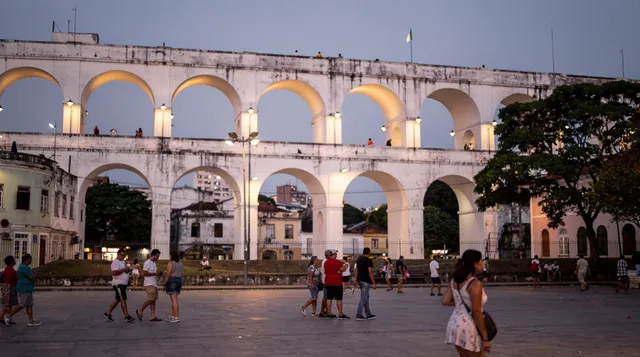
Rio Samba Bus: Hop-on Hop-off City Tour in Rio de Janeiro
Photos show the destination, not the operator's own pictures.